
The European Union and Benin
The European Union (EU) and Benin are long-standing partners: present in Benin for 60 years, the European Union, through its Delegation in Cotonou, has forged solid relations with Beninese actors both in cooperation with development than in the political, economic and commercial spheres.
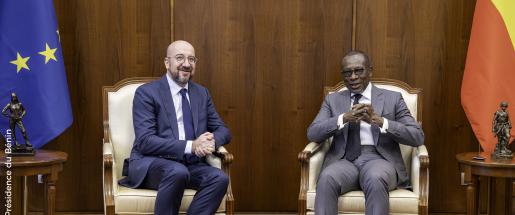
Political Relations
Whether it is the "Article 8" dialogue under the Cotonou Agreement, the donor-Government dialogue as part of the implementation of the Government's Action Program or even ad hoc dialogues with the various Ministers or institutions of the country and with civil servants, operational contacts are regular.
These consultations focus on support programs and on subjects of common interest such as security, multilateralism and the defense of universal values including human rights and democracy, regional integration and the fight against climate change.

Economic Relations
Aware of the economic challenges, the Government is proposing a growth model based on good governance and public-private partnership. The fight against corruption and an effective judicial system are essential elements for the pursuit of such reforms, in order to ensure the sustainable management of resources and the strengthening of the rule of law.
The European Union has offered to support Benin in these reforms by means of a "Good Governance and Development Contract". Budget support is one of the major tools for cooperation between the EU and Benin. It supports the Government's macroeconomic reform program, public finance management reforms and the fight against impunity with a judicial system that listens to litigants.
Trade Relations
The “Everything But Arms” initiative, independent of the negotiation of the Economic Partnership Agreements (EPAs) and the Cotonou trade regime, was set up unilaterally by the EU in 2002, for all LDCs (Least Developed Countries) of the world. Benin, a member of this group, enjoys duty-free access to the EU market for "all products except arms". This takes place without the obligation of reciprocity.
In terms of overall trade volume, the European Union and its member states continue to be Benin's primary commercial partner. In 2025, annual bilateral trade in goods reached €837 million, accounting for approximately 17.7% of Benin’s total international trade (IMF). The EU is Benin’s second largest source of imported goods (behind India), accounting for 18.6% of total imports (valued at €705 million in 2025). Key product categories include machinery, electrical equipment, processed food products, pharmaceuticals, and manufactured goods necessary for infrastructure and industrial development. The EU is also Benin’s second largest client for exports (after Bangladesh), with 14% of its total exports (valued at €132 million in 2025). Key export products to Europe include vegetable products, textiles and food.
To support trade, beyond trade facilitation initiatives within ECOWAS and the WTO instances, the EU remains actively engaged in supporting port infrastructure modernization in Cotonou, promoting sustainable agricultural supply chains, and facilitating private sector investments under the EU Global Gateway initiative.
-
Image

EU development cooperation in Benin supports reforms and social and economic development in Benin
Copyright: DUE
Development Cooperation
EU development cooperation in Benin supports reforms and the country's social and economic development, in particular by encouraging private sector investment. Since the creation of the first European Development Fund in 1957, Benin has benefited from more than 1.5 billion euros (1 trillion FCFA) in EU aid.
In the framework of the Global Gateway strategy, the Multiannual Indicative Programme (MIP) 2021-2027 has mobilised more than CFA 167 billion during the period covering 2021-2024, particularly in the sectors of environment, vocational training, agriculture, the port of Cotonou, energy, economic and financial governance, including social protection, private sector, digitalisation and security and stability. The EU has also supported the promotion of human rights and democracy and the civil society in the country. A link between peoples, the promotion and enhancement of culture is also at the heart of the action carried out by the EU in Benin.
This funding has been provided through direct support to the State budget, projects, blending and guarantees. For the second period of the MIPyears 2021-2027, cooperation programming is under preparation.
In a Team Europe logic, the EU Delegation works in complementarity and coordination with all EU Member States, mainly the Member States which have a presence in Benin: Belgium, France, Germany, Luxemburg and the Netherlands, as well as the European financial institutions, in particular the European Investment Bank.