
Four Years of Full-Scale War in Ukraine
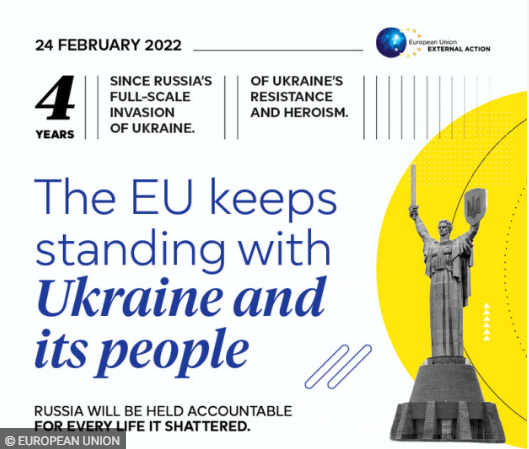
After four years, 2026 must be the year the aggression on Ukraine comes to an end. Ukraine has clearly shown readiness and demonstrated commitment to a just and lasting peace, based on the principles of the UN Charter. The European Union (EU) stands fully behind Ukraine: we want peace, which must be durable, credible, and consistent with international law. No peace arrangement can be sustainable without Ukraine. Ukraine has consistently demonstrated its readiness for peace, including by seeking a ceasefire, while Russia has refused to do so and continues its war of aggression, targeting civilians and civilian infrastructure.
Have you taken the quiz on how much do you know about Ukraine? Twenty questions that might change your perspective
Watch here how Russia is not winning and here how sanctions are biting deep, draining reserves, cutting trade, and shrinking Russia’s economy.
Follow the European Parliament’s extraordinary Plenary session on February 24 to reaffirm EU’s unwavering commitment to a just and lasting peace here
Principles that matters to all
Four years of war have shaken the global order and its stability, with global consequences. Economically, the war has disrupted food and energy supplies and contributed to higher inflation worldwide. The principles enshrined in the UN Charter — sovereignty, territorial integrity, and the peaceful settlement of disputes — are universal commitments. They are under strain in Ukraine and elsewhere, and respect for them is essential for the security of all states, large and small alike. A just and lasting peace in Ukraine is therefore critical to reaffirm the global value of these principles and to uphold the right of every sovereign nation to exist and make its own choices. The European Union remains committed to supporting Ukraine, politically, economically, militarily, and diplomatically, while remaining open to any credible path toward a just and lasting peace based on the principles of the UN Charter.
Disinformation as a destructive tool
As many of the cases at EUvsDisinfo prove, the Kremlin’s information manipulation and disinformation attacks on Ukraine began long before the start of the full-scale invasion on 24 February 2022. The Russian state-controlled ecosystem of foreign information manipulation and interference, including disinformation, was manufacturing myths and false pretexts for invading Ukraine for years. Ukraine has not only withstood the brutality of Russia’s onslaught; it is also standing up for the fundamental values of freedom, sovereignty and the right to self-determination. As the international community continues to support Ukraine’s struggle for freedom and sovereignty, it must also spare no effort to dismantle the false reality about the war that Russia has built on lies and deceit.
Discover more at the website marking Four years of Russia’s war of aggression in Ukraine
#StandWithUkraine