Interview of the Ambassador of the European Union to Albania, Silvio Gonzato, for Deutsche Welle
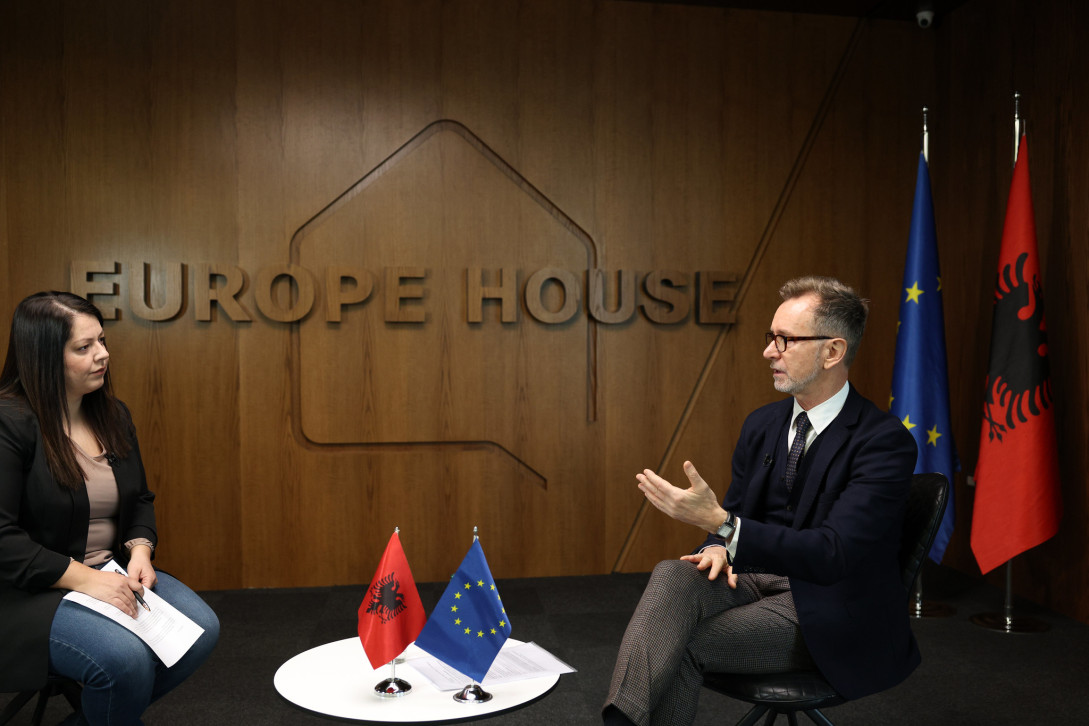
Journalist: Mr. Ambassador, thank you for this interview, and I would like to start with the question: How do you assess the Albanian current situation in its path towards the EU integration?
Ambassador Gonzato: I think Albania has really made remarkable progress and I feel privileged to have been the witness of this and maybe a bit more than the witness because I think we also contributed to it - the successful completion of the screening process, which was when the Commission and the Government assessed what needs to be done in order for Albania to qualify as a member of the European Union, and then, within 18 months, we managed to open all chapters of the EU legislation (the EU acquis), which was really a remarkable achievement.
But now we are at a really critical juncture. It's a moment when we need to assess whether Albania has made some very tangible progress in some key sensitive areas, which are called the Fundamentals in the European Union. It's basically what is at the very core of the European Union project, and they touch issues like fundamental rights, so the rights of women, the rights of children, but also they touch upon the rule of law and the justice system, the consolidation of the Justice Reform of 2016, they look at the fight against corruption and organized crime, and democratic standards.
So this is really a very, very crucial phase in which the Commission will assess whether the pieces of legislation and the regulations or the measures that have been taken by the government in the last few months reflect a real progress in all these areas. On this basis we submit a report to the Member States, and then it's up to the 27 Member States to say, “OK, now we agree with the assessment of the Commission”. If they do, then we can start closing chapters, which is absolutely key if we want to maintain the ambitious timetable that the Albanian Government has set itself. And it is a timetable that we want to support. It's ambitious, that's what they want to do, but we want to be helpful.
In this context, it's also important to underline one thing, because we are working under a lot of pressure, but I think it's important that we do not do this at the detriment of transparency, inclusivity, that the adoption of the laws and measures is based on an open debate where people understand what is being done and why it's being done, that this debate is constructive, so all, elements of society can contribute to it.
EU Delegation to Albania
Journalist: And in this long way towards the accession, in one of the latest activities of the Albanian Government, that you also participated in the social welfare funding, when it is Albania’s access to 100 million Euros in EU funds, dedicated to projects for social inclusion, you called for greater transparency with the EU funds. Why?
Ambassador Gonzato: If you look at all the different projects we have, it's more or less 100 million Euros that we are investing, for example for facilitating the transition from education to the labour market, which is so crucial for young people. I remember for me it was one of the most stressful periods of my life when I finished university and I had to start finding a job, because you realize that your education doesn't necessarily give you the tools to become a successful member of the labour market.
We do this with different actors and partners, it can be NGOs, it can be local government, it can be the ministries, but all in all what is important is that not only we provide benefits to Albanian citizens, but that we do this in a proper way.
Because I also have financial responsibilities, and I'm managing European Union taxpayers' money, and this money has to be handled in a transparent and accountable way. It is important that the Albanian authorities adopt the mechanisms necessary to ensure this transparency, because when Albania becomes member of the European Union, much of the European Union funds, which are there to show solidarity to its Member States, are delegated and managed by the national authorities. Local authorities have to provide evidence that they are doing this in line with the EU financial regulations, that the way in which you select a project, for example, for funding, is objective, is based on transparent criteria, it's not done because somebody knows somebody and that money is allocated on the basis of personal contacts. We need this transparency, and we need this rigor in the procedures.
Journalist: Mr. Ambassador, when it comes to EU funding, I want to go back to the IPARD funding about agriculture. What is happening with these blocked funds?
Ambassador: The stage we are at is that there are still ongoing negotiations between Brussels and Tirana, between the European Commission and the Albanian Government. The Albanian Government has tasked an external auditor to do an audit. They check who received grants, who received payments, and they check the regularity of those payments, and also assess whether the money was spent properly or not, and quantify this money.
And then they also checked the measures that were put in place by the government following what happened, to see if these measures are sufficient in order to provide those safeguards that we are asking for. Because the European Union is determined to continue assisting Albanian farmers. I think this is an important component of our assistance to Albania. The farming industry is one that needs all the help it can get in order to become competitive, because when Albania joins the European Union, they will have to withstand the competition of EU farmers.
But we cannot do that unless we have all the guarantees that the money is being managed properly, and we expect the Albanian government to take this seriously. So, the ball now is still with the Albanian government to assess this audit report and reassure Brussels that the measures that they've taken are sufficient for us to resume the assistance, the financial assistance under IPARD.
Journalist: Now I want to ask you about the judicial reform in Albania. That is one of the biggest investments of the European Union. What do you think about the work of SPAK currently?
Ambassador: I think SPAK is doing a very, very important job. If you talk to Member States, you will see that they appreciate extremely the work done by SPAK, for example, in the fight against organized crime, in dismantling criminal gangs which are operating not just in Albania but also in the EU and particularly in some Member States of the European Union.
They appreciate enormously the work that SPAK is doing in cooperation with their law enforcement agencies, and with Europol and Eurojust, in tracking these gangs, tracking their activities, and fighting organized crime. Because this is becoming an increasing concern in EU Member States, I mean the role that Albanian networks play in, for example, international drug trafficking, and it's having an impact also on the security of certain cities in Northern Europe. That is extremely appreciated.
Secondly, as you know, the fight against organized crime and corruption is one of the key elements in assessing Albania's preparedness to join the European Union. That's at the very core of the Fundamentals, as I said before. We see SPAK as playing a fundamental role in this respect, in fighting also corruption, in fighting impunity at political level, and seeing no obstacle in summoning and investigating also high-ranking politicians. I think that's an important element in assessing Albania's preparedness. It's something that we appreciate and we support. So definitely the assessment is positive.
We think that also more should be done on the preventive side in the fight against corruption and organized crime. That's why, for example, under the Fundamentals, some of the measures that were recently adopted by Albania as part of this initial step in the accession process was criminalizing money laundering. That's going to be an important way also of undermining financially some of the activities, illegal activities, that these networks carry out. We expect also the government to adopt not just strategies in preventing corruption but also to implement concrete action in that respect.
Journalist: But the strategy that the Albanian Government is undertaking is that they want to change the legislation to handle the suspension of public officials by SPAK. How do you consider these attempts of the Albanian Government?
Ambassador: We are following closely this proposed amendment to the Criminal Procedure Code, which is the article in the Procedural Code that allows a court to suspend a public official who is under investigation. Because anything which relates to the rule of law and the administration of justice is something that we follow closely and assess, not just in Albania but in all candidate countries.
As you know, the justice system is at the very heart of the work and the requirements of a country in the context of the accession negotiations. We expect any legislative initiative to be compatible with the overall commitments of the government in the fight against corruption and organized crime. And we will continue to monitor very closely how this impacts these elements.
Journalist: Mr. Berisha, the leader of the opposition, has been continuously attacking SPAK for its work and now this attempt of the Albanian Government. Do you think that Mr. Berisha and Mr. Rama are trying to undermine the work of SPAK?
Ambassador: I'm not going to speculate on this. What is certain is that we have expressed repeatedly in our Annual Reports our concern about the attacks against the judiciary. We have said that indeed the judiciary and the judicial system have become more resilient to these attacks also because it is an independent system. But nevertheless, these attacks by politicians and political interference is something that we look at with concern. It's something that should not continue.
Journalist: And one final question, which is the message that you have for the political class in Albania with regards to the accession to the EU? It’s a polarized situation.
Ambassador: I think the visit of the members of the Foreign Affairs Committee was for me extremely important because it shows that people with very different political backgrounds coming from different Member States, with different viewpoints, can work together. And the message that they delivered to their counterparts was quite a united one, which surprised even me, because I thought that there would be more divergence of views on this. It was very positive, it was one saying - you've got to take this seriously, you have to lead by example, particularly also in areas like the fight against organized crime and corruption. And you have to ensure that on the one hand there is space for the opposition, that the majority gives space for the opposition to play its role, and on the other that the opposition plays its role constructively. I think that was a very good message coming from politicians to politicians, so I can only echo it.
Journalist: Thank you very much!