
‘Colours by Europe’: European food and drink delights Chinese visitors at CIIE 2021

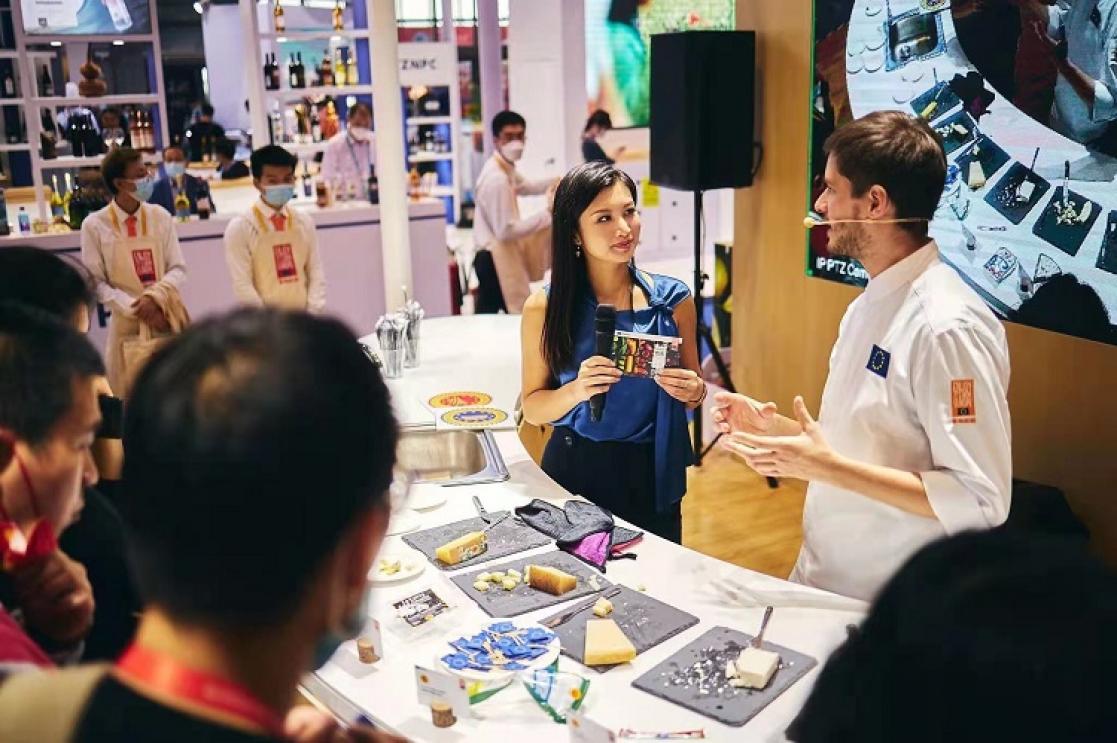
The 4th China International Import Expo (CIIE) was held at the National Exhibition and Convention Center in Shanghai from 5-10 November 2021. The European Union (EU) returned this year as a proud participant with the European Union Food Booth proving once again a popular draw for attending government officials, business communities, purchasers and importers.
Food production and gastronomy in the European Union are based on the combination of knowledge, skills, practices and traditions that ensure excellence at every stage of processing and uphold a concept that incorporates respect for animals and nature.
As part of ongoing efforts to promote the safety, quality, authenticity and sustainability of European food and beverage products to Chinese buyers and consumers through its ‘Colours by Europe’ campaign, this year’s EU Food Booth offered a unique opportunity to experience these close bonds between cultural heritage, local farming practices and the rich array of quality products from 27 Member States.
The Chinese market is a high-growth potential market with a growing middle class with a taste for iconic European products. Coming into effect in March this year, a bilateral agreement signed by the EU and China protects around 200 iconic European and Chinese agri-food names against usurpation and counterfeit imitation as Geographical Indication (GI) products, which offer unparalleled ‘quality with a story’ to the Chinese consumer, increasingly oriented towards authentic and unique foods and drinks. With permanent tasting opportunities each day, around 300 products across seven food categories were on display, including the largest selection of European GI products ever presented at an expo of this kind in China.
EU Delegation Counsellor for Agriculture, Mr. Damien Plan, was among the delegates to attend the EU Food Booth’s Official Opening Ceremony and delivered the opening speech: “European food is renowned worldwide. China is the EU's third global partner and the third largest destination for EU agri-food exports. In 2020, EU agri-food exports to China reached a new record level close to 18 billion EUR. The agreement on the protection of geographical indication products between China and Europe, which came into force in March this year, will help further promote cooperation on agri-food trade between the two sides.” Mr. Zhai Qian, Director General of the Department of European Affairs, Ministry of Commerce of PRC, and Mr.Pan Feng, Vice Chairman of China Europe Association for Economic and Technical Cooperation (CEATEC), and other Chinese officials visited the EU Food Booth.
Highlights from the six-day event then included six EU GI product-oriented workshops with EU chef Corentin Delcroix, focusing on the specific qualities of European GI products. Cooking shows also introduced visitors to European wine, spirits, beer and non-alcoholic beverages; fresh and processed meat products; dairy products and cheeses; olive oil and table olives; processed cereals and pasta; confectionery, pastry, jams and honey, and fruit and vegetables. Among chef Delcroix’s recipes that delighted participants were chicken cordon bleu with Pasta di Gragnano, Jamón Serrano and Noord-Hollandse Gouda, as well as a chocolate fondant with custard, Beurre d'Isigny and organic Castagno honey.
Making full use of this diverse range of EU food and drinks on show at the expo, Shanghai-based chef Tony Jiang hosted ten pairing shows, presenting innovative fusion recipes to match European products with local Chinese ingredients, such as crispy-fried Fangxian mushrooms cooked with Umbria extra virgin olive oil and Cognac sauce made of Hollandse geitenkaas and Nanfeng sweet orange.
The EU Food Booth at CIIE 2021 also shone a timely light on the European Union’s fresh international ambition for a fair, healthy and environmentally-friendly food system, having recently set itself ambitious goals to make its farming ever more sustainable, including further reductions in the use of chemical pesticides, fertilisers and farm antimicrobials, while boosting production of organic products. Together these efforts are not only bringing the great taste of quality European products to consumers in China and around the world, but also clear advantages for the greater good of the planet.
Safety
European food and beverage products may be enjoyed with peace of mind thanks to comprehensive safety and quality standards upheld at every step of growing and production. European Union farmers must adhere to some of the world’s strictest health and safety standards during food production. Food safety controls in the EU check for the presence of hormones, chemical residues, microbial contamination, hygiene, labelling, proper refrigeration, animal and plant health requirements, animal welfare and fraud.
For example, European dairy products originate at farm level, where it is imperative to ensure animal health with no symptoms of infectious disease. European farmers must also observe hygiene regulations throughout the milking, collection and transporting stages. Together these efforts result in the safest dairy products that are appreciated in equal measure at home and all over the world.
Quality
The high quality of European food and beverage products is guaranteed by rigorous production and quality standards, that also ensure that products remain nutritious and healthy. For example, all raw materials used in the production of European spirits must come from agricultural sources. Synthetically produced alcohols are not allowed in the EU and spirits exported from the EU must also comply with this rule. Similarly European beer is the result of carefully selected high quality raw materials, including malted cereals that are converted into alcohol by yeast and flavoured by hops.
Authenticity: EU and China protecting Geographical Indications
EU quality policy aims at protecting the names of specific products to promote their unique characteristics, linked to their geographical origin as well as traditional know-how.
Product names can be granted with a ‘Geographical Indications’ (GIs) if they have a specific link to the place where they are made so that consumers can trust and distinguish quality products, while also helping producers to market their products better. The EU and China have signed a bilateral agreement to protect around 200 iconic European and Chinese GI products against usurpation and counterfeit imitation that came into effect in March this year.
Sustainability
The EU pushes for sustainability in agriculture through its common agricultural policy (CAP) to ensure that Europe’s agriculture is socially, economically and environmentally sustainable. Supporting rural communities, the CAP sets out to tackle climate change, protect natural resources and enhance biodiversity in the EU while delivering safe and nutritious food for consumers in Europe and beyond. The EU’s transition to sustainable agriculture is driven by new technologies, research and innovation, and the spread of knowledge.
Food systems today account for nearly one-third of global GHG emissions and consume large amounts of natural resources. Moreover, they cannot be resilient to crises such as COVID-19 if they are not sustainable. The EU’s Farm to Fork Strategy is addressing this by making food systems fair, healthy and environmentally-friendly, bringing value for food producers and consumers alike.
‘Colours by Europe’
The Colours by Europe campaign introduces European food and beverage products to businesses and consumers in China through immersive events and a strong online and media presence (WeChat, Douyin and Weibo) to communicate the key attributes of European food and beverage products, namely their safety, quality, authenticity and sustainability.
Encompassing the true breadth and depth of Europe’s diverse food and drink including wine, spirits and beer; fresh and processed meat products; dairy; olive oil and table olives; processed cereals and pasta; confectionery, pastry, jams and honey, and fruit and vegetables, the campaign also seeks to draw attention to the afore-mentioned protected Geographical Indication (GI) products.
Food lovers in China are invited to follow the Colours by Europe campaign on WeChat and Weibo for latest updates and to explore the colourful and delicious world of European food and beverages.

For full details of the EU’s activities at CIIE 2021, please visit: coloursbyeurope-ciie2021.glueup2021.cn
Scan the QR code:

Scan the QR code or visit the link below:
WeChat official:

Weibo official: https://weibo.com/u/6997146302?is_all=1
Media contact
To request further information or high-resolution images, please contact:
HUANG Jingying
Email: jingying.huang@sopexa.com
Tel: (86 10) 6588 8675