
Ambassador Toledo’s intervention at 13th Caixin Summit
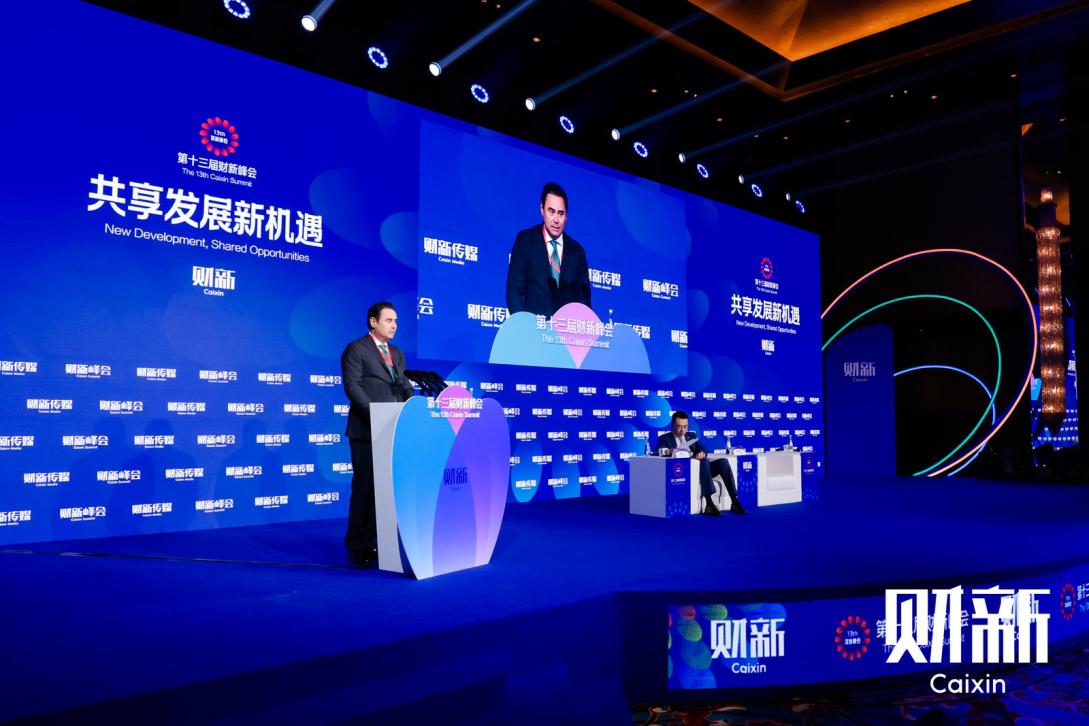
Ni hao, good morning everybody. Thank you.
Dear HUANG Shan, dear friends, dear viewers of the 13th Caixin Summit,
It is a pleasure to be with you this morning, 2.5 months after I arrived to China. I am very happy to be here at one of the most important newspapers in the world, and in this summit, which, I am told, is one of the most important journalistic and economic events of the year in China. And I am also very honoured to join a group of distinguished economists and share my thoughts on the economic outlook for the European Union and related policy challenges.
On the economic outlook of the European Union, let me first say that the economic outlook of the European Union is important for the world, but especially for China, as the Chinese economic outlook is also important for the European Union. Because we have the most important trade relations in the world. No other two big economic powers in the world have as important trade relations as the European Union and China. Our trade relation is even larger than the trade relation between the US and China. It is over two billion USD a day. Whatever happens in China is important for the European Union, whatever happens in the European Union is important for China. I would say that is more important for China, because our trade relationship is unfortunately unbalanced. The level of exports from china is much larger than our exports to China. We are trying to change that. We are trying to rebalance. But I spoke about this yesterday, in a closed session. Today, I am going to speak about something as I said very important for China, which is the European Union outlook which is the outlook of the largest export market for China.
According to the latest European Commission forecast released last Friday, the EU economy, after a strong first half of 2022, has now entered a challenging phase. The shocks unleashed by the Russia's war of aggression against Ukraine are denting global demand and reinforcing global inflationary pressures.
In the EU and euro area, and most Member States, we can say that there is a reasonable risk that we enter a technical recession this winter. Growth would return in spring, as inflation progressively relaxes its grip on the economy. However, with powerful headwinds still holding back demand – especially to the continued Russian aggression on the territorial integrity of Ukraine and the war –, the EU economy is set to manage only lacklustre growth or moderate growth next year
However, the pandemic, which caused already a recession both in China and the EU in 2020, in the EU is not going to cause any major disruption to our economy over the forecast horizon, though outbreaks and lockdowns in other parts of the world remain a source of indirect risk. The EU, like many other regions of the world boasting high vaccination rates appears to be settling on a steady-state where further economic disruptions from the pandemic can be avoided. We have learned to live with the virus and, with more than 90% vaccination rates, the Covid-19 has fortunately become something we can live with. People do not die in the big numbers in the EU anymore.
Faced with persistent inflationary pressures, monetary policy is expected to continue on its tightening path. In line with market expectations, the European Commission autumn forecast assumes the ECB keeps hiking its policy rate throughout 2023. With a few exceptions, most EU central banks are also expected to keep tightening throughout 2023 – meaning central banks of the EU Member States who are not in the eurozone. Because for the others that are in the eurozone, the policy rates are fixed by the European Central Bank. Long-term real rates of virtually all other Member States are by now well into positive territory.
The general government deficit in the EU is projected to decline by more than one percentage point in 2022. The 2023 aggregate general government deficit for the EU is set to increase again, but only by some 0.2 pps. to 3.6% of GDP.
Needless to say that all these projections are surrounded by a very high degree of uncertainty caused mainly by the Russia’s war of aggression against Ukraine and the potential for further economic disruptions is far from exhausted.
About the EU policy response to the economic crisis, against this very challenging economic outlook, the EU has responded decisively, both at the EU level, in coordination with EU Member States, as well as at the global level, seeking continuous engagement with the largest economic powers and stepping up efforts to support to those most affected by rising food prices. This is one of the most malign consequences of the Russian’s aggression against Ukraine.
At the level of the EU, the activation of the general escape clause in the Stability and Growth Pact has allowed Member States to undertake appropriate budgetary measures to react to the pandemic shock and to the economic consequences of Russia’s war of aggression against Ukraine.
The energy consequences of this aggression have been tackled by the EU successfully by the package that we call REPowerEU Plan. This is the EU response to the Russian boycott of gas supplies to the EU and to energy markets disruptions caused by this. We have taken this crisis also as an opportunity to transform Europe's energy system: we are ending the EU's dependence on Russian fossil fuels. We have gone already in a few months from 40% dependence on Russian natural gas to less than 9%. At the same we have tackled the climate crisis. Yesterday, by the way, vice-president of the [European] Commission Franz Timmermans announced in Sharm el Sheik that we are upgrading our climate commitments for 2030. So, not only has president Putin failed in making us, in the European Union, freeze this winter, we shall not, but we are abiding by our climate commitments despite the energy crisis, and upgrading them.
And also, we will press the accelerator on the green transformation, which will strengthen economic growth, security, and climate action.
Also, when the pandemic hit the European Union, we for the first time started a EU fiscal plan, which we call the Recovery and Resilience Facility (RRF). It is an extraordinary large fiscal plan to finance for the first time with EU debt and is at the heart of the REPowerEU Plan, supporting coordinated planning and financing of cross-border and national infrastructure, as well as energy projects and reforms.
At the global level, the EU remains engaged and defends the multilateral world order based on rules. At the G20 level this includes addressing the global consequences of Russia’s weaponisation of food, driving up hunger, poverty and instability. That is why the EU is mobilising funds of EUR 8 billion to address food security, notably in the developing world. Furthermore, on food security, the EU adopted the EU-Ukraine Solidarity Lanes Action Plan in May, enabling Ukrainian agricultural products to reach world markets. Ahead of the G20 Summit in Bali, the Commission stepped up support to help those most affected by the devastating effects of rising food insecurity globally. The EU is by far the largest donor of development aid and humanitarian aid. We will continue to respond to the global consequences of Russia’s war against Ukraine, especially with regard to developing countries, food supply and energy crises.
Climate neutrality by 2050 is and remains the EU’s guiding compass. This will not change because of conjectural energy squeezes caused by the war. The EU collectively remained the largest contributor to public climate funds of EUR 23 billion in 2021. At the Bali summit, European Council President Charles Michel has been calling on the G20 to steer a contribution to climate funds and to deliver on the 100 billion USD per year that the G20 have promised. It is time for the other developed partners to pay their fair share too.
The EU is also concerned about the lack of meaningful progress on debt relief for the world's poorest nations. Two years ago the G20 launched the Common Framework to provide a swift and comprehensive debt overhaul to nations buckling under heavy debt burdens after the COVID-19 shock. But results have proven elusive, also due to lack of progress in bringing key creditors around the table and getting them to commit to joint action. The world's poorest countries face USD 35 billion in debt-service payments to official and private sector creditors in 2022, more than 40% of that is due to China, the World Bank found. With the US dollar appreciating and interest rates up, the debt burden has become heavier. Not moving ahead with debt restructurings could burden dozens of highly indebted low- and middle income countries with years of debt servicing problems, lower growth and under-investment. The EU hopes that China, as these countries' largest bilateral creditor, will live up to its responsibilities. We are sure that China, as an economic power house, will live up to its responsibilities that come with this status of being one of the economic powers of the world.
With this I close my intervention, and I am happy to answer questions. Thank you!