
EU Delegation organizes hybrid seminar “The EU's CBAM for Climate Policy, and Implications for Chinese Companies"
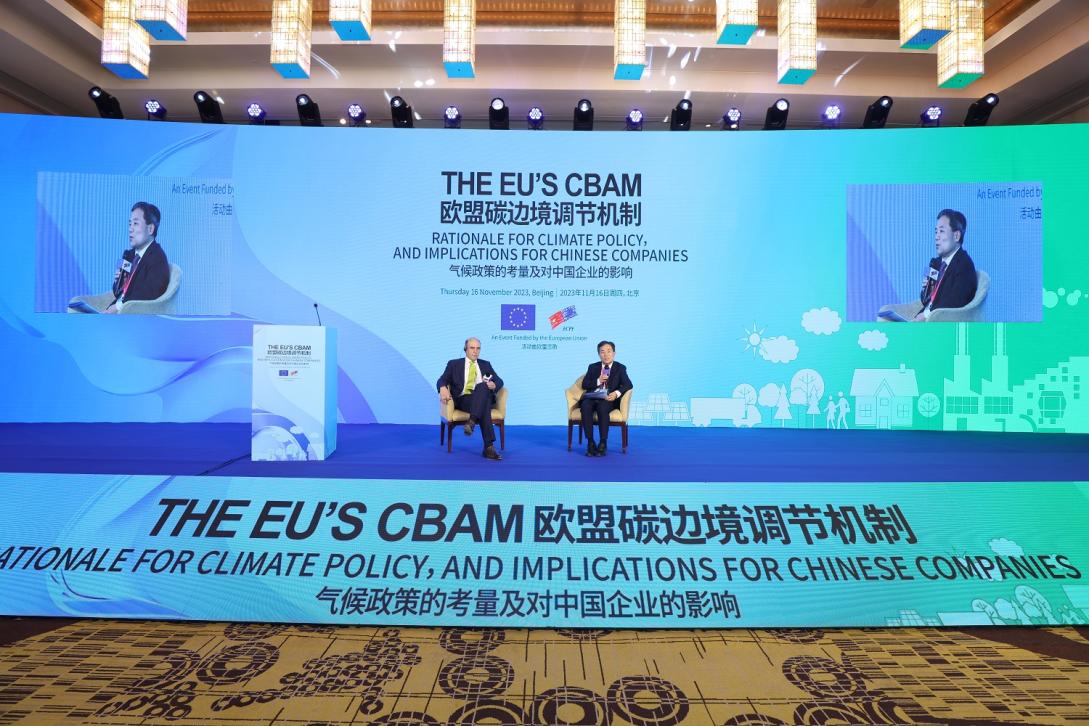
On 16 November, the Delegation of the European Union to China organized the seminar “The EU’s CBAM: rationale for climate policy, and implications for Chinese companies”. This full-day event took place at the Regent Hotel, in Beijing, and was attended by over one thousand people on-site and on-line.
The European Commissioner for Climate Action, Wopke Hoekstra and the Director General for Taxation and Customs Union at the European Commission, Gerassimos Thomas, opened this event. As the EU’s Carbon Border Adjustment Mechanism (CBAM) enters a transitional phase, this seminar not only provided further detailed explanation on the new mechanism, but also an opportunity for interaction and exchange of ideas with Chinese stakeholders, in particular companies. During the event invited panellists elaborated on multiple questions underlying the implementation of the CBAM, namely the rationale behind addressing carbon leakage risk in climate policy tools, the gradual phasing in of CBAM, the role of various actors, especially concerning the obligations of importers in the transitional period, rules on monitoring and reporting in the transitional period, the general approach to carbon price and carbon tax measures that could be recognized under CBAM, and the CBAM's functioning during its transitional phase.
This event was recorded on video. Follow the link to watch: https://live.polyv.cn/watch/4421342
More information about this event: https://www.eeas.europa.eu/delegations/china/eu%E2%80%99s-cbam-rationale-climate-policy-and-implications-chinese-companies_en?s=166
This event was funded by the European Union through the European Commission’s Service for Foreign Policy Instruments.
About CBAM – the EU’s Carbon Border Adjustment Mechanism
With its Green Deal and its commitment, now registered in law, to become the first climate neutral continent by 2050, the EU is keeping up to its responsibility in the fight against climate change.
But as the EU raises its own mitigation ambition including decarbonisation targets for EU industries and as long as less stringent mitigation policies prevail in many non-EU countries, there is a risk of so-called ‘carbon leakage'. Carbon leakage occurs when companies based in the EU move carbon-intensive production abroad to countries where less stringent mitigation policies are in place than in the EU, or when EU products get replaced by more carbon-intensive imports. This would undermine EU efforts to decrease emissions and ultimately global efforts for mitigating climate change.
The EU’s Carbon Border Adjustment Mechanism (CBAM) is the EU’s landmark tool to put a fair price on greenhouse gases (GHGs) emitted during the production of energy intensive goods, a price equivalent for goods imported and domestic production. The CBAM complements the strengthening of the EU Emission Trading System (EU ETS) which will allow an acceleration of decarbonisation efforts by EU industries. As of 1st January 2026 it applies to imports of certain goods whose production is carbon intensive and at most significant risk of carbon leakage: cement, iron and steel, aluminium, fertilisers, electricity and hydrogen. It will de facto, not only ensure that EU efforts to protect the climate are not lost, but also incentivize cleaner industrial production in non-EU countries. By 2030, the scope of CBAM might be extended to apply to a limited number of additional sectors that are covered by the EU ETS and that are at most at risk of carbon leakage.
On 1 October 2023, the CBAM entered into application in its transitional phase, with the first report for importers due for 31 January 2024.
More information: https://www.eeas.europa.eu/delegations/china/carbon-border-adjustment-mechanism_en