
Prime Minister launches Fiji’s Horizon 2030 food systems strategy and agrifood investment plan
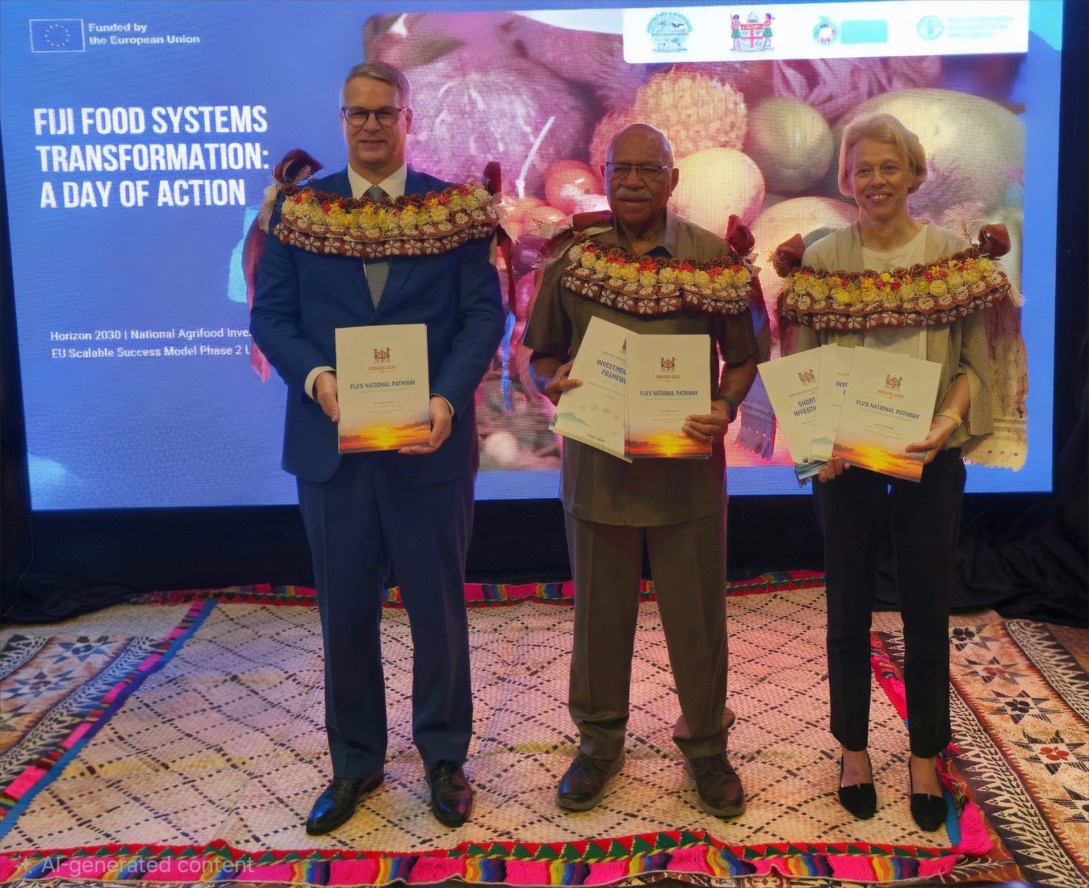
SUVA, 14 AUGUST 2026 – Fiji today brought its food systems priorities, investment plans and delivery arrangements into a single national framework. It launched the Horizon 2030 Food Systems Strategy and National Agrifood Investment Plan and moved into Phase 2 of the European Union funded Scalable Success Model (SSM), which builds on the successful completion of the Phase 1 design and the Convergence Initiative in 2025.
The launch formed part of Fiji Food Systems Transformation – A Day of Action, held at the Novotel Suva, Lami Bay, convened by the Government of Fiji through the National Food System Convenor, supported by the UN Food Systems Coordination Hub, the Food and Agriculture Organization of the United Nations (FAO), and funded by the European Union. The event brought together Fiji HON. Prime Minister Sitiveni Rabuka, government ministers, the EU Ambassador to the Pacific, the UN Resident Coordinator, UN agencies, national institutions and development partners.
Hon. Sitiveni Rabuka, Prime Minister of Fiji: "Horizon 2030 provides directions. The investment plan provides the framework. The short-term investment plan provides the immediate pathway for action. Our task now is to deliver."
Horizon 2030 sets Fiji’s national direction for food systems transformation, while the National Agrifood Investment Plan identifies the investments needed to support it. The plan sets out an indicative investment envelope of FJD 26.5 million (approximately USD 11.7 million), focused on governance and coordination; resilient and inclusive value chains; nutrition and food security; and climate resilience and natural resources. SSM Phase 2 will support the governance and technical arrangements needed to put these priorities into practice, including a technical working group, a National Agrifood Investment Forum and a public-private partnership framework.

Delegation of the European Union to the Pacific
H.E. Ms. Barbara Plinkert, Ambassador of the European Union to the Pacific: “The European Union is proud to support Fiji’s efforts to advance a more sustainable, resilient and inclusive agrifood system. The launch of the Horizon 2030 Food Systems Strategy, the National Agrifood Investment Plan and the Scalable Success Model Phase 2 demonstrates a strong commitment to food security, rural livelihoods and economic resilience, in the spirit of the EU’s Global Gateway strategy. This also includes support for Fiji’s agriculture sector to grow through stronger value chains and improved access to markets, building on the duty-free, quota-free access Fiji already enjoys to the EU’s single market. We deeply value our partnership with the Government of Fiji and remain committed to long-term, inclusive development across the country.”
Mr. Dirk Wagener, UN resident coordinator: “Fiji has the capacity to become a global example of how a small island developing state can build a resilient, nature-positive, and nutrition-sensitive food system.”
During a roundtable and stocktake, partners reviewed progress against Horizon 2030 and the investment plan, discussed how to align support and mobilise resources, and considered the proposed Convergence Steering Committee. Its draft Terms of Reference and workplan will provide a basis for coordination across ministries, data systems and investment instruments as work advances.
Mr. Antonio Salort-Pons, Senior Programme Officer, Food Systems Coordination Hub: “We warmly congratulate the Government of Fiji, and the wide ecosystem of partners who stood alongside it, for the leadership and perseverance that carried the formulation, finalisation and endorsement of Fiji’s national food systems pathway – Horizon 2030. With this milestone, Fiji joins a group of 31 countries across Asia-Pacific that have brought their national food systems pathways through to national endorsement, and now turns from vision to delivery.”
The Day of Action confirmed Fiji’s progress towards implementing Horizon 2030, with clear ambitions, priority actions and investment increasingly aligned behind the national plan. Senior representatives from Fiji’s key line ministries – including the Ministries of Agriculture and Waterways; Health and Medical Services; Fisheries and Forestry; Environment and Climate Change; Education; and Women, Children and Social Protection – provided updates on current and approved budget allocations across the plan’s convergence areas, underscoring the Government’s commitment to resourcing its food systems priorities.
During the roundtable and stocktake, United Nations agencies, regional organisations, and academic and civil society partners – including FAO, the Pacific Community (SPC), the World Food Programme, UNICEF and IFAD — set out how their programmes support the plan’s four convergence areas and signalled their readiness to coordinate support around Fiji’s national priorities. This includes work on climate-smart agriculture, digital platforms, nutrition-sensitive interventions, value-chain development and governance, backed by significant partner investment already supporting the plan, including FAO’s recently launched Fiji Blue Economy and Green Community Development Programme. Partners also discussed the proposed governance architecture, including the Convergence technical working group, and introduced the Phase 2 workplan, roles, reporting lines and coordination arrangements that will guide delivery.
About
-
Scalable Success Model (SSM): Accelerating Food Systems Transformation through a Scalable Success Model is a 36-month initiative funded by the European Union and coordinated by the UN Food Systems Coordination Hub with UN agencies and National Convenors. It supports eight countries, including Fiji, to put national food systems pathways into practice. In Fiji, the Government, FAO, the Hub and other national and development partners are supporting the governance and technical arrangements linked to Horizon 2030 and the National Agrifood Investment Plan.
-
UN Food Systems Coordination Hub and FAO in the Pacific Islands. The Hub is hosted by FAO on behalf of the UN system and supports countries to advance national food systems pathways by connecting expertise and coordinating support. FAO’s Subregional Office for the Pacific Islands, based in Apia, Samoa, coordinates FAO’s work across 13 Member Countries and Tokelau, an Associate Member, including Fiji, working with governments, the private sector, producers’ organizations, non-governmental organizations, UN agencies and regional organizations.