
Europe Week 2022: 65 years of EU-Ghana partnership, 2-9 May 2022
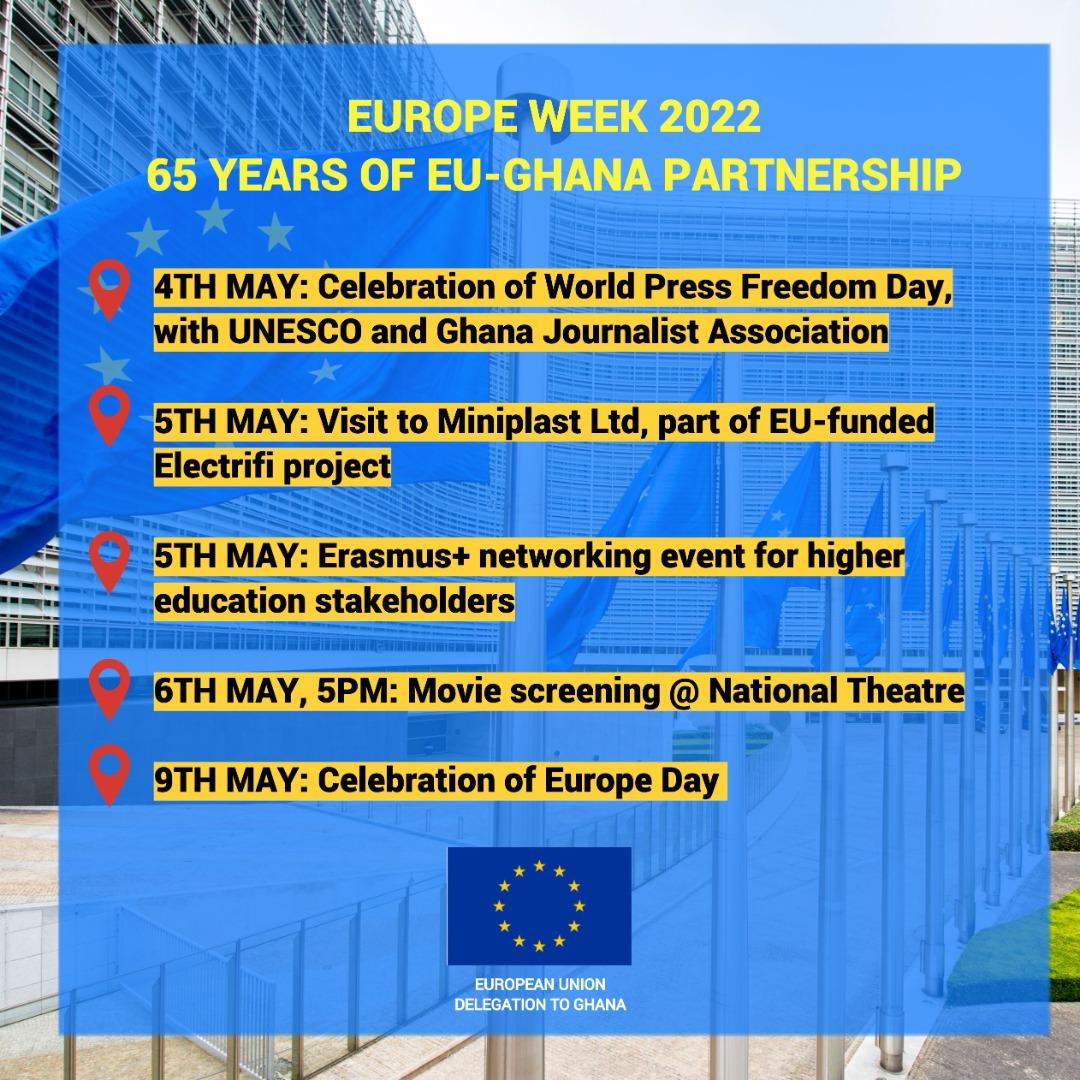
Europe Week presents a unique opportunity to highlight the cooperation and partnership between the EU and Ghana throughout the years and across different sectors. This includes a partnership for sustainable growth and job creation, the promotion of shared democratic values, and jointly working towards a greener future – but also investing in youth and cross-cultural exchanges.
To reaffirm the EU’s support for Ghana’s fishing sector, the EU Ambassador to Ghana, Irchad Razaaly, paid a visit to the fishing communities in Whuti and Keta in the Volta Region, beneficiaries of the EU-funded Far Ban Bo project. The EU is committed to supporting Ghana’s key industries, including the country’s ambitions towards more sustainable practices in the fishing sector. Watch the social media space of the Delegation for more on this visit.
On 4th of May, the EU will join the Ghana Journalist Association, UNESCO and the UN on 4th May to celebrate World Press Freedom Day. EU and Ghana share common democratic values that should be continuously nurtured, including freedom of expression and the press.
The EU Ambassador will pay a visit to Miniplast Ltd on 5th May to highlight the importance of the EU-Ghana partnership on green growth. Miniplast Ltd is a Ghana-based plastic manufacturing and recycling industry powered by solar panels, partially funded by the EU. EU is supporting Ghana to achieve a more sustainable tomorrow, for example by investing in renewable energy sources.
On 5th May, the EU will hold an event for the alumni of the Erasmus+ scholarship programme as well as higher education stakeholders. Investment in youth – a pillar of Ghanaian society – is essential to ensure a common prosperous future for both the EU and Ghana.
Finally, the EU also wishes to promote cross-cultural dialogue between Europe and Ghana. The EU will therefore organise the screening of two movies at the National Theatre on 6th of May: one film takes place in Europe, the other in Ghana – but both discuss the struggles of living with a disability.
Europe Week celebrations will conclude with the commemoration of Europe Day on 9th May at the EU Ambassador’s Residence.
Background: EU-Ghana partnership over the years
The partnership between EU and Ghana has progressed over the years and only grown stronger and more fruitful.
Some past success stories include:
- Support from the European Investment Bank (EIB) to the Kpong Dam: In 2019, funds from the EIB (€12.5 million) and the French Development Agency (€50 million) helped restore and upgrade the Kpong Dam facilities in 2019 – which now provide about 12% of the country’s electricity production.
- Training for the Mole national park wildlife census: The EU provided training for operational staff of the Mole National Park in West Gonja District of Savannah Region.
- Capacity-building of the Kumasi Metropolitan Assembly: Through the Holistic Reinforcement for Sustainable Development (HORESD) project, the EU provided €2.5million to the Assembly to help manage solid waste and improve service delivery in the metropolis.
The EU’s current engagement is also contributing to several sectors:
- EU initiatives to support the agriculture sector, such as the €132M EU- Ghana Agriculture Programme (EU-GAP) in the Upper West, Savannah and North East Regions. EU-GAP aims to increase agricultural productivity, protect natural resources, and improve access to markets, infrastructure and capital for smallholder farmers;
- Support to job creation, such as the €20.6M GrEEn project, which invests in young Ghanaian entrepreneurs in the green and circular economy sectors;
- Commitment to improving EU-Ghana trade relations through the implementation of the Economic Partnership Agreement;
- Ongoing engagement in the field of security, including projects in the North (such as NORPREVSEC) and in the maritime security sector.
Finally, the EU is committed to invest in our continued partnership with Ghana.
- The EU is starting its new Joint Programming for 2021-2027, which was launched by Commissioner for International Partnerships, Jutta Urpilainen, during her visit to Accra last month. EU has committed €203 million for the next fours years.
- It includes support for the joint priorities of green growth and jobs, and smart and sustainable cities – but also increase focus on areas including culture and security.
- EU will also continue helping Ghana to strengthen its health system by supporting its local vaccine manufacturing capacity with an upcoming programme in 2022; EU is already supporting Ghana’s Food and Drug Authority in their regulatory function for vaccines.