
EU-India Global Gateway Conference
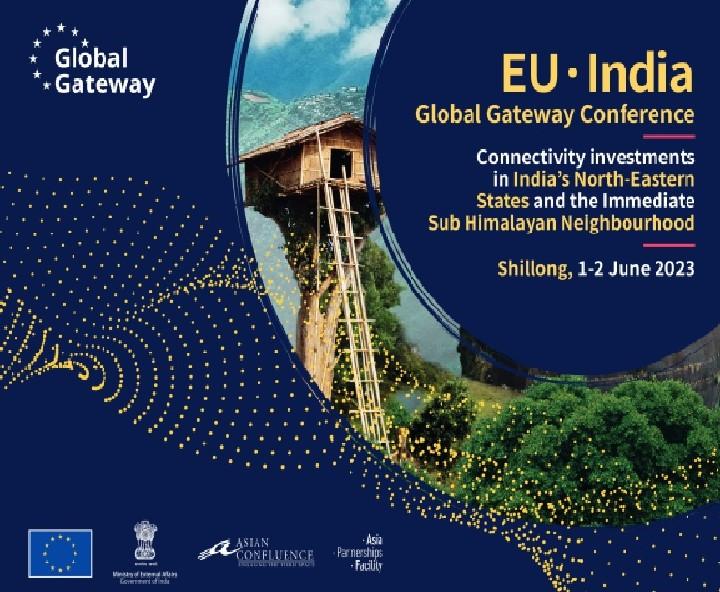
Background: Global Gateway and the EU-India Connectivity Partnership
Launched in December 2021, the Global Gateway Strategy builds on global priorities identified by the Paris Agreement on climate change and the 2030 Sustainable Development Goals. The European Union (EU) Indo-Pacific strategy, as well as the connectivity partnerships with Japan (2020) and India (2021) are also important building blocks in the region. The Global Gateway aims at boosting smart, green and secure links in digital, energy and transport and strengthen health, education and research systems across the world.
Global Gateway aims at increasing the size, scale and impact of Team Europe investments. It seeks to optimize coherence, while developing synergies and complementarity among EU actors. EU institutions, EU Member States, their implementing agencies and development financial institutions, the European Investment Bank (EIB) and the European Bank for Reconstruction and Development (EBRD) seek to work together more closely, along with the private sector, cities, regions and civil society stakeholders (think tanks, academia, NGOs).
Global Gateway aims to mobilise up to €300 billion in investments between 2021-2027 and relies on de-risking instruments such as guarantees and blending to draw on resources from both public and private sectors, including in remote or hard to reach areas, where investment failure risks are usually higher. It combines financial tools with technical assistance, policy and economic dialogue, trade and investment agreements and standardisation. Global Gateway is based on values of democracy and transparency, creating links, not dependencies.
The EU-India Connectivity Partnership (2021), stresses the importance of India as a geopolitical partner and our mutual interest in sustainable connectivity. The adoption of the EU Indo-Pacific Strategy (2021), is another step forward in working together for a peaceful and prosperous future in the region. The EU and India are committed to fostering connectivity dialogue and projects with particular emphasis on social, economic, fiscal, climate and environmental sustainability. Transparency, good governance, and ensuring a level playing field for economic operators must be essential features of all investments in infrastructure. The Connectivity Partnership aims at supporting sustainable digital, transport and energy networks, and the flow of people, goods, services, data and capital centred on equity and inclusivity for the benefit of both the EU and India.
The EU and India undertake regular policy dialogues in key policy areas, contributing to the implementation of the Connectivity partnership. These dialogues address crucial topics such as Smart and Sustainable Urbanisation, Water, Clean Energy and Climate, Circular Economy and Resource Efficiency as well as more transversal Science & Technology issues. The Global Gateway has given new impetus to further strengthen these partnerships and leverage investments from a wide array of public and private sector actors, to reach impact at larger scale for a green, digital and resilient future.
The needs for connectivity enhancement in the region are well-known. Infrastructure connectivity investments may be faced with a series of challenges, but potential and opportunities are no less real. The EU Global Gateway Conference in Shillong is an initiative to help boost smart, green and secure connectivity investments, including with Team Europe partners’ support, in digital, energy, transport, health and education sectors, in India’s Northeastern States and the Immediate Sub Himalayan Neighbourhood.
The Conference is an occasion to:
-Share preliminary findings of an (ongoing) mapping of initiatives, projects and investments with a particular focus on EU institutions and EU Member States in the North East, but also looking at other financers, both Indian and foreign.
-Present more in details a few EU/EU MS infrastructure investments or pipeline projects in the North East
-Exchange on priority connectivity investment needs with a focus on energy, transport and digital infrastructure (digital infrastructure in the health and education sectors more specifically).
-Help the EU-funded research team start working towards a draft Roadmap of investments by 2025, to be sent for comments post conference, both to conference participants as well as to individuals and institutions consulted for the online EU/EU MS connectivity investments mapping.
-The mapping exercise and the conference are based on a joint geographic and thematic cluster approach.
In terms of geography, the focus is on 3 geographic clusters:
- Connectivity within the North Eastern Region
- Connectivity between Northeast and the rest of India
- Connectivity between Northeast and neighbouring countries (priority: Bangladesh, Bhutan and Nepal)
In terms of themes, the focus is on the five investment pillars of the EU Global Gateway: digital, climate and energy, transport, health, and education and research. To be noted however that however that the digital sector is analysed with a particular focus on health and education infrastructure. There are therefore 3 thematic clusters:
-Digital connectivity investments in the health and education sectors
- Energy connectivity (particularly clean or renewable energy)
- Transport connectivity (roads, bridges, rail…)
The conference will be held over two days and will bring policymakers, public and private investors, development agencies, practitioners, city and region administrations as well think tanks, academia and other civil society actors to discuss on EU-India cooperation in Northeast India, the immediate sub Himalayan Neighbourhood and Bay of Bengal region.
Participants will include representatives from:
-The National Government of India
-Regional state governments and planning bodies
-Representatives of the neighbouring countries
-Team Europe institutional representatives
-Industry stakeholders (from Team Europe, India, and partner countries),
-Think-tanks and academic institutions
-Civil society organisations.
To maximise participation, the event will take place in a hybrid format.
For Agenda (Link)
To watch Live on Youtube (Link)