
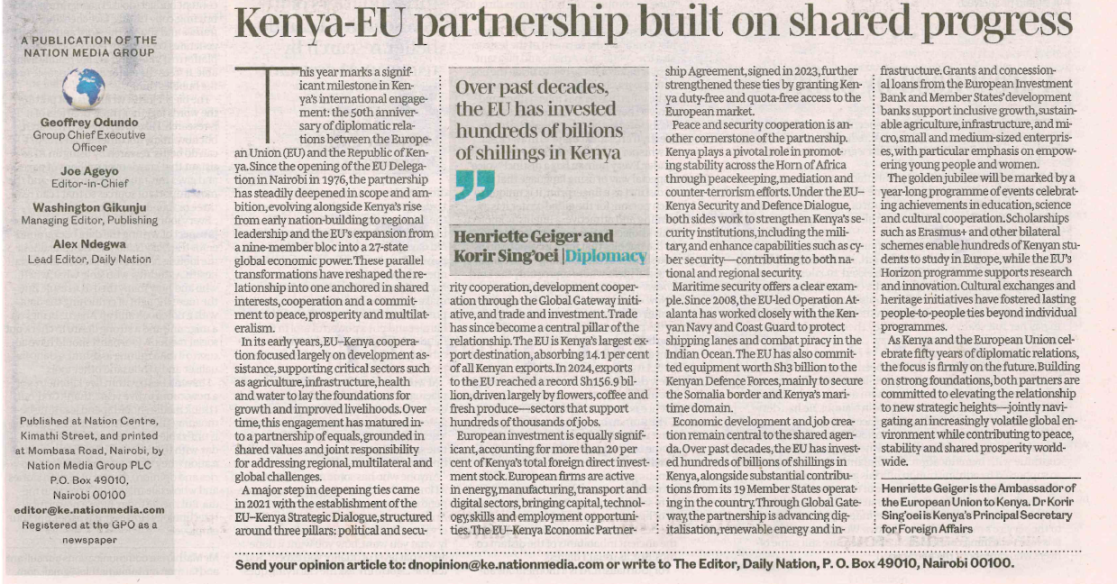
EU- Kenya Partnership built on shared progress
This year marks a significant milestone in the history of Kenya’s international engagement: the 50th anniversary of diplomatic relations between the European Union (EU) and the Republic of Kenya. From the opening of the EU Delegation in Nairobi in 1976, our relationship has grown in depth, scope and ambition, reflecting the profound changes experienced by both Kenya and the European Union, as well as our shared commitment to peace, prosperity and global cooperation through a revamped multilateral system.
Fifty years ago, Kenya was still in the early stages of nation-building, focused on consolidating stability and fostering development. The European Union only had nine member states and focused mainly on developing the internal common market. Since then, Kenya has emerged as a regional economic hub and a diplomatic leader in East Africa and beyond, while the EU has expanded into a union of 27 Member States and has become the largest economy in the world and an important global player. As both Kenya and the EU have evolved, so too has the nature of our relationship.
In the early years, EU–Kenya cooperation was largely focused on development assistance, supporting key sectors such as agriculture, infrastructure, health and water to support Kenya in laying the foundations for growth and improved livelihoods. Our engagement has since developed into a partnership of equals, grounded in mutual interests, shared values and the joint responsibility for addressing regional, multilateral and global challenges.
In 2021, the EU and Kenya established a Strategic Dialogue around the three pillars of political and security cooperation, development cooperation through Global Gateway and trade and investment.
Trade and investment have become a central pillar of our relations. The European Union is the largest export destination for Kenyan products, receiving 14.1% of all Kenyan exports. In 2024, we recorded a record high of Kenyan exports worth 156.9 billion Kenyan shillings, driven by flowers, coffee and fresh produce exports that support hundreds of thousands of jobs in Kenya. Moreover, EU investments account for more than 20% of Kenya’s total foreign direct investment stock and European companies invest in Kenya’s energy, manufacturing, transport and digital sectors, bringing capital, technology, skills and above all more jobs. The EU-Kenya Economic Partnership Agreement signed in 2023 provides Kenya with duty free and quota free access to the European market.
Cooperation in peace and security is another cornerstone of the partnership. Kenya plays a critical role in promoting regional stability across the Horn of Africa through peacekeeping, mediation, and counter-terrorism efforts. Under the EU-Kenya Security and Defence Dialogue, both parties collaborate to strengthen Kenya’s security institutions, including the military, and to enhance the country’s capacity to safeguard its cyber space.
This joint effort supports not only Kenya’s national security but also contributes to broader regional and international peace. A notable example is maritime security: since 2008, the EU-led Operation Atalanta has worked alongside the Kenyan Navy and Coast Guard to protect shipping lanes and combat piracy in the Indian Ocean. The EU has also committed to providing equipment for the Kenyan Defence Forces, valued at 3 billion Kenyan shillings, mainly to secure the Somalia border and Kenya’s maritime domain.
Economic development and job creation remain central to the shared agenda, with the EU continuing as a reliable partner, having invested hundreds of billions of Kenyan shillings over past decades, in addition to substantial contributions from its 19 Member States operating in Kenya. Through initiatives such as the EU’s Global Gateway, the EU and Kenya are promoting digitalisation, renewable energy, and infrastructure development. Grants and soft loans from the European Investment Bank and Member States’ development banks support inclusive growth, sustainable agriculture, infrastructure, and micro, small, and medium-sized enterprises. A particular emphasis is placed on empowering young people and women, recognising their vital role in Kenya’s future. These efforts are closely aligned with Kenya’s national development priorities and continental ambitions, including regional integration and the African Continental Free Trade Area.
The 50th anniversary of EU-Kenya relations will be marked by a year-long series of events, celebrating achievements in education, science, and cultural cooperation. Partnerships with universities, vocational training, research institutions, and people-to-people programmes enable hundreds of students to pursue studies in Europe through scholarships such as Erasmus+ and various bilateral schemes. The EU’s Horizon programme also supports research and innovation. Cultural exchanges and heritage projects have fostered long-lasting mutual understanding and connections that extend beyond individual initiatives.
Our relationship invests in people, ideas, creativity, innovation, and mutual understanding, and it underpins our strong economic ties, effective diplomacy, and enduring partnerships.
As we celebrate fifty years of EU-Kenya diplomatic relations, we celebrate the strong foundations laid over the past 50 years and move forward with ambition to build an ever-stronger Kenya EU relationship that can confidently and jointly meet the many challenges lying ahead in an increasingly volatile global environment. May our strong collaboration contribute to peace and stability in the world. Let us jointly celebrate this golden jubilee year through many events and activities and lift European Union and Kenya relations to strategic heights.
Nation Media Group 2026