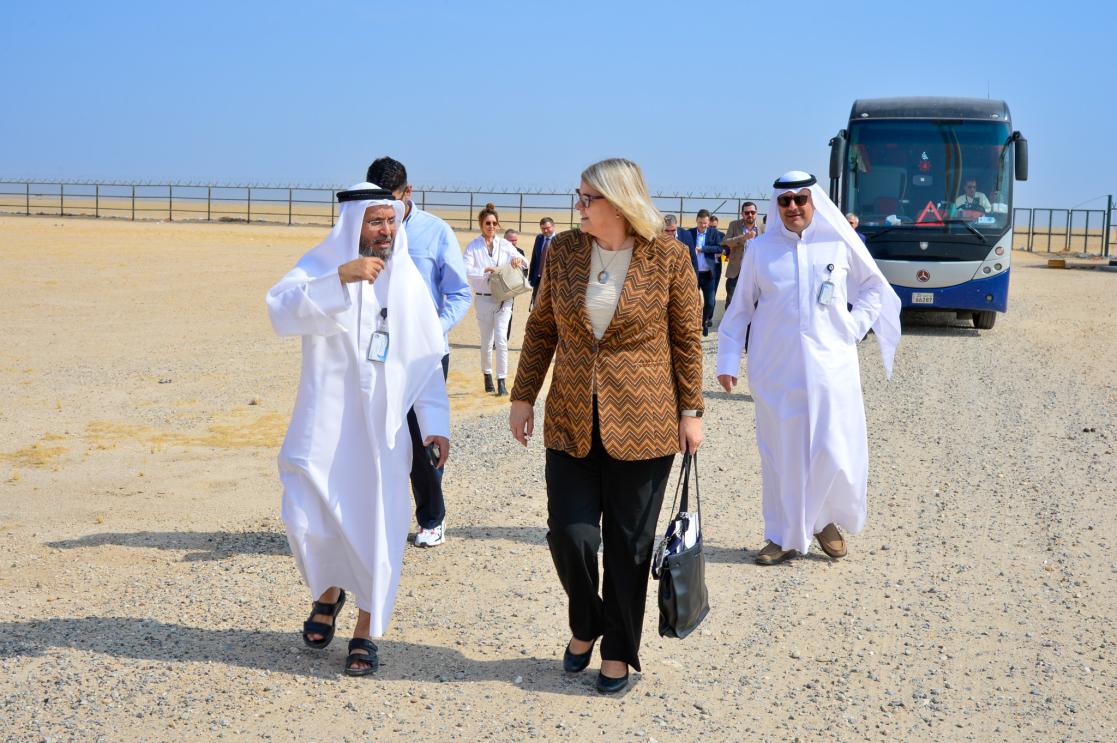
European Union Ambassadors in Kuwait Visit the Shagaya Renewable Energy Plant ahead of COP28
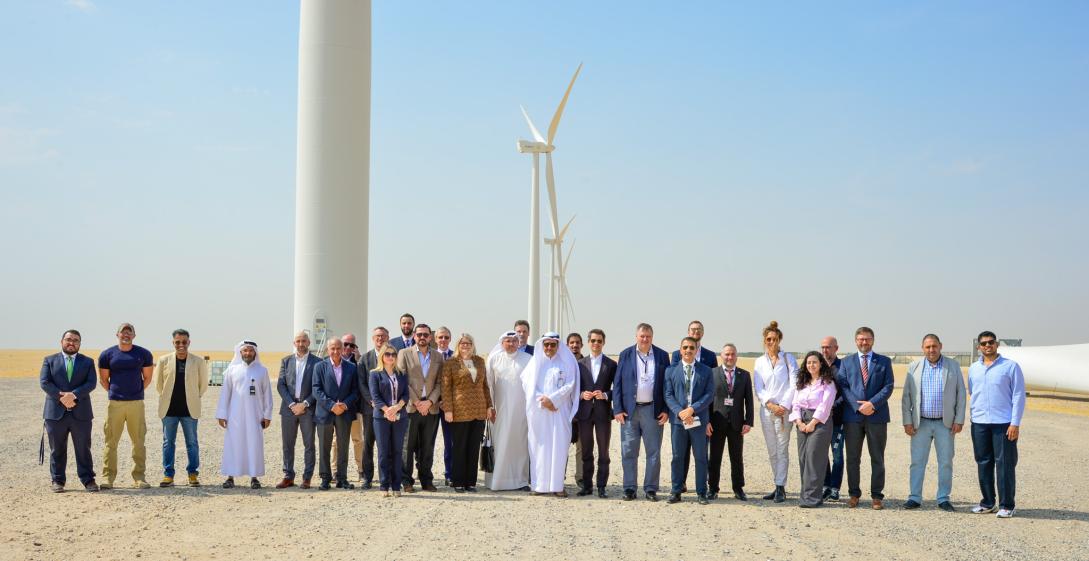
The Delegation of the European Union to the State of Kuwait, in cooperation with Kuwait Institute for Scientific Research, in cooperation with as well as the Spanish Embassy in Kuwait – in the context of the current Spanish Presidency of the Council of the European Union, organized a visit to the Shagaya Renewable Energy Complex for Ambassadors and Chargés d’Affaires of the European Union Member States in Kuwait on October 24, 2023. This visit comes in the run up to the United Nations Climate Change Conference, also known as COP28, in Dubai. Additionally, the visit falls within the context of the Green Diplomacy Weeks 2023, an initiative organized by the European Union, which aims at promoting a Just Energy Transition globally.
During her visit to Shagaya, Anne Koistinen, Head of the European Union Delegation in Kuwait, emphasized that the visit reflects the European Union's commitment to combating climate change and the urgent need to transition to renewable energy sources. “For instance, the European Union is aiming to generate 45% of its energy from renewable sources by 2030”, she said. She noted that Kuwait has significant potential in solar energy due to its unique geographical location between Europe and Asia, making it economically rational to invest in clean energy to meet the growing global demand for stable and affordable green energy. She also highlighted that the EU experience and knowhow can help Kuwait to become a global leader in solar energy production.
For his part, Miguel Moro Aguilar, Spanish Ambassador to Kuwait, said: “I am delighted to visit the Shagaya Renewable Energy Complex alongside my European colleagues at this important moment in the run up to COP28, where all shall have to join forces to present a coordinated front, in order to have a substantial positive outcome. The EU, the European technologies and its leading companies, have been present from the very inception of the first Kuwaiti plans to diversify its dependency on fossil energy, and we are indeed ready to continue to collaborate in the next phase, assisting Kuwait to boost its renewable energy. I would like to avail of this opportunity to thank KISR for hosting us in this important field visit.”
On this occasion, Dr. Ahmed Al-Mulla, Acting Executive Director of the Energy Research Center at Shagaya, said that the Shagaya Renewable Energy Complex is an ambitious plan developed by the Kuwait Institute for Scientific Research. He further said that the capacity of the station reaches 70 megawatts in the first phase of the project, and it consists of three technologies: solar thermal energy, photovoltaic energy, and wind energy. “The production capacity is expected to reach 4,500 megawatts upon completion of the second and third phases of the project”, he concluded.