
EU-IDFR Diplomacy Course charts the way forward for EU-ASEAN partnerships
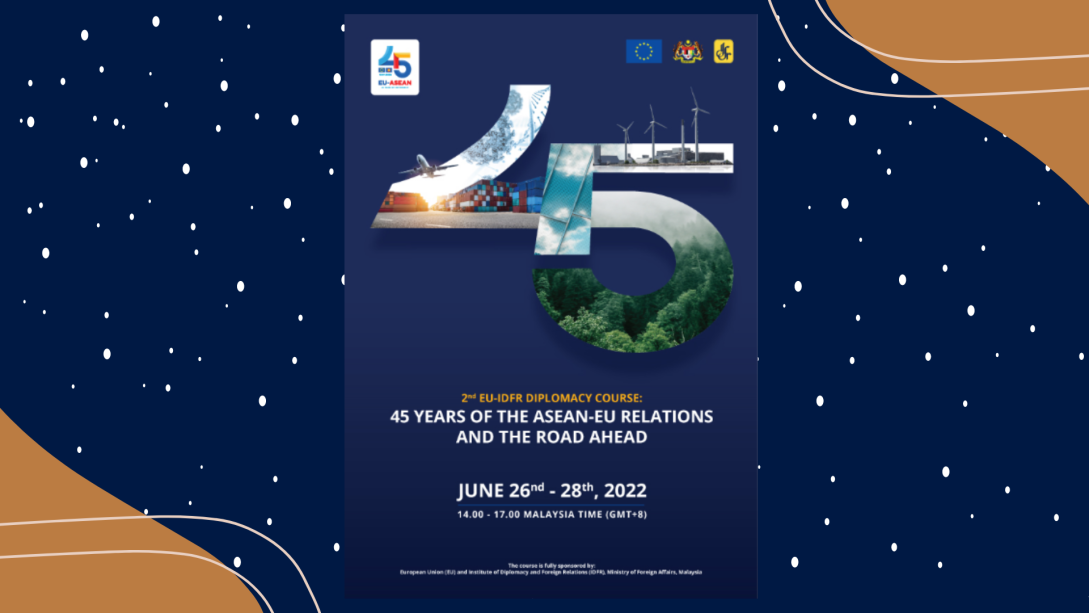
Senior-level ASEAN diplomats and Malaysian Government officials participated in an online course jointly organised by the Delegation of the European Union to Malaysia and the Institute of Diplomacy & Foreign Relations (IDFR) Malaysia.
Themed “45 years of ASEAN-EU Relations and the Road Ahead”, the 2nd EU-IDFR Diplomacy Course held from 26 to 28 October 2022 focused on stability in the Indo-Pacific as well as EU-ASEAN partnerships for maritime security and connectivity.
Against the backdrop of a volatile and evolving geopolitical environment, the attendees exchanged views on strengthening the ties between the two blocs through the EU Strategy for Cooperation in the Indo-Pacific, Global Gateway and the EU-ASEAN Strategic Partnership.
Cooperation is fundamental in the EU's approach in the EU Strategy for Cooperation in the Indo-Pacific, said Mr Stavros Petropoulos, Senior Expert, Relations with the Indo-Pacific at European External Action Service (EEAS).
“Through our strategy, we aim to enforce presence in the Indo-Pacific and contribute to the stability, security and prosperity of the region. We will base our cooperation in this region on our shared values and interests and on our respective complementary visions for the region,” he said.
On maritime security, Mr Giovanni Cremonini, Head of Maritime Security, Security and Defence Policy (SECDEFPOL) at the European External Action Service (EEAS), elaborated on the EU’s role as the maritime security provider.
He highlighted three main points that are relevant in the context of EU-ASEAN cooperation.
“First, naval presence - patrolling, presence of ships on the sea lines of communication to protect them, to make them safe. The second is the promotion of international maritime law, UNCLOS (United Nations Convention on the Law of the Sea), and the third is capacity building, in particular with regard to maritime domain awareness.”
Adding on to maritime domain awareness, Dr. Adina Kamarudin, Director General - Department of Maritime Affairs at Malaysia’s Ministry of Foreign Affairs, shared: “A country cannot possibly be alone to face all kinds of challenges in terms of maritime domain awareness. It is about sharing of information. Because the country cannot handle this on its own, it needs international cooperation.”
To chart the way forward in EU-ASEAN cooperation, Dr. Maaike Okano Heijmans, Senior Research Fellow of the Netherland’s Clingendael Institute, zoomed in on digital connectivity out of the five investment priorities in the European Global Gateway Initiative, namely digital, climate and energy, transport, health, and education and research.
She noted that the Southeast Asia Internet economy is expected to reach $300 billion, based on a 2020 Google, Temasek and Bain Company report. This shows the importance of this part of the economy to the Asean region, she said. “And one, of course, that European companies would want to engage with, and one that the European governments also want to help ASEAN governments with to get the regulatory side properly in place.”
The challenge, nonetheless, is to narrow the digital divides among the ASEAN member states, such as in the e-commerce and digital payment sectors, Dr Heijmans added. “Making sure all countries benefit from each other’s position, expertise and investment could be an important objective within ASEAN, and the EU, through the Global Gateway, can help to stimulate that.”

In concluding the course, H.E. Michalis Rokas, EU Ambassador to Malaysia, reiterated that the EU’s commitment in the region is there for the long run. Both EU and ASEAN were founded to prevent conflicts and bring economies together to ensure stability, he said, adding that the shared inspiration will continue to bring the two blocs closer together.
“It is quite obvious that in the face of today’s severe security and economic challenges, it is particularly important to be able to rely on and work with partners who share the same values, principles and attachments to multilateralism, free and fair trade, and rules-based global order,” he said.
Hailing the EU’s commitment to closer engagement with ASEAN, H.E. Charles C. Jose,
Ambassador of the Philippines to Malaysia, said the Philippines looks forward to advancing the strategic partnerships between the two blocs for the next five years, as outlined in the Plan of Action to Implement the ASEAN-EU Strategic Partnership (2023-2027).
“As the current country coordinator of EU-ASEAN dialogue relations, the Philippines is pleased to work with the EU and fellow ASEAN members to push forward cooperation in areas of common concerned such as maritime cooperation, digital technology and cyber security; strengthen public health system, biodiversity conservation and management; and ensure stability in global supply chains,” he said.
In all, the diplomacy course was attended by forty-five government officials, mainly from the Ministry of Foreign Affairs, of eight ASEAN member states: Brunei Darussalam, Indonesia, Lao PDR, Malaysia, Myanmar, the Philippines, Thailand and Vietnam, as well as candidate country Timor-Leste. Officials from the ASEAN Secretariat and EU Member State embassies in Kuala Lumpur also joined in.
Other speakers who shared their views at the three-day event were Dr. Bruno Hellendorft, Guest Lecturer at the Catholic University of Louvain and Dato’ Dr Mohamad Rameez Yahya, Minister Counsellor / Head of Chancery, High Commission of Malaysia in Namibia.