EU Supports Namibia in Strengthening Efforts Against Illicit Financial Flows (IFFs)

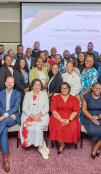
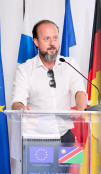
Over the past year, Namibia’s six-member team worked with STA coaches to analyse drivers of tax-related IFFs and design solutions tailored to Namibia’s administrative and economic context. The initiative also deepened cooperation between national institutions and facilitated exchanges with other African countries. The four-year collaboration foresees a new Namibian team each year addressing a different IFF-related challenge. This is part of the wider EU SecFin Africa Project, aimed at supporting Namibia in addressing the FATF grey listing. Speaking at the event, EU Ambassador to Namibia, H.E. Ana Beatriz Martins, highlighted that the ceremony is not only a celebration of the participants’ achievements but also a tangible demonstration of the EU’s broader cooperation with Namibia in fighting illicit financial flows and helping Namibia exit the FATF grey list. She said,
“Today’s graduation shows how practical, sustained partnership such as the SecFin Africa project, translates into stronger institutions, improved financial integrity and real progress in addressing the root causes of IFFs.”
At the ceremony, Dr Bryan Eiseb, Director of the FIC, commended the participants for their perseverance and emphasised the importance of continuous capacity building to safeguard Namibia’s financial system. He said that that this project will contribute to reducing illicit financial flows from roughly 9% of GDP in 2025 to about 5% by 2030, in line with Namibia’s Sixth National Development Plan. He emphasized that while IFFs may appear to be solely a tax matter, leaving it to the Namibian Revenue Agency alone would be a myopic approach in today’s “business unusual” environment. Illicit financial flows are a national development challenge and addressing them requires a coordinated effort across all key institutions. Deputy Ambassador of Sweden to Namibia and South Africa, Kristian Olsson Selerud, reaffirmed Sweden’s commitment to supporting African countries in strengthening revenue systems and combatting organised financial crime. While STA Project Manager Ms. Caroline Österberg praised the team for successfully applying the PDIA method to a challenging and technical problem area. While Team Namibia coach Ms. Suzan Uhlen highlighted the dedication and high level of engagement shown by the participating Namibian officials. The ceremony was attended by senior government leaders, including Acting Deputy Executive Director in the Ministry of International Relations and Trade, Mr. Charles B Josob, Deputy Director at Bank of Namibia, Ms. Penelao Kapenda; Mr. Oscar Capelao, Tax Policy Lead in the Ministry of Finance and Honorary Consul of Sweden to Namibia, Ms. Lena Brinkmann, among others.
ABOUT THE SECFIN AFRICA PROJECT
SecFin Africa is an EU-funded initiative supporting Sub-Saharan African countries in preventing and combating illicit financial flows linked to transnational organised crime, through strengthened anti-money laundering (AML) and counter-terrorist financing (CFT) frameworks. By reinforcing financial integrity, the project contributes to the African Union’s Agenda 2063 (Goal 20 on Financing Development) and the UN Sustainable Development Goals (Target 16.4 on reducing IFFs).
Launched in August 2024, SecFin Africa is implemented by Expertise France, the Swedish Tax Agency, FIIAPP, GIZ, CIVIPOL and CABRI. The STA specifically applies the PDIA approach to enhance tax compliance and financial integrity in partner countries including Rwanda, Kenya, Zambia, South Africa, Namibia and Liberia.
Africa loses at least €76 billion annually to illicit financial flows, resources that could otherwise support health, education, infrastructure, and overall development. The SecFin Africa project aims to assist 49 African countries over four years in tackling these challenges through capacity building, institutional strengthening, and improved cross-border collaboration.