
FIC and EU Enhance Namibia’s Capacity to Combat Financial Crime
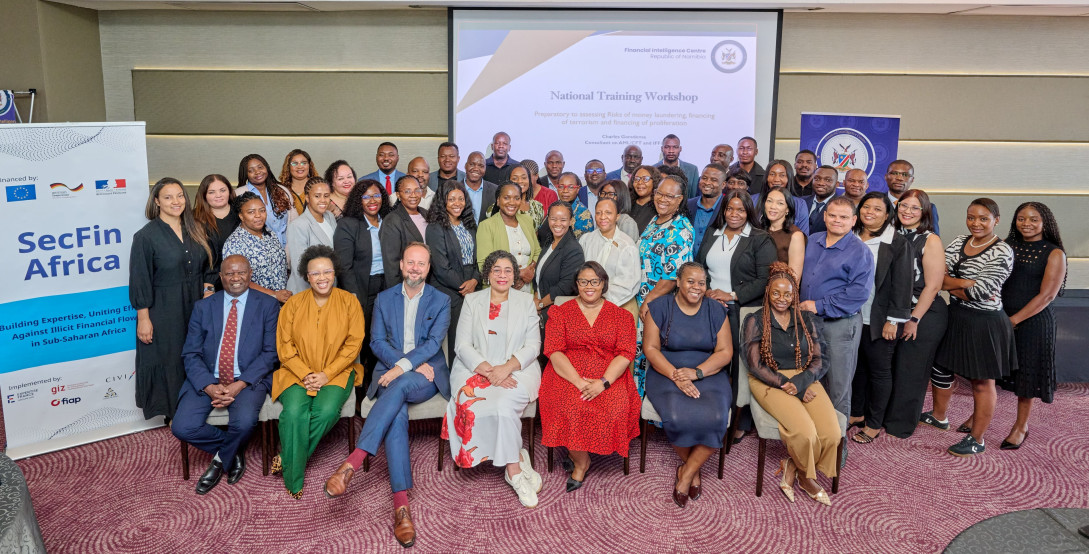
The workshop forms a critical part of Namibia’s efforts to strengthen its Anti-Money Laundering, Combating the Financing of Terrorism and Countering Proliferation Financing (AML/CFT/CPF) regime. The ultimate objective is to protect the integrity of Namibia’s financial system, foster investor confidence and contribute to sustainable and inclusive economic growth. It further supports Namibia’s ongoing efforts to exit the Financial Action Task Force (FATF) grey list and to prepare effectively for the upcoming Eastern and Southern African Anti-Money Laundering Group Mutual Evaluation for Namibia.
The FIC expressed appreciation to the EU for its continued support and technical assistance through the SecFin Africa project, which is instrumental in equipping Namibian authorities with the tools, methodologies and expertise required to conduct a robust and credible National Risk Assessment (NRA). The NRA workshop aims to strengthen Namibia’s ability to proactively identify vulnerabilities, prioritise resources and design proportionate and targeted measures across both public and private sectors. Participants include representatives from FIC, NAMFISA, Bank of Namibia, National Planning Commission, Bankers Association of Namibia, Office of the Prosecutor- General, BIPA, Master of the High Court, Non-banking financial sector, Law Society of Namibia, Nampol, ACC and Council of Churches, reflecting a truly national and collaborative approach to risk assessment.
At the opening of the workshop, Ms. Zenobia Barry, speaking on behalf of Dr Bryan Eiseb, Director of the Financial Intelligence Centre, said: “Over the course of this training, stakeholders will be empowered to understand the process of conducting an NRA, appreciate its significance and prepare for active participation when the assessment commences. A National Risk Assessment can only be truly national if it reflects the experience, data and insights of all stakeholders.”
On his part, Mr Ian Dupont, EU Deputy Head of Mission, emphasised the importance of sustained collaboration, as he said: “Combating financial crime cannot be achieved by one institution alone. It requires coordinated action across government agencies, financial institutions, designated non-financial businesses and professions, and international partners. The real success of this exercise will not be measured solely by the completion of the report, but by the reforms, institutional improvements and operational outcomes that follow. The EU is a proud partner of Namibia in this journey.”
Both the FIC and the EU reaffirmed their commitment to continued cooperation in strengthening Namibia’s resilience against illicit financial flows and safeguarding the integrity of its financial system.
ABOUT THE SECFIN AFRICA PROJECT
The SecFin Africa project, “Securing a Robust AML/CFT Framework Against Illicit Financial Flows in Sub-Saharan Africa,” is a flagship initiative jointly implemented by Expertise France, CIVIPOL, GIZ and FIIAPP, with financial and technical support from the European Union, Germany and France. The project is designed to address the profound challenges posed by illicit financial flows (IFFs), which threaten the economic stability, governance and security of Sub-Saharan Africa.
IFFs stemming from activities such as tax evasion, corruption, organised crime and human trafficking have reached alarming proportions. Estimated at approximately USD 88.6 billion annually, these flows are comparable to or even exceed the combined inflows of Official Development Assistance (ODA) and Foreign Direct Investment (FDI) to African countries. Their far-reaching impact erodes public resources, weakens institutions and compromises the delivery of essential services, particularly in vulnerable communities.
Recognising the urgency of addressing this economic drain, SecFin Africa adopts a multidimensional approach focused on strengthening Anti-Money Laundering (AML) and Countering the Financing of Terrorism (CFT) frameworks at national and regional levels. The project enhances the capacity of key stakeholders — including governments, civil society organisations, regional networks and international partners — to work collectively and effectively in combating illicit financial flows.