
Remarks by Charge d’Affaires at the Civic Education and Public Consultations Event
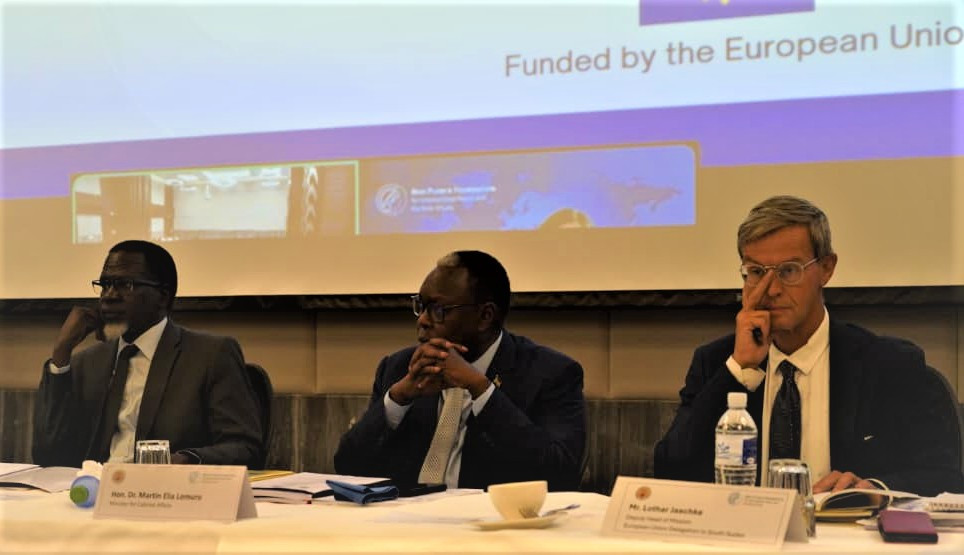
I am very grateful for the chance to stand here in front of you today and become a small part – but still a part - of the historic journey towards a permanent Constitution, initiating a federal and democratic system of government as spelled out in Chapter 6 of the peace agreement and Chapter 1 of the 2022 Act on the Constitution Making Process.
This process has made great progress in the last months, and I would call it the greatest success story in South Sudan since the signing of the peace agreement in September 2018. We are proud to support this process, and we are proud of the work of Max Planck Foundation which organised several workshops to create space for the process and produced handouts of key documents and readers around constitutional processes.
I call on the Government to continue to support the process, to support the steps that are now needed, e.g. the establishment of the Constitutional Drafting Committee and the National Constitutional Conference. The Constitution Making Process should be seen an opportunity to redefine a strategic direction towards a stable democracy with the rule of law and respect for human rights.
A constitution can also be understood as a contract between those who govern and those who are governed. It is a framework for the people to demand accountability and claim their rights. Their civic rights to personal liberty, to a fair trial, freedom of expression and media and right of assembly and association, their social and economic rights to education, public health care and access to information. The Constitution Making Process is a renewed chance to unite the country, put it at peace and build a nation.
I recently saw a short fictional video about Dr John Garang returning to Juba in 2026. At the end of the video you can hear the voice of H.E President Salva Kiir, saying: “there is no meaning of revolution unless it makes our people happy, unless the masses of our people become prosperous, go ahead, get food and shelter, get clean drinking water, education, health care; if we just shout revolution, but the bare minimum are not available, then the people will drive us to the sea”. This is accountability for economic and social rights.
On 2 July, NCRC Chair Hon Dr Riang informed the RJMEC Board about the progress made in the Constitution Making Process and stated that the permanent constitution could be finalised even before the end of the transitional process if all pull in the same direction. During this meeting Hon Minister Elia Lomuro acknowledged and appreciated the progress achieved.
In the meantime, amendments to the peace agreement have entered into force to the effect that elections will be run on the transitional constitution and not on the permanent constitution. But the permanent constitution was the promise in 2018 of a democratic governance system creating social cohesion. I understand, although with regret, that time is too short for a permanent constitution if elections take place in December 2026.
Due process for changing the peace agreement was not respected. Due process is that the Revitalized Agreement be amended by the Parties, with the consent of at least two–thirds of the members of the Council of Ministers of the RTGoNU, and at least two–thirds of the voting members of the RJMEC, to be then ratified by the Transitional National Legislature. The RJMEC Board was not consulted as Chapter eight, point four of the peace agreement requires.
This should be corrected, RJMEC cannot be bypassed, things should be done correctly before any change can take effect. Otherwise, we are in a legal limbo and there will always be a doubt about the conduct of elections.
During the meeting of 2 July, Hon Minister Elia Lomuro made an extremely important announcement. He promised to shift the pending tasks of the peace agreement to a so-called “post-election R-ARCSS arrangements”. We warmly welcome this announcement. It is encouraging to hear that the Government intends not to walk away from the peace agreement and its reform program, even after it has expired. At the same time, we encourage as much progress as possible on implementing its provisions during the remaining lifetime of the agreement.
Let me conclude by thanking you for the invitation and thanking Kathrin and her team for all the work she is doing. We are proud to support you and through you the constitution making process. You are part of a historic process; the Government and its institutions have a key role to play in this process and overall, in the public life of South Sudan. It is history in the making. Please support the process. For the people of South Sudan. They deserve it.
May God bless you; may God bless the people of South Sudan.