
Better Job Opportunities In Farming For Syrians And The Host Communities
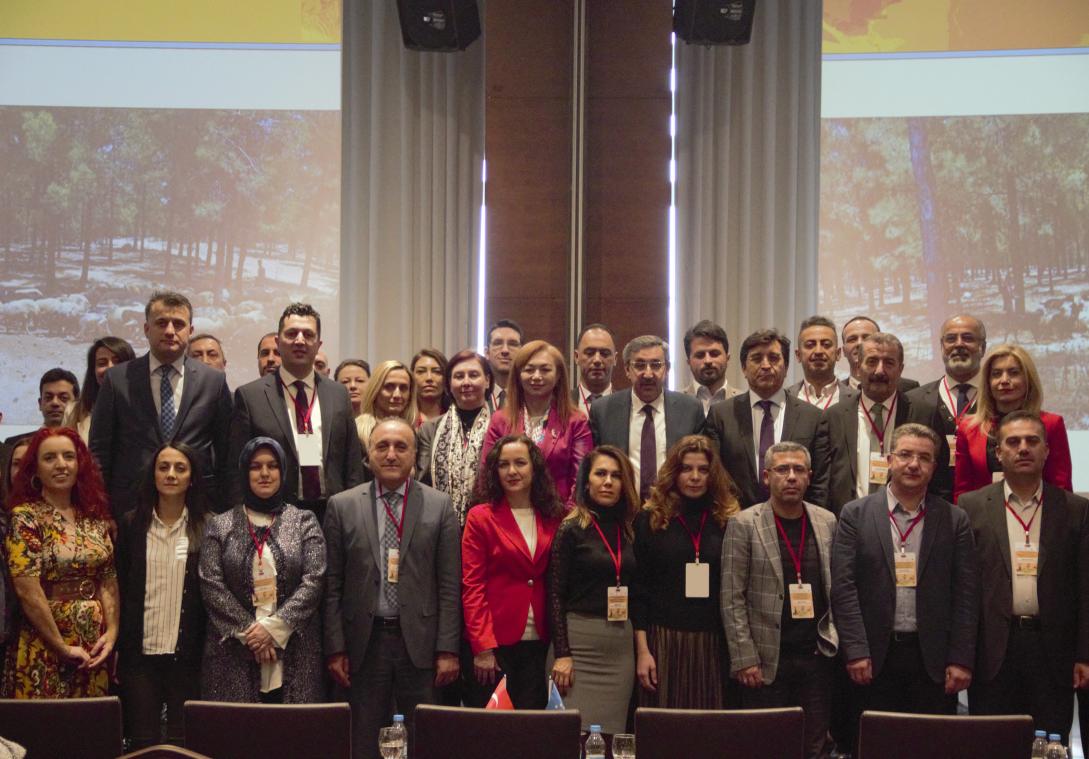
A €10 million project under the EU Facility for Refugees in Turkey is supporting now the refugee and host communities alike by increasing their chances on the labour market and through business opportunities in farming. The project is running in ten cities with a high presence of refugees. Feyhan Canbay, EU Delegation Programme Manager - Socioeconomic Development; Dr. Ayşegül Selışık, Assistant FAO Representative; Mr. Halil Afşarata, FRIT Chief Coordinator from the Vice Presidency Office; M. Fethi Güven, Head of Department for Technical Services of Turkish Chambers of Agriculture Representative, A. Volkan Güngören, DG EU and Foreign Relations Representative, Ministry of Forestry and Agriculture and Sadettin Akyıl, DG International Labour Force, Ministry of Family, Labour and Social Services attended the ceremony.
What is the aim of the project?
The European Union continues to support refugees in Turkey together with its partners. This €10 million project aims to foster the social and economic cohesion of Syrian refugees and Turkish host communities via increasing their employability through employment and entrepreneurship opportunities in agriculture. The 10 million project is implemented in 10 cities with high refugee population: Adana, Gaziantep, Hatay, İzmir, Kahramanmaraş, Kilis, Van, Mardin, Bursa and Şanlıurfa.
What is the scope of the project?
The project’s first main component is enhancing the self-reliance of the SuTP (Syrians under Temporary Protection), and host communities through increased employability. In this context certified vocational training courses will be organized in crop production, livestock and food sectors for 3 000 SuTP, and host community members. The project will target the ESSN (Emergency Social Safety Net) beneficiaries in the rural area for these vocational training courses as much as possible. After the training courses, graduates and the potential employers seeking skilled employees will be brought together on Job Fairs.
Furthermore, the Project will transfer knowledge and skills in new and improved climate-smart agriculture technologies to 1.500 smallholder farmers. Farmer Field Schools (FFSs) will assist participants to increase their production and create more employment. They will receive agricultural tools and a start-up package to test and learn the technologies of their choice.
This intervention also provides an opportunity for 1 500 SuTP to gain short-term employment through “cash for-work-plus (CfW+)” supporting participating farmers and their communities with land development activities (i.e. tree planting (agro-forestry), land levelling, soil and water conservation measures, terrace, water harvesting, irrigation channel and fish pond rehabilitation, etc.
The Project will establish agricultural employment desks in targeted provinces. The desks will facilitate the employment of the successful graduates of the vocational training courses and provide skilled labour to the local producers and agri-food industries by acting as a contact point between the employers and the workers.
The action will also seek to capitalise on existing entrepreneurial initiatives, to expand production and thus generate employment. To do this, a grant scheme is envisaged for indicatively 250 micro-scale entrepreneurial activities (2.190 Euro each) and 50 small scale activities (10.951 Euro each).
The pilot social insurance scheme will facilitate access of beneficiaries to social insurance by stimulating the demand and supply of services. The Project will provide a subsidy to pay for the first three months of employed beneficiaries’ insurance premiums.
On Economic and Social Cohesion
The Head of the EU Delegation to Turkey, Ambassador Christian Berger, said on the occasion: "The EU has been working with its partners to successfully develop projects in the fields of health, education, infrastructure, socio-economic support, and humanitarian assistance. The EU assistance reaches refugees in need while at the same time helping host communities face the challenges involved. Livelihood projects intend to give refugees the opportunity to work, be self-reliant and provide for their families, while learning skills that may open new doors for them in the future. This project aims to make a positive contribution to all communities involved."
Background
The Facility for Refugees in Turkey:
The European Union has been supporting Turkey in response to the refugee crisis since 2011. Initial support was in the form of Civil Protection and Humanitarian Aid (ECHO). Other EU financial instruments for medium- and long-term support were added later, responding to the protracted nature of the crisis. In January 2016 this support was substantially scaled up with the entry into force of the Facility for Refugees in Turkey.
Through the Facility, €6 billion has been committed to assist both refugees and host communities in Turkey, by providing assistance in key areas such as education, health, infrastructure, migration management, socio-economic development and humanitarian assistance.
The EU support to Syrians and host communities in the socio-economic sector focuses on skills development and employability, labour market access and integration of refugees. It includes also the Turkish population residing in communities with a high presence of refugees. The projects are intended to address current problems of Syrian refugees in the Turkish labour market, as well as to support host communities, Turkish institutions, local authorities and economies. Under the €6 billion the Facility for Refugees in Turkey allocates almost €1 billion to socio-economic projects.
For more information please contact:
Feyhan Canbay - Programme Manager, Facility for Refugees in Turkey
feyhan.canbay@eeas.europa.eu / T +90 312 459 87 00
For press inquiries:
Miray Akdağ - Press Officer for the Delegation of the European Union in Turkey
miray.akdag@eeas.europa.eu
M +90 532 624 93 56 / T +90 312 459 88 77


