Participation of the Official Delegation of the European Union to Dushanbe Water Conference
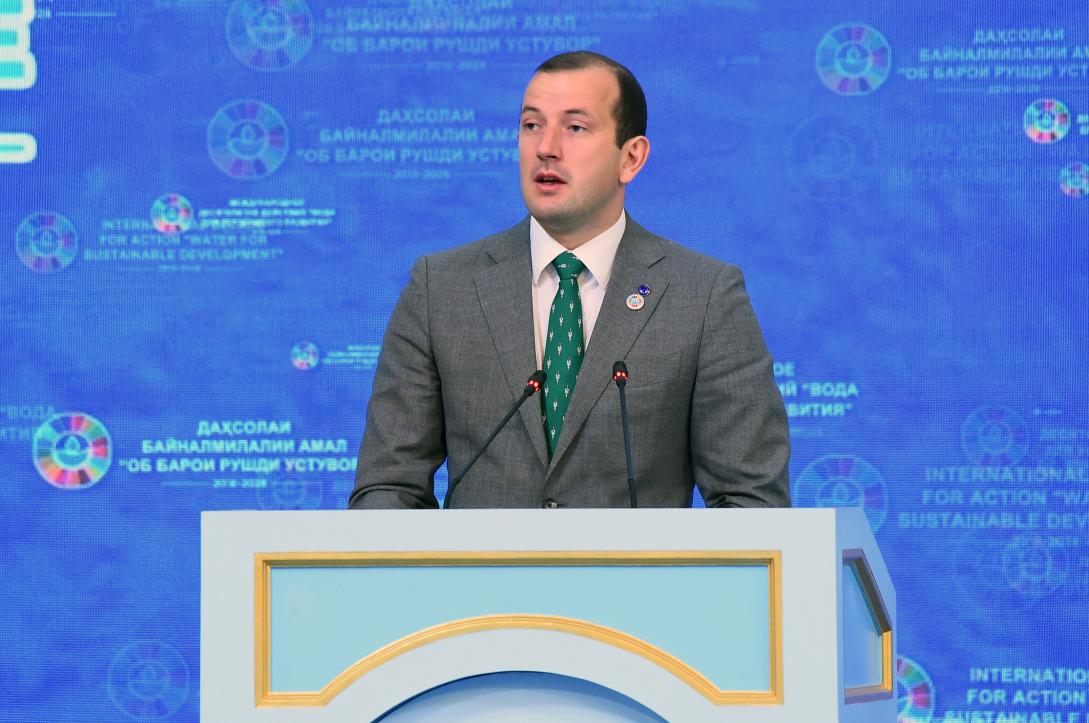
On 6-9 June, the European Union delegation led by Mr. Virginijus Sinkevičius, European Commissioner for Environment, Oceans and Fisheries, with Ms Terhi Hakala, EU Special Representative for Central Asia and Ms Marjeta Jager Deputy Director-General for International Cooperation and Development (INTPA) participated in the 2nd International High-Level Conference on International Decade for Action “Water for Sustainable Development 2018-2028” and also held bilateral meetings with representatives of the Government of Tajikistan and international partners and signed important water projects.
On 6 June 2022, Commissioner Sinkevičius opened the Youth and Children Water Forum that brought together representatives of youth, environment activists, government officials, and international organizations who discussed the role of young people and their view on urgent water problems and possible solutions. Commissioner called for managing the water resources in a much more efficient and sustainable way to address water scarcity and to ensure access to water and sanitation, as human rights. He called on the youth to be loud and daring and act now for a more environmentally sustainable future.
The Regional Water Cooperation in Central Asia Forum focused on opportunities and significance of transboundary cooperation. Comissioner Sinkevičius highlighted that “trans-boundary cooperation in the area of water and climate is of critical importance, if we want to prevent climate change and environmental degradation from becoming a source of new threats and instability. This is valid globally, but also in Central Asia”. In the panel dedicated to development partners, EU Special Representative Terhi Hakala noted that effects of climate change were already felt in Central Asia, and that to mitigate them “we will need to address both inclusive governance to achieve stable and sustainable development, and the investment into regional integration and green transition – two important dimensions of the SDG 6 Global Acceleration Framework. Access to clean water and energy is critical for economic growth and sustainable development, and that is as relevant to Central Asia, as much as it is across the globe.”
Ms Marjeta Jager Deputy Director-General for International Cooperation and Development presented the key orientations of the future Team Europe engagement in Central Asia, focusing in particular on green energy connectivity. In the opening of the Women Water Forum, she recalled that “barriers to gender equality and women’s empowerment are persistent and pervasive worldwide. They are also connected to water: girls and women walking to access water; limited or no water supply in school; no adequate access to menstrual hygiene management facilities. Women rights are human rights, and the more invest in gender aspects development, the more we encourage equality, empowerment and possibility for women to fully develop their potential.”
On 7-8 June, the EU Delegation took part in the High-Level Conference on International Decade for Action “Water for Sustainable Development 2018-2028”. In the Opening panel, Commissioner Sinkevičius stressed the importance of accelerating the process of achieving sustainable development goal on water. Pointing out the EU’s support, Commissioner Sinkevičius stressed “along with our Member States, we are launching a Team Europe Initiative on Water, Energy and Climate in Central Asia. Through it, we aim to promote transboundary and integrated water management as well as effective water governance in the region.”
In the margins of the Water Conference, Commissioner Sinkevičius held bilateral meetings with the Minister of Foreign Affairs H. E. Sirojiddin Muhriddin, with whom he discussed key environmental challenges and priorities in the area of water and energy in Tajikistan, as well as a broad range of regional and bilateral cooperation issues, including negotiations of new Partnership and Cooperation Agreement, GSP+, human rights, situation in Afghanistan and in Ukraine. Discussion with H.E. Usmonali Usmonzoda, Deputy Prime Minister, focused on green energy and regional energy connectivity. With H.E. Bahodur Sheralizoda, the Chair of the State Committee on Protection of Environment, EU-Tajikistan cooperation on water, climate change, energy, and regional cooperation was discussed. With key international partners, essential topics evolved around multilateralism, the green deal and environmentally sustainable water policies, on the way towards the UN Water Decade conference in 2023. UNDSG H.E. Amina J. Mohammed shared her vision from the UN perspective, SG of ECO H.E. Mr. Khusrav Noziri outline the connectivity options in the broader region. Bilateral meetings with Deputy Prime Ministers of Kazakhstan, Uzbekistan and Turkmenistan and Deputy Foreign Minister of Kyrgyzstan completed the picture of the Central Asia region.
The European Union has been one of the leading donors in the field of water – including irrigation, drinking water and sanitation, river basin water management. In the sidelines of the conference, two important water projects were signed by members of the EU delegation to the Conference: EU-EBRD “Kulob Water and Wastewater” project and EU-World Bank “Sustainable Water Irrigation Management” project.
Firstly, the Kulob Water and Wastewater is a project with total budget of 16.7 million EUR, to which the EU contributes with a grant of 8.4 million EUR. During her speech at the signing ceremony, Ms Marjeta Jager stated that “The project will focus on water supply and sanitation, addressing directly or indirectly all the elements of the WASH sector, which is a priority for the country. Both water supply and wastewater infrastructures in Kulob, the third largest city in Tajikistan, are currently severely deteriorated and in great need of improvement”.
Secondly, the EU-World Bank “Sustainable Water Irrigation Management” project that was signed by Ms Marjeta Jager and Tatiana Proskuryakova, World Bank Regional Director for Central Asia, will help strengthening capacities for water resources planning and irrigation management as well as supporting improved performance of selected irrigation schemes in the Vakhsh and Zarafshon river basins. The EU will contribute with EUR 17.5 million in addition to the USD 30 million from the World Bank.