
Remarks by the EU Ambassador Peter Cavendish - Technical Workshop on Advancing Digital Payments & Financial Inclusion across the Eastern Caribbean
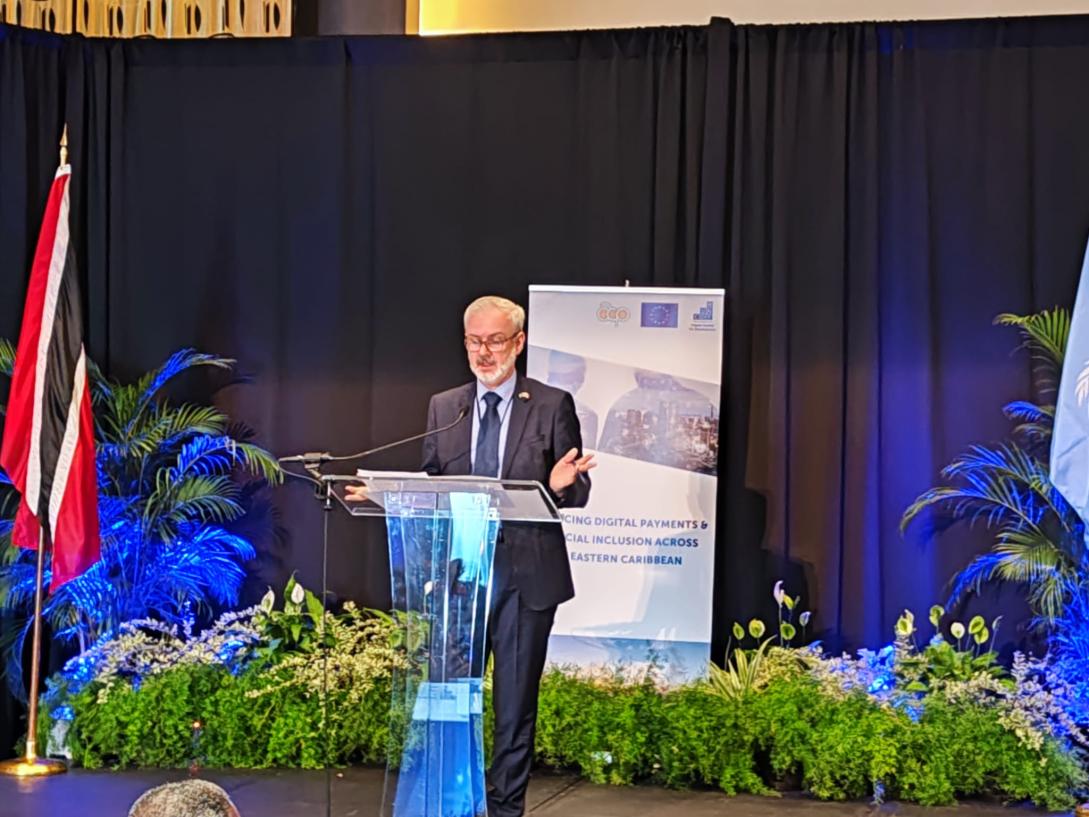
[Salutations]
We in the European Union have nearly five decades of close partnership with the nations and regional institutions of the diverse Caribbean. A partnership that has led and will continue to lead to many successes.
Last October the first Ministerial meeting between the EU and the Caribbean countries in over 5 years was held in Barbados, with the participation of the EU Commissioner for International Partnerships.
The Ministerial Meeting also served as the launch of the new way of engaging our EU support with the Caribbean, which under the new Post-Cotonou Agreement moves away from purely donor-recipient model to a partnership among equals. This is translated into groundwork by the establishment of three Caribbean-EU Partnerships:
- The Partnership for a Caribbean Green Deal;
- The Partnership for Economic Resilience and Trade; and
- The Partnership for Governance, Security and Human Development.
Together, these partnerships lay the framework for a greener, more sustainable, and more resilient Caribbean region.
These partnerships are not only based only on words. They are part of the EU’s EUR 300 billion infrastructure investment strategy: Global Gateway.
With Global Gateway we foster partnerships with countries around the world – on digital, green, health, transport, education and research.
Global Gateway is delivered by Team Europe, which combines the resources and expertise of the EU, its 27 Member States, and their financial institutions, such as the European Investment Bank.
This means the Caribbean region will have access to the full scope of the EU’s economic, social, and political knowhow, and will be a catalyst for growth.
The Ministerial Meeting also paved the way towards the reinvigorating of our relationship with the broader Latin American and Caribbean region in a Leaders’ Summit, EU–LAC, in July this year - the first since 2015.
Digital is one of the new pillars of support of the EU with partner countries. Today more than ever, digital technologies have a central role to increase access and usage of affordable financial products and services that meet people and business needs as well as accelerate economic recovery from the coronavirus pandemic. The access to digital finance and infrastructure is a major determinant of how resilient societies and businesses are in the face of the shocks caused by the pandemic. Cooperation on digital technologies is a priority in the effort, given the region’s need for greater connectivity.
In that regard, the European Union - Latin America and the Caribbean Digital Alliance constitute a comprehensive political and cooperation framework for digital engagement with the region.
I would like to share three examples of specific projects:
- Counter Terrorism Technology Programme - Trinidad and Tobago has been identified among the five partner countries that will receive specific tailored capacity building assistance on policy development and application of law enforcement capabilities assessment framework. Trinidad and Tobago selection has been made on the basis of several criteria (participation in regional consultations and the early and strong expression of interest in receiving assistance by GoRTT, but also threat assessment and T&T’s level of digital advance).
- The Latin America and Caribbean Cyber Competence Centre (LAC4), established in 2022 LAC 4 is a training and knowledge hub for sharing EU’s collective expertise and building up regional capacity and collaboration in cybersecurity and cybercrime. The hub’s physical training facility is located in Santo Domingo, the Dominican Republic. The hub is offering:
- state-of-the-art hybrid training facility, digital forensics lab and cyber assessment range;
- capacity to develop and provide technical, policy and strategic level courses and simulation;
- a platform for doctrine development and research coordination; and
- a channel for cyber capacity building projects, training modules and materials developed in the EU.
- Finally this project to ‘Accelerate Digital Financial Inclusion’ that has led to this workshop today. Beyond than the noble objective of financial inclusion, Digital Financial Services can have an important impact on regional integration by increasing trade among Caribbean countries.
The project will also enables digital cooperation with the EU market. The EU’s unique experience in consolidating its Digital Single Market provides an example of how digital transformation can benefit citizens while supporting business through increased market integration.
Also at this time, I have to mention the BELLA project. BELLA stands for bridging the link between Europe and Latin America. The EU with partners has constructed a super conductivity cable stretching from the EU to Brazil and this cable is to be extended with the aid of partner countries across Latin America and to Panama and the Dominican Republic. This will allow third level bodies to exchange any amounts of data for research into all of the challenges of our era. International companies requiring access to research will be able to relocate research facilities to this region.
Further, the Erasmus+ programme, with an allocation of EUR 15 M is currently open to calls for proposals from the third level in T&T to build educational capacity at third level, including in the digital domain.
Let me present you more into detail the EU Digital Single Market
The Digital Single Market is a top priority of the European Union. In the eyes of many, it represents a panacea to the European economy and a fresh push for the largest unified consumers' market area in the world.
The strategy contains a roadmap for EU member states, setting milestones for the process of harmonization and removing barriers in particular areas of e-commerce, geo-blocking, copyright frameworks, and sales taxes.
Let me share with you two very concrete examples:
- The Geo-blocking regulation adopted by the EU in February 2018 prohibits any attempt to restrict consumers’ access to goods and services on e-commerce websites on the basis of their nationality or country of residence and establishment. The customers will be entitled to order the product and services irrespective of their place of connection and without having to pay additional fees.
- End of Roaming charges; the elimination of retail roaming charges effective June 2017. It means that mobile users periodically traveling in the EU are able to call, text and access the Internet on their domestic tariff.
The EU estimates that bringing down digital barriers within Europe could contribute an additional EUR 415 billion to the EU´s GDP. It would also create hundreds of thousands of new jobs.
Finally, we have been very encouraged by the strong progress by the Government of the Republic of Trinidad and Tobago on advancing its digital finance goals. In particular, the Government has employed a unique approach to drive its agenda, with several achievements to date since establishing the agenda in late 2020.
Only yesterday I was very impressed to attend the launch of more ways to pay where the Housing Development Corporation, under female leadership, explained the new digital options for tenants to pay for their housing. This is just one example of how this dynamic twin island republic is able to move forwards.
The Managing Director of HDC shared a part of her dream for this country with me “Imagine the day when everyone pays for doubles digitally”.
I look forwards to other examples that may be directly and indirectly linked to this programme!
-END-