
EU Ambassador Deike Potzel: ‘What happens in Geneva is fundamental to us’
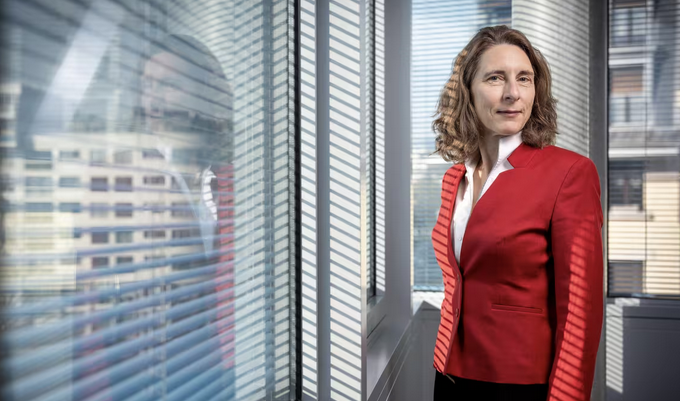
Two months in since arriving in Geneva to lead the European Union’s diplomacy at the United Nations, German diplomat Deike Potzel stresses how closely EU values align with international Geneva’s brand of multilateralism, while arguing that the UN must be reformed so it can perform better.
Deike Potzel took up her post as the EU’s new ambassador to the UN in Geneva in early September. A German career diplomat, she brings years of experience in multilateralism. Potzel couldn’t have picked a more turbulent time to enter the Geneva fray – funding troubles shaking the multilateral system, relocations and Washington’s retreat from the multilateral stage. She shares her vision and hopes with Le Temps.
Le Temps: Ukrainian, American and European officials were in Geneva recently to discuss the US peace plan for Ukraine, which appears to reflect Russia’s maximalist position. What are the EU’s red lines?
Deike Potzel: This is a crucial and important question, because it is intricately linked to Europe’s security and safety. We welcome the efforts made by the United States. It is good to see movement, because what we want and what we need – above all, Ukraine – is a lasting and stable peace. We want this war to end. We want the killing and destruction to end, and to prepare for a safe, secure and prosperous future for Ukraine and the Ukrainian people.
It is also important that all actors are at the table, and that Ukraine has the opportunity to be heard and have its interests visible in any plans. We have said time and again that Ukraine’s sovereignty and territorial integrity must be safeguarded, that its concerns must be heard, and that accepting the shifting of borders by force is out of the question – as should be with any war of aggression. Russia invaded Ukraine and is attempting to alter the borders. That is a clear violation of the UN Charter and of the principle of territorial integrity and sovereignty. This is unacceptable for us. That is why we continue to strongly support Ukraine, financially and militarily, but also politically.
You have only been in Geneva since early September. Do you already see signs of Russia’s hybrid warfare against the EU, and are you in touch with your Russian counterparts?
We have a no-contact policy with Russia because of its war of aggression in Ukraine. In Geneva, it doesn’t play out in the form of cyberattacks, but it is nevertheless a major topic in discussions at UN agencies such as the World Meteorological Organization and the International Telecommunication Union, where climate, safety and security data are critical. The EU is deeply concerned about this. We continue to alert other countries to what is happening, stressing that it is unacceptable and threatens our security.
The United Nations is going through a serious crisis. In response, it launched the UN80 process, involving budget cuts and reforms. Can this restore the UN’s credibility?
This reform process is an opportunity, and we must seize it, because we want a UN that truly delivers for people in need all around the world – a UN grounded in the Charter, the Universal Declaration of Human Rights, the principles of the Pact for the Future and the Sustainable Development Goals. On that basis, the UN must become more efficient, effective and impactful.
But UN80 cannot just be a financial exercise. It must also be political, strategic and visionary. It must focus the different agencies on their core mandates and avoid duplication in the system. It also requires a stronger commitment from all member states. We are in constant talks with our partners to move this process forward, which naturally generates a great deal of discussion. Important progress has been made in humanitarian reform, and other organisations, such as the World Health Organization, have also taken impressive steps.
Yet in Geneva, observers feel that UN80 is essentially budget-cutting and that agency heads are more concerned about their own futures than that of the UN.
This process must not be only about staff reductions. It really needs to be about how projects are run, how work is carried out and refocus on normative work in each organisation and on impact on the ground. So, it is an opportunity that we need to seize – not least because we know funding will not return to previous levels. The organisation needs to become leaner, more agile and more efficient.
We want to see UN agencies collaborate based on their distinct added value. That means bringing together humanitarian, development and peace actors in the field so they work better together. For instance, development and peace actors should be brought in from the beginning to ensure real coherence. We also feel that the ownership of host countries over UN operations can be strengthened. This should lead to more locally led projects that buy locally. The result will be lighter, cheaper projects that stimulate local economies and support national development.
The 17 SDGs are meant to be reached by 2030, but are far off track. Can we still correct the course?
We are not where we should be – that is a fact. But that should be a wake-up call because we agreed to the SDGs. They are still our guiding light. It was right to set ambitious goals.
The EU remains committed. We are one of the largest donors in the multilateral system. Around 25 per cent of the UN’s regular budget comes from Europe. Together, the EU and its member states also provide more than one third of all financial contributions to UN agencies, funds and programmes. We have a strong interest in a functioning multilateral system and a well-performing UN. In the same spirit, we support many NGOs.
This conviction stems from our own experience. To me, the EU is truly a wonderful peace project after everything this continent has lived through – the Second World War, the destruction we saw, a complete redefinition of values and principles, the atrocities that happened, which led to the dismantlement of our human relations. And now have reached a point where we live together in peace and friendship despite our differences. The fact that Germans and the French can shake hands again is a miracle. It is wonderful.
Doesn’t international Geneva embody the values the EU has championed since its creation?
As I said, international Geneva is grounded in the UN Charter and the Universal Declaration of Human Rights – and that’s 100 per cent what the EU strives for. They are our core principles. What happens in Geneva is of fundamental importance to us.
Geneva prides itself on being the world’s humanitarian capital. Yet severe cuts have hit organisations from the UN Refugee Agency, the UN relief agency, to the International Committee of the Red Cross. Experts now speak of a so-called humanitarian reset. Is this a revolution?
We had all hoped the number of humanitarian crises would decrease. Sadly, the opposite is happening. Sudan is a stark example – the atrocities and suffering are immense. There is a huge need for strong humanitarian action, not only from UN agencies but also from NGOs. But we have to admit that some crises have dragged on for 10, 15, 20 years, and all these efforts have not led to real improvements on the ground. Political will plays a major role, of course, but the system is also not able to induce change. There have been calls for reform. There have been proposals for years, and the time has come to implement them. Some argue that simply managing endless crises without being able to resolve them is not what the system should aspire to.
Is the EU still financially committed to humanitarian action?
The EU is one of the largest contributors to some UN agencies. With the US withdrawing, we may well become their biggest. We remain committed to principled humanitarian assistance and to helping people in need everywhere.
What about international Geneva’s ecosystem? Its dense interconnectedness is both a strength and a vulnerability: tug one thread, and the fabric can begin to unravel.
UN agencies are very happy with Geneva’s ecosystem; they see their proximity as a real asset. When we talk about relocating certain posts, this is about streamlining processes but it needs to be done with care. Geneva must remain a strong international hub.
Budget cuts in Geneva have been painful. How do you see the future of multilateral funding?
Multilateral funding is a challenge across the board – for all member states. We have long said the current situation is unsustainable. Up until now, 60 per cent of humanitarian funding came from essentially three donors: the US, Germany and the EU. That is not viable in the long term. We need to broaden the donor base – more countries, but also philanthropy and international financial institutions. What reassures me in Geneva is hearing that multilateralism must be strengthened, and that we cannot afford to lose the UN.
With the US pulling back from the multilateral stage, can the system still function – and what role can the EU play?
Colleagues from around the world tell me that there are high expectations of the EU. This is an opportunity for the EU and its member states to stand up for their principles and values, and we continue to do so, including at the Human Rights Council. But I would add that the US remains a key partner with whom we work closely.
The rules-based liberal order has been in place for 80 years. Is it under threat? Should it prevail?
This international order is, in our eyes, a precious asset. Within the EU, we understand how vital it is for the prosperity and security of our citizens. That is why we will keep defending it. But we also have a duty to explain to people the benefits it brings: why a pandemic treaty can reduce global deaths; how the Human Rights Council helps tackle violence against women and girls online; how the International Labour Organization improves life in the workplace; or how data processed by the World Meteorological Organization shapes maritime and air traffic. We must make sure this is understood by citizens worldwide.
This article was originally published in French in Le Temps. It has been adapted and translated into English by Geneva Solutions.


