
EU holds dialogue with the UN Committee on the Rights of Persons with Disabilities
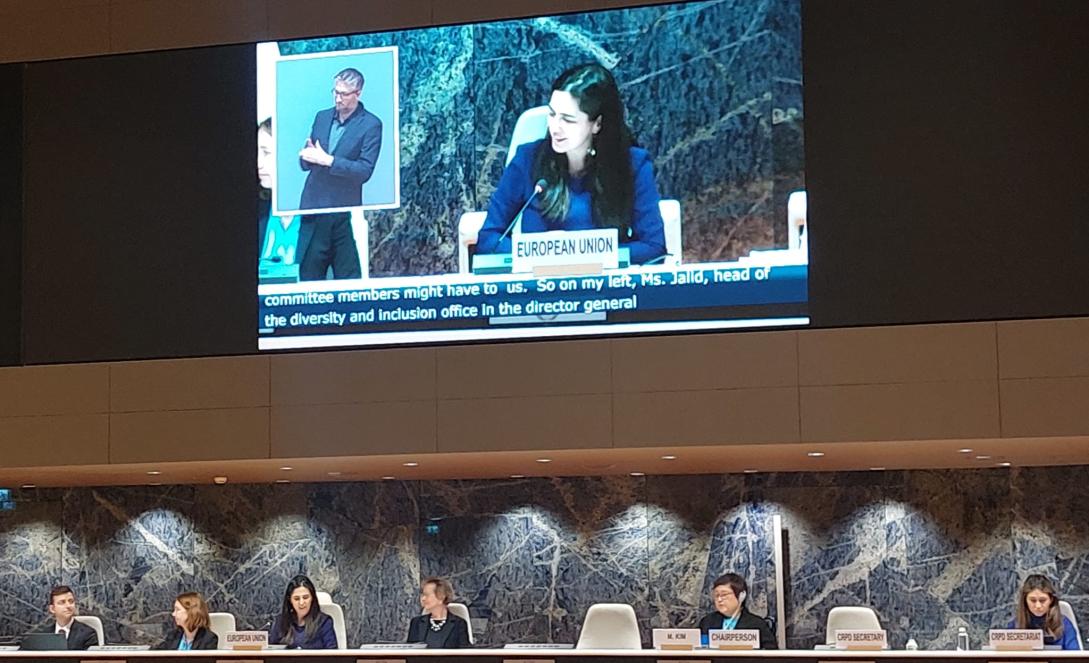
The EU Commission delegation attending the review, which was held at the UN in Geneva, was led by Ana Carla Pereira, Director for Equality and Non-Discrimination of the EU Directorate-General for Justice and Consumers. Officials from the European Ombudsman, the Fundamental Rights Agency and the European Disability Forum as well as the additional participants from the EU Member States were also present.
In her opening video message, Commissioner for Equality, Preparedness and Crisis Management, Hadja Lahbib, underlined the EU’s commitment to ensuring and promoting human rights and fundamental freedoms of all persons with disabilities, in line with its competences, through legislation and policies. She referred to the United Nations Convention on the Rights of Persons with Disabilities (CRPD) as ‘our common beacon in this respect’, emphasizing that the issue of equal rights relates to every single area of the life of a person with a disability.
Commissioner Lahbib outlined how for the past 15 years, implementing the Convention had been part of all disability policy across the European Union, in institutions and Member States.
Ana Carla Pereira, Director for Equality and Non-Discrimination, Directorate-General for Justice and Consumers, said the European Union strategy for the rights of persons with disabilities 2021-2030 was the main policy framework for the implementation of the Convention at the European Union level.
Accessibility continues to be one of the EU’s utmost priorities, as accessibility is an enabler of rights and a prerequisite for the full participation of persons with disabilities on an equal basis with others in society. The European Accessibility Act, adopted in 2019, is a landmark achievement in the area since the latest UN review in 2015. The Act sets accessibility requirements for certain important products and services of everyday use in the EU internal market. Accessibility obligations are also included in several other acts such as the 2016 Web Accessibility Directive. Furthermore, to stimulate convergence and coherence, the Commission has launched AccessibleEU, in 2023 as a flagship of the Strategy. AccessibleEU is the EU resource centre on accessibility, and it is already reaping great results by enabling training accessibility professionals, sharing promising practices and promoting the development of tools and standards.
The EU also adopted a directive establishing the European Disability Card and European parking Card for persons with disabilities, which will facilitate the free movement of persons with disabilities. The cards will become operational as of 2028.
The constructive dialogue with the Committee covered most of the articles of the Convention and included discussion on various areas such as equality in access to information, the rights to privacy, access to justice, accommodation for persons with disabilities in emergency response plans, measures to ensure persons with disabilities could live independently, and issues relating to health, work and employment for persons with disabilities. The dialogue also addressed how the EU leads by example as a public administration.
Ms. Pereira, in concluding remarks, stated once more the EU joint commitment to act together under the UNCRPD to advance the rights of persons with disabilities. The Commission will make sure to enact the recommendations of the Committee as part of its efforts to implement its Strategy on the rights of persons with disabilities.


