
Holocaust Remembrance for Dignity and Human Rights
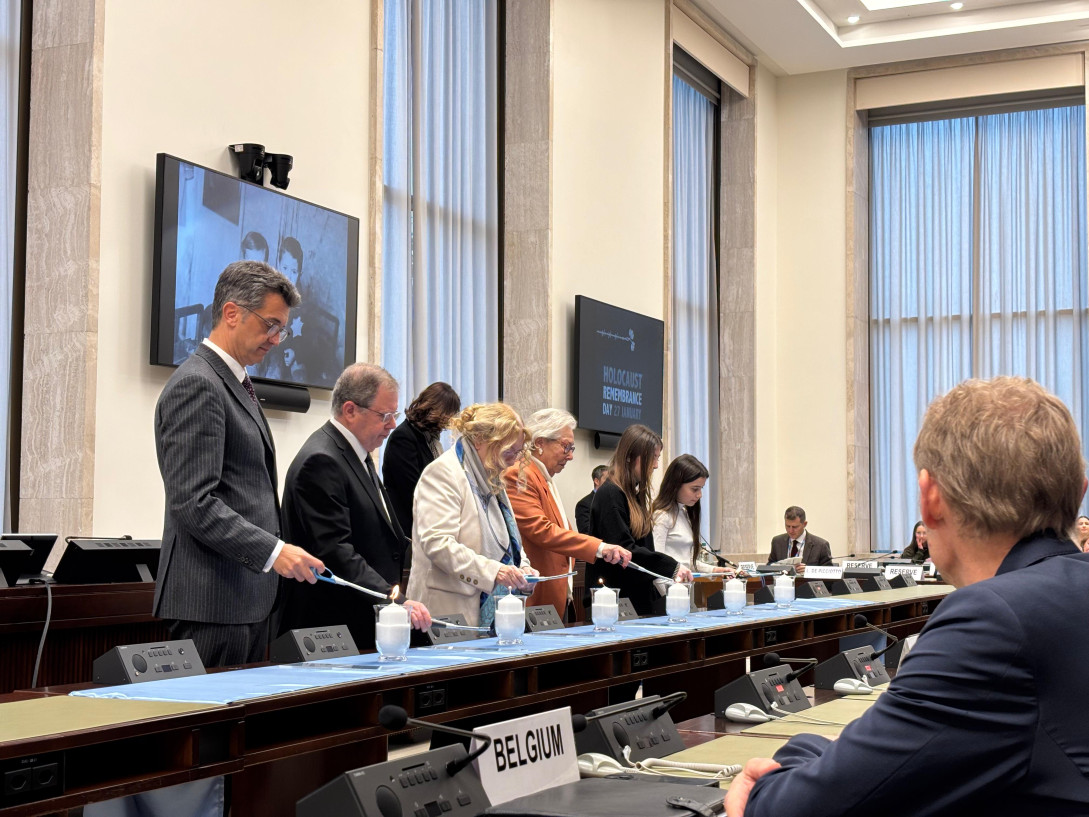
Held at the Palais des Nations, the ceremony paid tribute to the six million Jewish men, women, and children murdered during the Holocaust, as well as the hundreds of thousands of Roma and Sinti, persons with disabilities, political opponents, LGBTQI individuals, and all others persecuted and killed by the Nazi regime and its collaborators.
The event opened with a video message from UN Secretary-General António Guterres, followed by remarks from Ms. Tatiana Valovaya, Director-General of the United Nations Office in Geneva, who emphasized the responsibility of the international community to preserve memory and translate remembrance into action in defence of human dignity.
“We owe it to the victims of the Holocaust and their families to push back against the intolerance and hatred we see in our world today. Diversity is a richness, not a threat. We need greater solidarity, a renewed focus on our shared humanity, and a firm commitment from all of us to promote a culture of peace and human rights.” Tatiana Valovaya, Director-General of the United Nations Office in Geneva
Ambassador Daniel Martin Meron, Permanent Representative of Israel to the United Nations Office at Geneva, highlighted the enduring impact of the Holocaust on Jewish communities and warned against the dangers of Holocaust denial, distortion, and the alarming resurgence of antisemitism.
Speaking on behalf of the European Union, Ambassador Michele Cervone D’Urso, Deputy Head of the Permanent Delegation of the European Union to the United Nations Office at Geneva, underscored that Holocaust Remembrance Day is not only a moment of mourning, but a moment of responsibility. He warned against the trivialisation of the Holocaust in public discourse and stressed the direct link between remembrance, the defence of human rights, and the foundations of the multilateral system.
“The Holocaust was not an accident of history, It was the outcome of systematic dehumanisation and the collapse of moral and legal restraints. Never again is not a slogan. It is a duty.” EU Ambassador Michele Cervone d’Urso
He highlighted that the creation of the United Nations and the development of the international legal order were profoundly shaped by the lessons of the Holocaust, and that the post-war commitment to accountability and justice was intended to ensure that mass atrocities would never be repeated. He also reaffirmed the EU’s commitment to combating antisemitism and fostering Jewish life, notably through education, research, and remembrance, which are central pillars of the EU Strategy on combating antisemitism and fostering Jewish life (2021–2030). Between 2010 and 2025, the European Commission has supported the European Holocaust Research Infrastructure with over EUR 26 million, reinforcing the EU’s long-term commitment to preserving memory.
“The alarming rise in antisemitism has been matched by a surge in racism, intolerance, and hatred. This is why this year’s Holocaust Memorial Day carries even greater urgency. Remembrance is not only about honouring the victims, is it also a warning to the living of where hatred, denial, and indifference can lead.” EU Ambassador Michele Cervone d’Urso
A central moment of the ceremony was the testimony of Holocaust survivor Ms. Leonie de Picciotto. With striking clarity and emotional strength, she recounted her family’s persecution under the Nazi regime, explaining how she was hidden and protected by the Dutch resistance while her parents and other family members were deported to the Bergen-Belsen concentration camp. Their eventual reunion after the war made her testimony a powerful story of survival and hope.
Reflecting on why she continues to share her story, Ms. de Picciotto reminded the audience that she was not statistically supposed to survive. As a Jewish child under Nazi persecution, her chances of survival were extremely limited, and without the intervention of the Dutch resistance, she would almost certainly not have lived. Precisely because she lived, she explained, she feels an obligation to give back to society and to do good. She called on everyone to become an “upstander” — someone who does not remain silent, but stands up against antisemitism, racism, and discrimination wherever they appear.
All speakers were then invited to light candles in remembrance of the victims, followed by a minute of silence observed by everyone present in the room, creating a powerful collective moment of reflection and tribute. The ceremony concluded with a musical performance by Sergey Ostrovsky, accompanied by violinist Eliron Czeiger.