
Human Rights Council adopts 43 resolutions, five of them led by the European Union
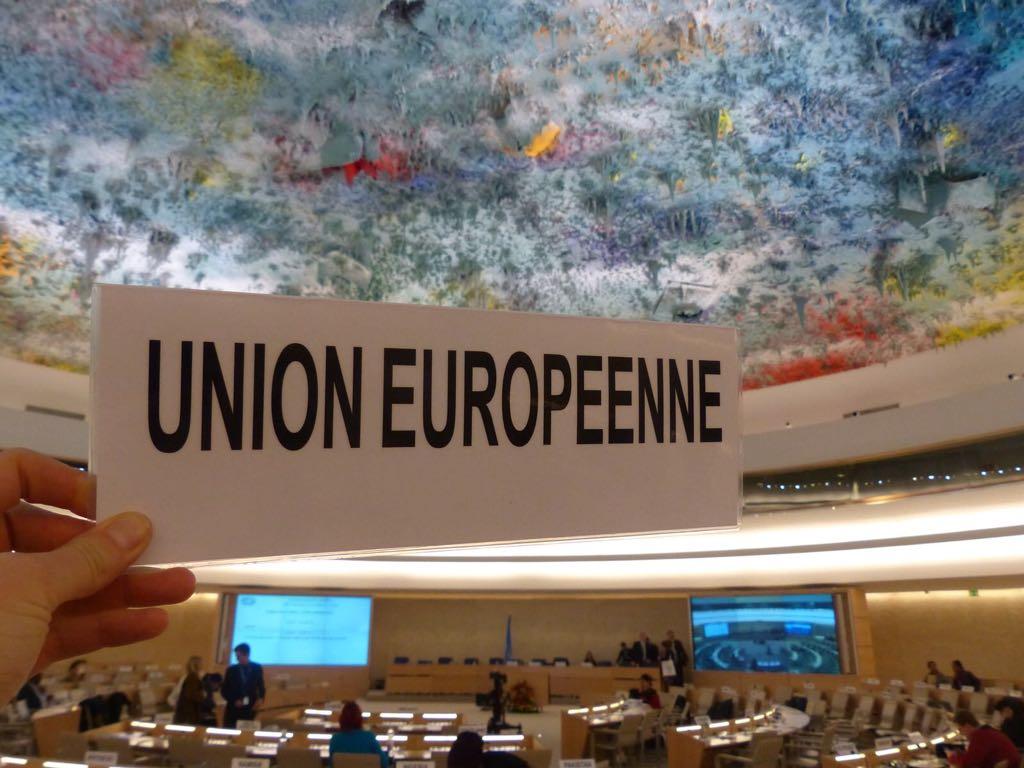
2023 marks the 75th anniversary of the Universal Declaration of Human Rights. The EU stands united as a staunch supporter of the United Nations human rights system, and will continue to stand up for human rights as a priority of its external action.
During the 52nd session of the Human Rights Council, the European Union presented the following resolutions:
- A resolution on Belarus to address the further deterioration of human rights situation and violations of international human rights law in the country. The resolution renewed the mandate of the High Commissioner to continue with examination of human rights violations in the run-up and the aftermath of the last presidential elections, with a view to facilitate holding those responsible fully accountable and bringing justice for victims. The number of arbitrary detentions and arrests of peaceful protesters in Belarus has reached an unprecedented scale. Given the extent and severity of the human rights violations committed and total lack of accountability, it is indispensable that the Human Rights Council continues its scrutiny.
- The resolution North Korea (DPRK) draws attention to the deteriorating human rights and humanitarian situation in the DPRK and allows support for the work on accountability. Furthermore, the resolution renews for one year the mandate of the Special Rapporteur as well as for two years the capacity of the OHCHR including its field-based structure in Seoul. It is the responsibility of the Human Rights Council to ensure that the egregious human rights situation in North Korea continues to be addressed decisively. We hope that this resolution will contribute to accountability for the human rights violations committed by the government.
- Myanmar is a country in freefall. The responsibility for this lies fully with the Myanmar military, which commits the worst atrocities to stay in place. The resolution led by the EU and adopted by the Council condemns in the strongest terms the violence inflicted by the military on the people of Myanmar. The resolution renews the mandate of the Special Rapporteur for one year and expresses continued support for accountability processes, including the Independent Investigative Mechanism on Myanmar as set up by the HRC.
- The promotion and protection of the right for everyone to freedom of religion or belief remains a key priority for us . We are witnessing a rise in hate speech on social media and elsewhere, and the recent incidents of religious intolerance in various countries around the world are visible consequences of populism in hate speech targeting persons belonging to religious and other minorities. This worrying trend requires closer attention by states, who have a primary duty to protect all individuals. The EU-led resolution urges States to step up efforts to promote and protect freedom of thought, conscience & religion or belief.
- We were pleased to partner again with our GRULAC friends on the resolution on sale and sexual exploitation of children. The resolution renews and strengthens the mandate of the Special Rapporteur on the sale, sexual exploitation and sexual abuse of children. No child should face such horrors.
The EU also actively supported resolutions led by other States. We fully supported the resolution led by Ukraine on the situation of human rights in Ukraine stemming from the Russian aggression, which renews the mandate of the UN Commission of Inquiry. Collecting, preserving and analysing evidence is essential in view of ensuring accountability for the atrocities that are being committed in connection with Russia’s aggression against Ukraine. To those who claim that this resolution will lead to further polarization, or that it is politicizing human rights, we would like to emphasize once again that there is only one aggressor in this war. It is Russia that is blatantly violating the principles of sovereignty and territorial integrity and the prohibition against the use of force that are the foundation of the UN itself. By adopting this resolution, this Council is in fact upholding the UN Charter, not politicizing it. To address situations of violations of human rights, including gross and systematic human rights violations, and to make recommendations thereon, is an integral part of this Council’s mandate.
The EU firmly supported the mandate of the Special Rapporteur on the situation of human rights in Iran, renewed by the Council in this session. We urge Iranian authorities to cooperate with him and the Fact-Finding Mission, and facilitate their access to the country.
We fully supported the resolution on the human rights situation in Syria and its emphasis on accountability and justice, as well as its continued attention to the fate of missing persons. The resolution extends the mandate of the UN Commission of Inquiry by one year.
In view of the latest appalling developments especially with regard to those forcibly displaced and arbitrarily deprived of their Nicaraguan nationality, we believe it necessary to continue giving high visibility to the human rights situation in Nicaragua, which was addressed in a resolution during this session.
The human rights situation in Haiti continues to deteriorate and we welcomed the initiative taken by Haiti to present a resolution on technical assistance & capacity-building. This will allow the UN Human Rights Office to strengthen its cooperation with Haiti and to provide recommendations.
We remain concerned for ongoing human rights violations in Libya. We welcome the assistance of the UN Human Rights Office to strengthen Libyan capacities to follow up on the work of the Fact Finding Mission.
We also lend full support for a resolution on advancing human rights in South Sudan.
Human Rights Defenders play a pivotal role in the protection and promotion of human rights, often putting themselves at great personal risk. We strongly supported the renewal of the critically important mandate of the Special Rapporteur on the situation of Human Rights Defenders.
All human rights are equally important to ensure human dignity, whether civil, political, economic, social and cultural rights. The EU therefore welcomed the adoption of several other thematic resolutions, including the right to food and adequate housing. We also welcomed the adoption by consensus of the human right to a clean, healthy and sustainable environment.
Racism, racial discrimination and xenophobia are an affront to human dignity. They have to be overcome. The EU therefore supported both the renewal of the mandate of the Special Rapporteur on Racism and of the International Working Group on the Durban Declaration and Programme of Action.
Freedom of opinion and expression are fundamental rights of every human being. We therefore fully supported this important resolution.
We are strongly committed to ensuring respect for the absolute prohibition of torture and ill-treatment. We therefore fully supported this resolution.
The EU also delivered and supported several Joint Statements during this session. The EU-India led Joint Statement on Youth galvanised solid cross-regional support with 92 countries in total and drew attention to the importance of young persons, especially girls and young women, as powerful agents of change in our societies and the protection of young activists and human rights defenders. The EU also led a Joint Statement on women’s and girls' rights in Afghanistan, which gained the cross-regional support of more than 70 states.