
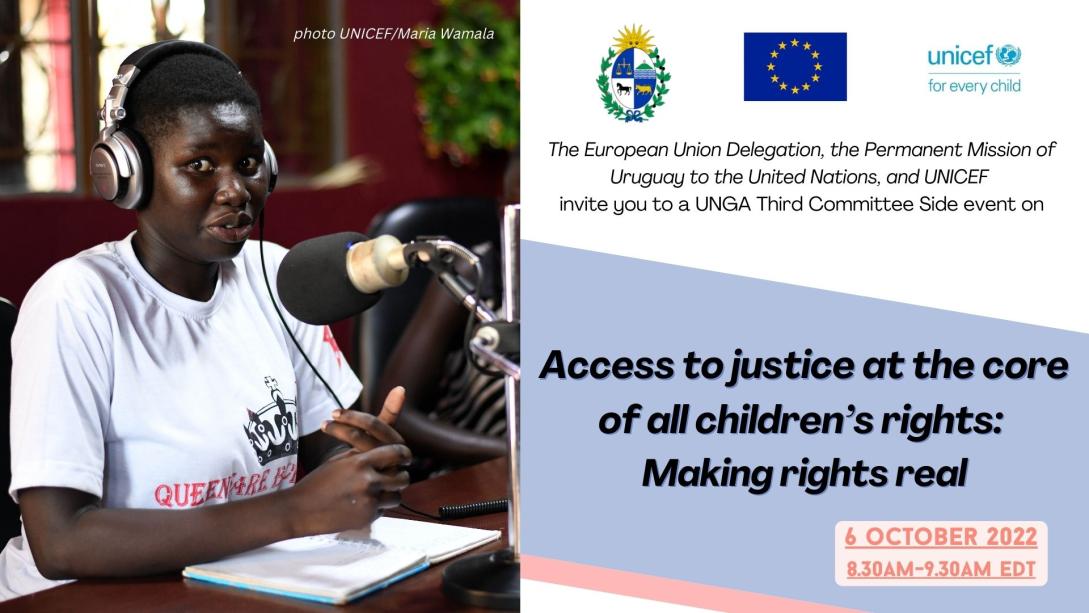
Access to Justice at the Core of All Children's Rights: Making Rights Real
Moderated by: Meg Gardinier, Secretary General of ChildFund Alliance
Background
The Delegation of the European Union and the Permanent Mission of Uruguay to the United Nations, together with UNICEF, will host in the margins of the Interactive Dialogue of the Third Committee on the promotion and protection of the rights of the child, an online panel discussion with a specific focus on “Access to justice at the core of all children’s rights: Making rights real”.[1]
Access to justice is a fundamental right in itself. Being able to seek and obtain remedy when one’s rights are violated, including in the context of the digital environment, is both a right and a means to enforce rights put forth in international, national norms and standards including the Convention on the Rights of the Child. The right to remedy, to an effective remedy, as provided in Article 2 (3) of the International Covenant on Civil and Political Rights, is at the very core of a human rights approach and hence a child-rights approach. It is also central to the realisation of the full spectrum of children’s rights- civil, political, social, economic and cultural.
Yet, while millions of children have their rights violated every day,[2] only a fraction come forward and seek redress and even fewer obtain an effective remedy, hence being denied their status as full-fledged rights holders. This is due to several factors, including a lack of child rights awareness and limited knowledge about the tools that are available to access justice. Many of the obstacles children face in accessing justice are in fact either specific to children or greater for children, who often depend on adults to obtain information and navigate complex administrative and judicial systems. Procedures are generally not adapted to children; legal aid is insufficient; support services are rare; and social norms (i.e perceived informal, mostly unwritten, rules that define acceptable and appropriate actions within a given group or community)[3]often make it difficult for children to seek redress [4].
Access to justice for children: what does it entail?
Access to justice requires that children can access timely and effective remedies in response to violations of their rights.
For that to happen, children may require a range of support services when their rights have been violated or their entitlements denied, including financial, educational, social, health and psychological support in tandem with legal assistance. [5] In addition, children must be able to access relevant information, including through legal and other services, child rights education, and support from informed adults[6] while adults and institutions must be child friendly, child sensitive and knowledgeable about the full spectrum of children’s rights.
Access to justice can be achieved through litigation and other forms of formal dispute resolution, as well as through other means outside of formal judicial systems (i.e non-judicial and quasi-judicial avenues).
In that context, the role of independent human rights institutions is critical as they may have the power to consider complaints submitted by or on behalf of children and conduct investigations. They may also provide support to children taking cases to Court, whether directly on behalf of child complainants or as an intervener in ongoing proceedings.
Objectives
The proposed online event will serve to prompt a discussion on the role of Governments and other stakeholders in supporting children’s access to justice. It will bring together a diversity of speakers with experiences and perspectives on child rights education and the legal empowerment of children, children’s access to remedies, children acting as human rights defenders, and the role of independent child rights institutions. It will shed light on some of the avenues and support that are available to children, how these can produce life-changing outcomes, and what more should be done.
Agenda
- Introduction and welcome by moderator (Meg Gardinier, Secretary General of ChildFund Alliance; five minutes)
- Opening statements by UNICEF, the European Union and Uruguay (10 minutes)
- Intervention from keynote speaker: Ms Mikiko Otani, Chairperson of the Committee on the Rights of the Child (five minutes)
- Panel (20 minutes):
- Overview on what access to justice for children entails– Professor dr. Ursula Kilkelly, Professor in children's rights and youth justice at University College Cork
- Child rights core competencies approach for justice personnel–Mr.Théophane Nikyèma, President of the International Bureau for Children’s Rights
- Legal empowerment of, and for children: experience sharing– Yu Cheng, 17 years old from Malaysia
- Independent institutions with a child rights mandate, and their role in supporting children’s access to justice–Commissioner Angie Makwetla, South African Human Rights Commission, Responsible for Children’s Rights
- Video related to the Optional Protocol to the Convention on the Rights of the Child on a communications procedure (also known as OPIC) (three minutes)
- Q and A session (10 minutes)
- Wrap up and closing by Moderator (five minutes)
Event hashtag: #RightsofChild[7]
[1] The Committee on the Rights of the Child noted that: “[f]or rights to have meaning, effective remedies must be available to redress violations”. See Committee on the Rights of the Child, General Comment No 5 (2003): General measures of implementation of the Convention on the Rights of the Child (arts. 4, 42 and 44, para. 6), UN Doc CRC/GC/2003/5 (27 November 2003) 7[24] (‘General Comment No 5’).
[2] https://documents-dds-ny.un.org/doc/UNDOC/GEN/N21/235/90/PDF/N2123590.pdf?OpenElement
[3] https://www.unicef.org/media/111061/file/Social-norms-definitions-2021.pdf
[4] https://www.unicef.org/eca/reports/childrens-equitable-access-justice-central-and-eastern-europe-and-central-asia
[5] https://www.unicef.org/eca/media/981/file/report_equitable_access_to_justice.pdf
[6] A/HRC/25/35
[7] Participants are encouraged to tweet/post on social media key takeaways from the event