
CSocD Side Event: Fundamental Principles and Rights at Work
Overview
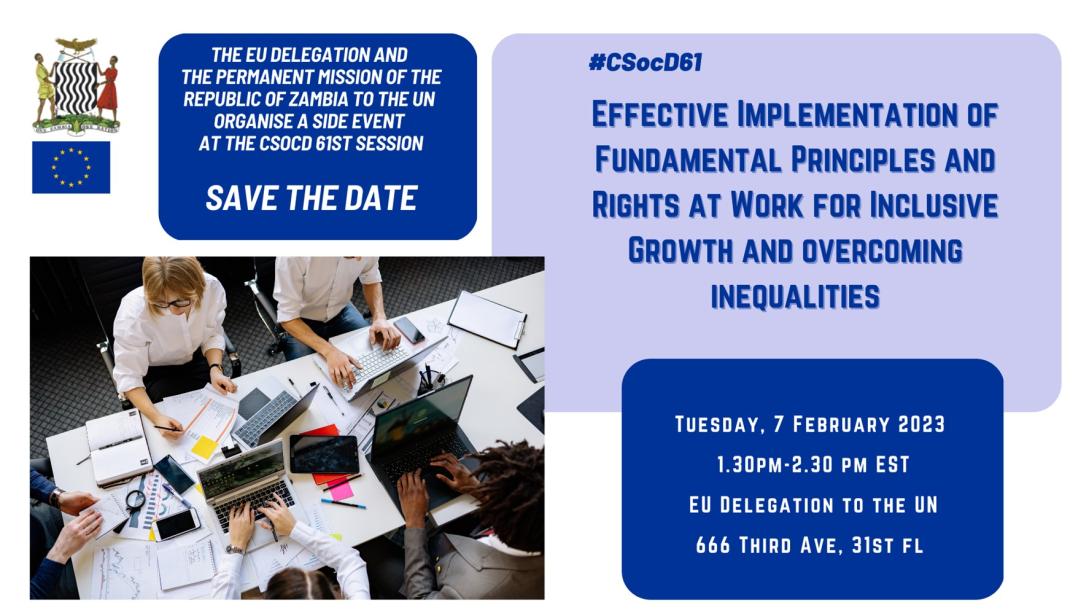
The event will focus on one of the elements of the decent work agenda, namely fundamental principles and rights at work and their effective implementation.
The latest figures show that effective implementation of fundamental principles and rights at work is still not a reality for many people around the world and more remains to be done to make it happen. The elimination of child labour and forced labour is at the heart of this endeavour.
160 million children one in ten worldwide are in child labour. Nearly half of them 79 million children work under hazardous conditions while 25 million people are in a situation of forced labour. The number of children in child labour has increased, inverting the previous positive trend. Millions of workers are affected by health and life threatening workplaces and suffer from in work poverty, excessive working hours, discrimination, harassment and violence, including gender based violence, without the freedom to associate. People working in labour intensive sectors such as agriculture, fisheries and textiles are particularly affected. Poor living and working conditions are linked to various factors such as the stage of economic development, low levels of legislation on labour and social protection, weak law enforcement, ineffective public administration and irresponsible business practices.
The global COVID 19 pandemic has exacerbated income and labour market inequalities and disproportionately affected women and vulne rable and disadvantaged groups such as young people and children, persons with disabilities, older persons, migrant workers and workers in the informal economy. It has aggravated occupational health and safety as well as the exercise of other fundamental l abour rights highlighting the urgency of promoting decent work including in global
supply chains. The prospect of an asymmetric global recovery risks aggravating conditions of the poor even further and of entrenching them more deeply.
It is a global commitment to ensure that workers’ rights and their dignity are respected, in particular regarding the eradication of child labour and forced labour, effective implementation of freedom of association and collective bargaining (which are important enabling rights for the reali zation of all other labour rights), elimination of discrimination at work, occupational health and safety and universal social protection. Promotion of the Decent Work Agenda and in particular the ratification and effective implementation of the fundamental ILO Conventions is in the interest of workers,
businesses and consumers everywhere.The Decent Work Agenda also aims to promote gender equality including through women’s economic empowerment, increasing women’s participation on the labour market in all s ectors and at all levels and ensuring equal pay for work of equal value. Social dialogue is a necessary governance tool for making effective implementation of labour standards a reality and in particular ensuring that the formalisation strategies are inclusive and effective. This includes that the voice of trade unions and workers, including informal worker s, must be heard and taken into consideration, if the formalization process is to be successful.
Global megatrends are also rapidly transforming the world of work, including through technological advances, the environmental and climate crisis, demographic changes and glob alisation, which can have an impact on labour standards and workers' protection. These transformations have the potential to generate economic growth and create new job opportunities, but in some instances, they can also contribute to a lowering of labour standards. Therefore, it is of utmost importance to ensure that the economic recovery is inclusive and that green and digital transitions go hand in hand with social justice that ensures the creation of decent work for all, effective implementation of international labour standards, social protection, social dialogue and addressing inequalities.
This is the reason why, promoting decent work is increasingly coming into focus in the international context, particularly through the work of the International Labour Organization and within the broader United Nations System.
Objective: discuss global challenges and opportunities in effective implementation of workers’ rights as part of the decent work agenda.