
EU Statement – UN General Assembly 4th Committee: Questions relating to information
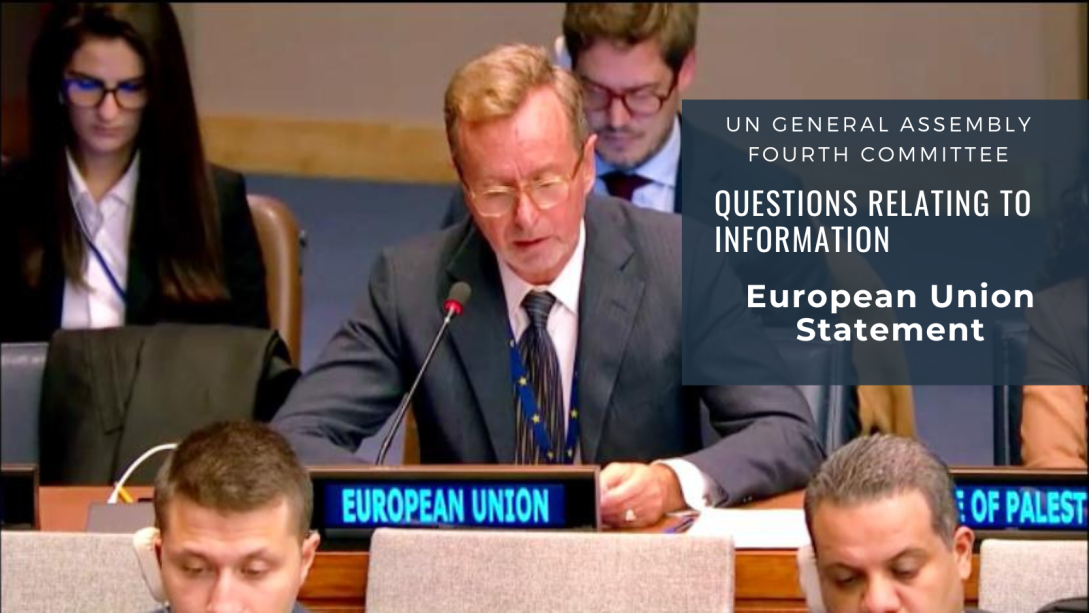
(trilingual version, as delivered)
Mr Chair,
Madam Under-Secretary-General,
Distinguished colleagues,
I have the honour to speak on behalf of the European Union and its Member States.
The Candidate Countries North Macedonia, Montenegro, Albania, Ukraine and the Republic of Moldova, the country of the Stabilisation and Association Process and potential candidate Bosnia and Herzegovina, and the EFTA country Iceland, member of the European Economic Area, as well as Georgia, Andorra, Monaco and San Marino align themselves with this statement.
We thank USG Fleming and the Department of Global Communications for the reports submitted to the Committee, as well as for their regular updates and all opportunities to exchange on the work of the Department.
The Department of Global Communications has a major responsibility to inform everyone, everywhere, about the UN’s work, and to do so while addressing the intertwined challenges that affect the information environment. To name just a few: The unequal access to digital technologies, including the gender digital divide, or uneven information and media literacy; increasing attacks against freedom of expression and freedom of the press; and rampant disinformation and information manipulation resulting also in hate speech, including disinformation aimed at justifying violence and military aggression. We note your determination, and that of the Secretary General, to tackle these developments, and stand by your side in these efforts.
You can count on the European Union’s support to the Department’s activities across all UN pillars. We continue to appreciate the Department’s increased agility in daily communication activities. Your engagement with more diverse stakeholders, including civil society and young people, has resulted in expanded audiences across platforms. Such developments are especially important in times of crises, when our citizens look to the UN to grasp the burning problems they and their societies and countries face. Last year in this Committee, we noted how the consequences of the pandemic had accentuated the urgency to act – for the enjoyment of all human rights and for gender equality, for the climate and the environment, for realizing the SDGs, and for the crises in Afghanistan, Ethiopia and many other countries in which vulnerable communities depend on UN coordinated assistance, with the support of the EU and other donors. We welcome the use of crisis cells within the UN Communications Group, which has allowed for effective, nimble and cross-departmental responses.
As we all know, Russia’s brutal aggression against Ukraine has dramatically deteriorated the lives not only of the Ukrainian people – with more and more attacks on civilians and civilian infrastructure –, but also of millions of people around the world, affected by food insecurity and rising energy prices. We appreciate the DGC’s expanded communication activities detailed in the annual report, which enables informing all people, in multiples languages, about the UN and the international community’s response to this aggression and its consequences. The growing audiences prove that the public expects the UN to be a reliable source of information and to act, both to stop this war and to alleviate its impacts.
We also welcome the resolutions agreed by consensus by the Committee on Information this year, including the strengthened references to human rights and the strong condemnation of “all forms of propaganda, which is either designed or likely to provoke or encourage any threat to peace, breach of peace, or act of aggression”.
Information manipulation and disinformation have also increased within the walls of the UN. For nearly eight months Russia has been abusing the UN system, further intensifying the spread of fabricated accusations in an attempt to enable and justify its military aggression against another UN member state. The Secretary-General has been clear in his statements regarding the blatant violations of the UN Charter and the aggression against Ukraine committed by Russia. We urge the entire UN system to be consistent in the way it refers to this aggression – in all its communications, including in its reports and policy documents. The numerous resolutions adopted by the General Assembly, the only universal deliberative body of the UN, as well as the Secretary-General’s statements should guide the terminology used by the UN system. Any attempts to conceal Russia’s aggression and the aggressor itself contributes, willingly or not, to Russia’s deceitful narratives and goes against the clear positions expressed by the international community. Fighting disinformation starts with calling things by their name.
M. le Président,
L'Union Européenne et ses États membres restent des soutiens fervents de l'initiative Verified lancée par le Secrétaire Général pendant la pandémie, et nous soutenons l'élargissement de son champ d'application à d'autres questions cruciales comme le climat et les discours de haine (par exemple la campagne #NoToHate). Nous sommes grandement préoccupés par les campagnes de désinformation qui visent l'ONU, y compris ses opérations de maintien de la paix et ses actions humanitaires. Nous exprimons notre solidarité en particulier aux États membres qui ont perdu des membres de leur personnel dans les missions de l'ONU à la suite de campagnes de désinformation. Nous devons redoubler d'efforts pour relever ce défi avec les outils nécessaires et d'une manière adaptée au contexte local, y compris par l’implication du Département de la Communication Globale dès la phase de planification des opérations et tout au long du « continuum » de paix. La question du comportement responsable des États au sein de l'environnement de l'information doit également faire partie de cette discussion.
Señor Presidente,
La semana que viene participaremos en varias actividades en el marco de la Semana Mundial de la Alfabetización Mediática e Informacional, proclamada por la Asamblea General. Invertir en alfabetización mediática, educación y sensibilización es esencial para generar resiliencia, para dotar de mejores herramientas a las personas para que puedan identificar por sí mismas la manipulación de la información y la desinformación, a la vez que se garantiza el respeto de la totalidad de los derechos humanos y las libertades fundamentales, incluida la libertad de expresión. Del mismo modo, debemos encontrar formas más efectivas de reducir la difusión no intencional de mala información.
In this context, the SG’s proposal of a Global Code of Conduct on the integrity of public information should be developed through a whole-of-society approach involving all stakeholders, including independent regulators, civil society and the private sector. Online platforms, in particular, are among the main routes for unintentional misinformation, but are also exploited strategically to spread disinformation; they must do more to address harmful content, including by reviewing their business models. The EU stands ready to share its experience, including with the EU’s strengthened Code of Practice on Disinformation, which requires the industry to adhere to self-regulatory standards to combat disinformation and manipulative behaviour, as well as the Digital Services Act and the European Media Freedom Act currently under discussion.
In such a complex information environment, speaking to people in a language they understand is more important than ever. Multilingualism is a core value of this Organisation, a cornerstone of all our work and leverage for a stronger, more networked and inclusive multilateral system. We welcome that UN News and other platforms and products have shown impressive growth in all six official languages as well as in other languages over the last year. We also recognize the essential contribution which the UN info centres, including the UNRIC in Brussels, and national centres have made to reach audiences in all countries. However, looking in particular at activities deployed from New York, we continue to call on the DGC to ensure a fully equitable treatment of all official languages, and to pursue efforts to disseminate information in the other languages used by the Department.
Mr Chair,
Let me in particular praise UN efforts to keep the spotlight on the climate crisis and encourage continued efforts also on biodiversity as we prepare for some crucial conferences. The SG himself has been a very effective spokesperson on these crises, but we also heartily support the platform offered to grass-root initiatives, such as the creative ActNow campaign, as well as creative material such as the video of a dinosaur speaking from the rostrum, which allow reaching global audiences on this existential issue.
The international community’s redoubled efforts to realize all SDGs also remain a top communications priority. This includes the EU’s new Global Gateway strategy, the main framework for our renewed commitment to partner countries’ efforts to attain all SDGs. Through partnerships with the private sector and the renowned “SDG advocates”, the EU and its member states contribute to raising awareness of the SDGs to the broader public. UN communication campaigns on the 2030 Agenda could be joined up with communication on “Our Common Agenda” (OCA) to demonstrate how these two processes are mutually reinforcing. We also encourage the DGC to dedicate sufficient resources to accompany the process leading towards the milestone of the “SDG Summit” in 2023 and the ”Summit of the Future” in 2024, with the important Ministerial meeting taking place during next year’s High-Level Week. The next two years should be used for close and inclusive consultations with civil society and other key stakeholders, building on the remarkable efforts deployed during the global consultation around the UN75 Political Declaration, with a view to shape together “the future we want and the UN we need”.
We particularly look forward to enhanced engagement with youth as essential contributors to the UN’s work, and in this regard strongly welcome the membership’s decision to upgrade the SG’s youth envoy office to a proper UN Youth Office. This is a clear and tangible contribution to the inclusive and networked multilateralism the SG has called for and which we fully support – including new permanent platforms such as “Youth 4 Climate”. The EU now has two Youth Delegates alongside many Youth Delegates from EU Member States who play a key role in communicating and engaging youth in and around the UN. We strongly support communication initiatives with the SG’s Youth Envoy and the new dedicated UN Youth Office. In terms of community outreach, the UN’s Messengers of peace and the Goodwill Ambassadors have a significant reach, and we encourage collaboration with personalities from diverse backgrounds and nationalities.
The follow-up to the OCA is indeed an opportunity to improve digital cooperation, by maintaining an open, free and secure digital space to enable the achievement of the 2030 Agenda for all. The EU promotes a human rights based, multi-stakeholder approach including civil society and the private sector. Earlier this month, the Council of the EU approved the Digital Services Act, a ground-breaking piece of legislation that aims to create a safer digital space in Europe where the fundamental rights of users are protected. We look forward to working with the UN Tech Envoy, all Member States and stakeholders on global solutions for a safer and more accountable online environment, not least through elaborating input for a new UN Global Digital Compact.
Mr Chair,
We are glad to see the return of journalists to the UN premises after the pandemic. Materials from UNifeed news video service have been aired in record numbers by broadcasters around the world, showing that there is increased media interest in covering the UN, and that many news outlets depend on such resources for this coverage due to their limited assets. Allow me to conclude by reiterating our support to the essential work of journalists accredited to the UN, and to their colleagues around the world who – often taking significant risks – form the cornerstone of free and democratic societies.
Mr. Chair, Madam Under-Secretary-General, please count on the European Union's continued support in working with the DGC and all Member States for a UN at the service of our citizens.
Thank you for your attention.