
EU Statement – UN General Assembly: Global Digital Compact Deep dive on Human Rights
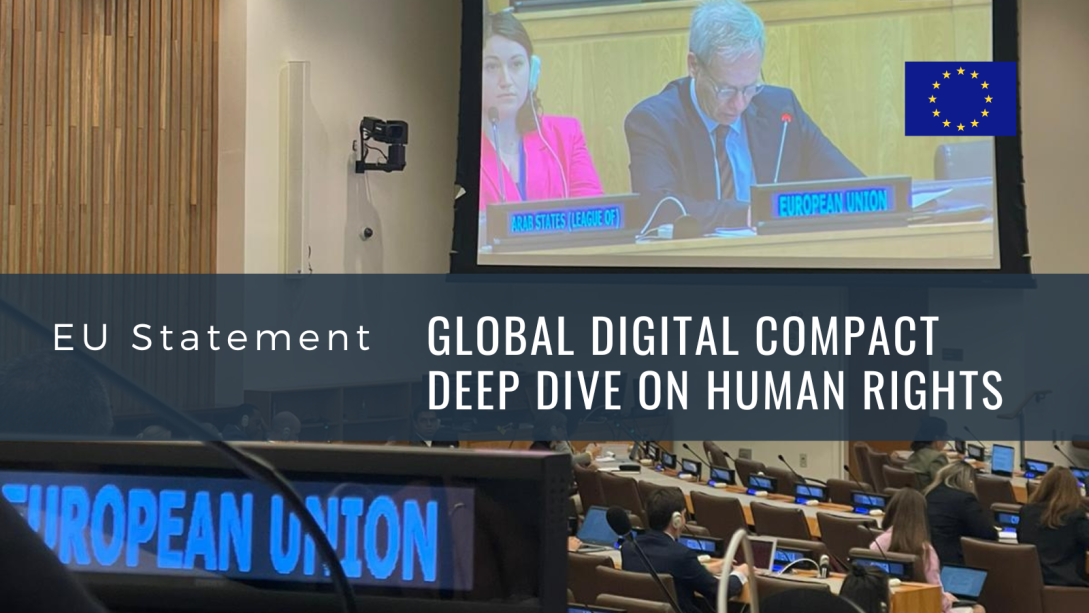
Thank you for giving me the floor Mr/Ms Co-facilitator. I have the honour to deliver this statement on behalf of the EU and its Member States.
In this year that marks the 75th anniversary of the Universal Declaration on Human Rights (UDHR), the EU strongly believes that fundamental freedoms and human rights must be upheld in the digital world just as they are in the offline world - this includes civil and political rights, as well as economic, social, and cultural rights.
The rapid development of digital technologies has brought many benefits, including improved communication, access to public services, increased opportunities for public participation and more possibilities for civil society to document human rights violations and war crimes. However, technologies can be unintentional drivers of misinformation or can be intentionally easily misused to spread disinformation and hate speech, to violate and abuse the right to privacy, to increase state capacity for surveillance and to perpetuate and reinforce harassment and violence, as well as discrimination and structural inequalities.
This particularly affects marginalized communities and persons in vulnerable situations. Online sexual and gender-based violence as well as disinformation are often disproportionately affecting women and girls. We highlight the urgency of robust measures to prevent, detect, address, criminalize and end all forms of online sexual and gender-based violence. The significant risk for children to be exposed to online threats, including all forms of sexual violence, exploitation and abuse material calls for the development of targeted and robust prevention initiatives to protect children against these crimes.
The protection of human rights, democracy, and the rule of law must remain at the center of all our considerations. To address these challenges, the EU has a human-centric, human rights-based vision for the digital transition. We stand for a free, safe, open, secure and non-fragmented Internet for all and we actively condemn and combat all kinds of Internet shutdowns. This means that we counter information manipulation and interference, including disinformation; and that we are firmly committed to digital privacy and data protection. We furthermore believe that the promotion of digital humanities and digital humanism, which stands for the complex interplay between digital technology and human beings, is essential in this context.
To address the impact of digital technologies on human rights, we need a multi-stakeholder approach involving national authorities, human rights institutions, academia, civil society, human rights defenders, journalists, international and regional organizations, and the private sector. The UN fora, including the UN General Assembly, and the Human Rights Council, should remain at the center of these discussions, with the involvement of all UN agencies, UN Special Procedures and the UN Tech Envoy.
Our approach must be a systemic one that is based on the entire cycle of digital technologies, including their design, development, deployment, evaluation, and use. In the EU, this approach is reflected in the combined regulatory package of the Digital Services Act (DSA) and the Digital Markets Act (DMA), which regulate the providers of the EU common market. At the same time, the Artificial Intelligence Act aims to set global standards for the development and use of Artificial Intelligence systems in the EU, following a risk-based approach for citizens’ protection. Concerning children, the recent “EU Better Internet for Kids strategy” contributes to the implementation of the regulatory framework provided in the Digital Services Act and ensuring age-appropriate digital services. In concrete terms, through this legislation, each and every child in Europe is to be protected, empowered, and respected in the online sphere.
Digital accessibility is also a priority of the European Union's commitment to inclusion, diversity, and creating a Union of equality. We must close the digital divides, including the digital gender divide, and help all people, including all women and girls, to acquire digital skills by supporting accessible digital education worldwide and ensure universal connectivity. The digital transformation will only be successful if it is also socially just and gender equal, involves everyone and is a part of a human rights-based transformation. Within the EU, the signature of the European Declaration of Digital Rights and Principles, in December 2022, reflects the shared political commitment of the EU and its Member States to a human-centric, sustainable digital transformation, where fundamental rights are respected and no one is left behind, in line with fundamental freedoms and universal human rights. The Strategy for the Rights of Persons with Disabilities 2021-2030 also helps to build a Union of Equality and to deliver on the European Pillar of Social Rights.
The EU therefore proposes that the Global Digital Compact maintain a strong focus on the protection of human rights, including the rights to the freedom of opinion and expression and promote the following four commitments:
- First, to promote a human rights-based approach to the whole life cycle of digital technologies – including design, development, deployment, evaluation, and use – as part of a coherent narrative of the human-centric vision of the digital transformation, including in international standard development processes. The EU is committed to, and expects the Global Digital Compact to ensure a safe, secure, gender equal and fair online environment, that facilitates innovation and in which human rights are protected and promoted, and responsibilities of platforms, especially very large online platforms, are well defined.
- Second, to support an online environment where everyone is safe from all forms of discrimination, harassment, cyberbullying, online sexual and gender-based violence, information manipulation, including disinformation, hate speech and other forms of harmful content, such as Child Sexual Abuse Material (CSAM)
- Third, to promote the rights to privacy and data protection, to protect an enabling online space for civil society, to address mass surveillance, and actively combat internet shutdowns and online censorship, in full compliance with international human rights law.
- Fourth, to ensure that all women and girls have equal opportunities to safely and meaningfully access, use, lead, and design technology and innovation through, among other things, addressing the gender dimensions of digital inequality, embedding gender and non-discrimination in digital technologies, making digital spaces safe and addressing the root causes of gender inequalities, as well as promoting inclusive innovation ecosystems. The recent CSW Agreed Conclusions give us concrete tools to achieve this.
Digital technologies have the potential to promote and strengthen democracy, peace, and human rights, as described in the Universal Declaration of Human Rights, as well as the principles of the rule of law, legitimate purpose, non-arbitrariness, effective oversight, and transparency. The EU is firmly committed to a vision of the Internet as a safe and trusted space for everyone, where the fundamental freedoms and human rights that citizens have offline are also protected, promoted, enjoyed and applied online, and in line with digital humanism.
Thank you!