
EU Statement – UN General Assembly: Situation in the Middle East (Syrian cross-border mechanism)
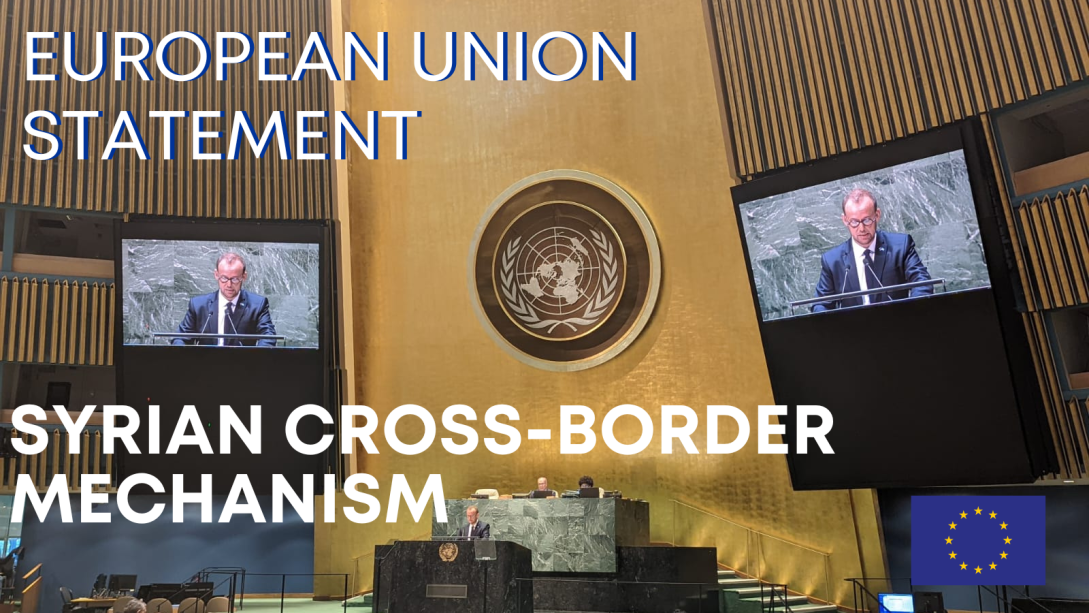
I have the honour to speak on behalf of the European Union and its Member States.
The Candidate Countries North Macedonia*, Montenegro*, the Republic of Moldova, and Ukraine, the country of the Stabilisation and Association Process and potential candidate Bosnia and Herzegovina, as well as Monaco and San Marino align themselves with this statement.
This is the second debate held pursuant to General Assembly Resolution 76/262. We do appreciate the opportunity to continue to speak about the importance of humanitarian access in Syria with the full UN membership. However, we deeply regret the veto applied by the Russian Federation to the resolution proposed by the co-penholders, Ireland and Norway, for a twelve-month renewal of the cross-border mechanism in Bab Al Hawa.
The penholders’ proposal for a full year renewal had wide support from Security Council members, with 13 votes in favour. The UN Secretary-General, the European Union, and the humanitarian community had also continuously called for a twelve-month renewal. Humanitarian actors and beneficiaries must have enough predictability to be able to plan and organise their life-saving assistance.
Ultimately, this mechanism was renewed, via Security Council Resolution 2642, for six months, with a further extension of an additional six months requiring a separate resolution. For now, United Nations humanitarian assistance can continue crossing at Bab Al Hawa, which is the single remaining border crossing. Continued cross-border humanitarian access to northwest Syria is critical for the 4.1 million Syrians who depend on the vital humanitarian assistance delivered though this mechanism. While the European Union recognises that the six-month renewal of cross-border access is an important outcome, we urge the Security Council to renew the cross-border mechanism for a further six months by January 2023.
At present, there is simply no viable alternative to the cross-border operation to meet the needs of millions of people in North West Syria. The current mandate expires in winter, at a time when people in North West Syria will be most in need of humanitarian assistance.
Let us be clear - life-saving and life-sustaining humanitarian actions must not be disrupted, targeted, or politicised. Safe, unhindered, and sustained access to all those in need in Syria must be maintained.
Humanitarian needs in Syria have increased and will likely continue to increase, especially in light of the food crisis due to Russia’s invasion of Ukraine. Today, over 12 million Syrians are food insecure, relying on external food assistance for their survival.
In the face of this significant need, the EU and its Member States are the largest donors supporting Syrians in the country and the region. At the sixth Brussels Conference on Supporting the Future of Syria and the Region in May of this year, hosted by the EU, the international community pledged close to 6.4 billion Euros for 2022 and beyond, including over 4.8 billion Euros pledged by the EU and its member states.
The EU reiterates its call for a political solution and remains firm in its commitment to this goal. Finally, the EU emphasises that no normalisation, lifting of sanctions or reconstruction will be possible until the Syrian regime engages in a political transition, in the framework of UNSC Resolution 2254 and the Geneva process.
Thank you.
* North Macedonia, Montenegro, Serbia and Albania continue to be part of the Stabilisation and Association Process.