
EU Statement – UN General Assembly: Strengthening of the coordination of humanitarian and disaster relief assistance of the United Nations, including special economic assistance
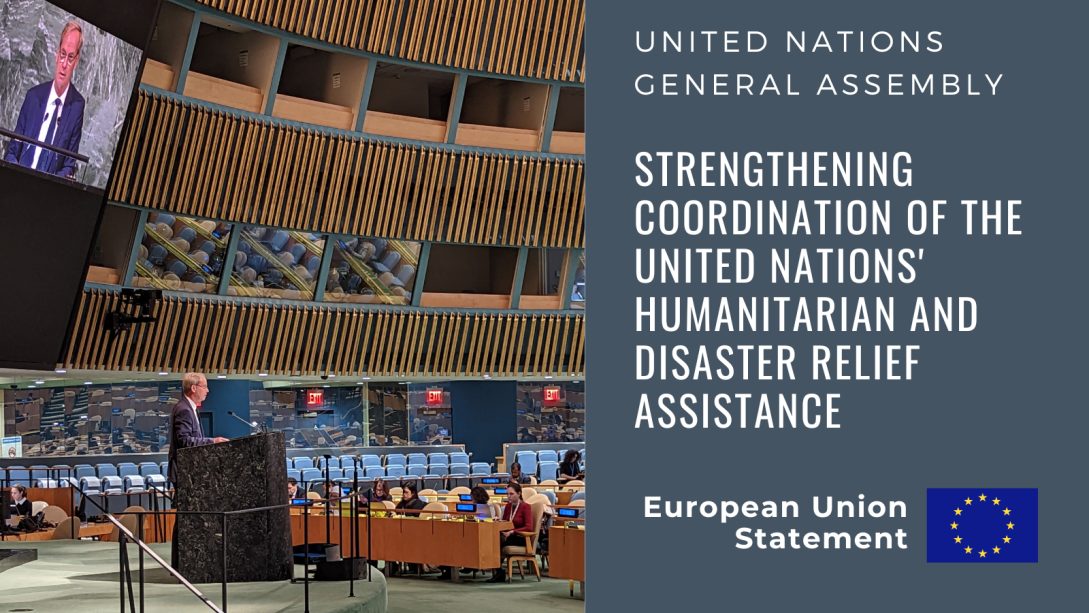
- CHECK AGAINST DELIVERY -
Distinguished colleagues,
I am pleased to speak on behalf of the European Union and its 27 Member States.
The Candidate Countries Türkiye, North Macedonia*, Montenegro*, Serbia*, Albania*, Ukraine and the Republic of Moldova, the potential candidate countries Bosnia and Herzegovina* and Georgia, as well as Andorra, Monaco and San Marino align themselves with this statement.
Mr. President,
In 2022, the combined impact of new and ongoing wars, the worsening global climate emergency, and the COVID-19 pandemic has created a ‘perfect storm’ of crises, resulting in a rise in humanitarian needs that is unprecedented in scale and speed.
The humanitarian situation this year has been much worse than projected – from an estimated 274 million people to 324 million people that are currently in need of assistance. Alarmingly, we will start 2023 with a massive humanitarian caseload of 339 million people in need, according to the Global Humanitarian Overview, launched last week.
In addition, a record number of 103 million people, one percent of the world’s population, are displaced - many of whom for the second or third time, or for a protracted time. Many countries across the world have been affected by devastating floods or droughts and others will soon have to face extremely harsh winters. The impact of climate change further erodes the resilience of the most vulnerable communities.
We salute and honor the life-saving work undertaken by humanitarian and medical workers and express our solidarity to people in need. The EU and its Member States remain committed to addressing the root causes of humanitarian crises, reducing needs and continuing to promote cooperation between humanitarian, development and peace actors.
I will highlight three points today. First, respect for international humanitarian law remains paramount to protect people affected by armed conflict. Second, the food crisis, unprecedented in our modern history, poses a serious threat to people around the world. And third, to meet the rising needs, we must expand the donor base.
First, we must continue to promote respect for international humanitarian law.
To put it plainly: continued violations of IHL lead to massive assistance and protection needs for civilians. And even more so, they prevent vital assistance from reaching people in need. Saving lives should not cost lives. The EU and its Member States will continue to take action to deter such violations and protect the humanitarian space.
We strongly advocate for compliance with IHL. Compliance also means that principled humanitarian actors, as well as medical workers, must never be targets. This pertains to all humanitarian relief and medical personnel, wherever they are from. Perpetrators must be held accountable. The safety and security of humanitarian workers, often operating on the frontline in complex environments, is of paramount importance. This year, we continued to witness attacks and threats against those people whose role it is to help others. One particularly worrying trend is the rise of information manipulation, including disinformation, which can undermine trust in humanitarian organizations and put their personnel at serious risk. States and parties to conflict must respect IHL as well as take action within the bounds of international human rights laws, to prevent disinformation.
We are also deeply concerned by the impact of the widespread destruction or damage caused to civilian objects such as schools, hospitals, energy and water infrastructure, in violation of IHL. The direct and indirect effects are not only one of the most critical challenges to the lives and well-being of civilians, they are also major drivers of long-term social and economic instability.
To ensure that humanitarian space remains open for all necessary aid to reach those in need, we must also continue to make progress in preventing any potential negative impact of sanctions and counter-terrorism measures on exclusively humanitarian activities, including medical work, that are carried out by humanitarian actors. The EU will continue to take mitigating measures, such as the consistent inclusion of humanitarian exceptions to sanctions.
Lastly, we must not forget to keep those who bear the consequences of breaches to IHL at the center of our attention. Be that children caught in war who fall victim to one or more of the six grave violations against children in armed conflict. Or survivors of conflict-related sexual violence, who need access to services, justice and accountability. In this vein, accountability measures should take a survivor-centred approach and avoid re-traumatizing those who have already suffered harm in their call of duty.
Second, the fight against hunger. The world is facing an unprecedented food crisis. Almost a million people are living in famine conditions, with starvation and death a daily reality. This is ten times more people than five years ago. Food crises are also increasingly protracted, affecting the same countries and populations year after year. South Sudan, Ethiopia, Somalia, Nigeria, Afghanistan and Yemen remain the countries of highest concern. And women and girls continue to be disproportionally impacted, often eating last and least.
Conflict remains the primary driver of hunger. But we also increasingly see the impact of weather extremes, exacerbated by climate change, driving hunger. We are particularly concerned about the drought in the Horn of Africa, already persisting for two years.
This year, global food insecurity has been further exacerbated by the effects of Russia’s aggression against Ukraine on the prices on food, energy and fertilizers, as well as on international supply chains. This is having devastating effects especially for fragile countries around the world that were already facing high levels of food insecurity, including countries in North Africa, the Horn of Africa, and the Middle East.
We urgently need to step up to keep famine at bay. There is no time to lose. The European Union is doing its part. We have increased our humanitarian food assistance by 64% since 2020. And the comprehensive Team Europe Global Food Security Response, implemented jointly with our Member States, is supported with around 8 billion Euros of EU funding until 2024.
But we need others to step up too. We need to work together for at-scale multi-sectoral solutions. Food security solutions alone will not be sufficient to prevent deteriorations. We need holistic responses and we need to look at how we can act now to avert a further slide towards catastrophe. A comprehensive approach that addresses the root causes of food insecurity is essential. This includes front-loading funding to enable an early response, as well as investments in sustainable solutions and building the resilience of communities.
Collectively we can do a lot more to prevent a further worsening of the hunger crisis.
And this brings me to my third point: to meet the high level of humanitarian needs, we must expand the donor base for humanitarian assistance.
The EU and its Member States, in the Team Europe approach, are determined to do our part. We remain committed and ready to continue assuming our share of responsibility in addressing emergencies worldwide, in 2023 and beyond.
But the donor base for humanitarian action remains extremely narrow and is overstretched. The ten biggest humanitarian donors account for over 80% of all humanitarian funding and the three biggest donors are providing over 60% of all GHO funding. This is not sustainable. Helping the most vulnerable people around the world is a shared responsibility and we need to see a much broader group of countries contributing to humanitarian funding.
Let me conclude by reiterating that the EU’s engagement towards principled humanitarian action is an integral part of our strategic commitment to effective multilateralism. The UN can continue relying on our support.
Thank you.
* North Macedonia, Montenegro, Serbia, Albania and Bosnia and Herzegovina continue to be part of the Stabilisation and Association Process.