
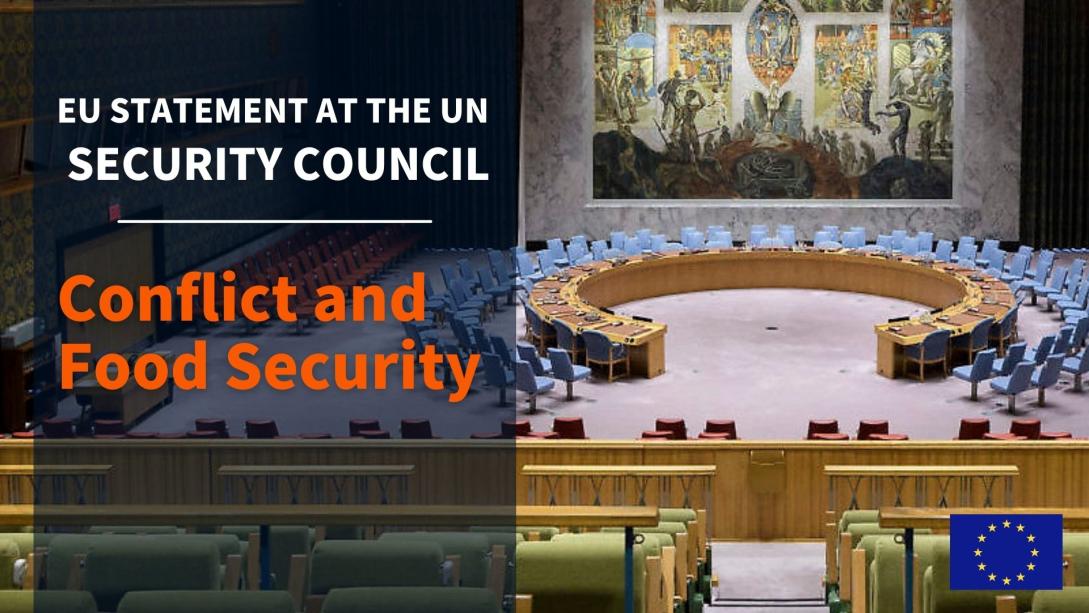
EU Statement – UN Security Council: Debate on Conflict and Food Security
Mr President,
Excellencies,
Conflict remains the main driver of food insecurity.
Russia’s war against Ukraine has caused an unprecedented surge in global food prices, on top of the already devastating effects of the COVID-19 pandemic and climate change.
It is therefore crucial to put an end to Russia’s aggression and to the suffering of the Ukrainian people, also to avoid the consequences of a protracted war on global food security.
Let me make it clear: blaming sanctions for increased global food prices is a weak attempt to conceal the truth and divert action from where it is needed. Our sanctions target the Kremlin’s ability to finance its aggression against Ukraine and its people. They are carefully drafted so as not to affect the agricultural sector. What we heard today from Russia about some “grain for weapons” scheme is another item to add to the long list of misinformation
Now, more than ever, it is time to show solidarity. The world can count on the EU’s support. Whenever and wherever our solidarity is needed, the EU will deliver.
We support the work led by the UN Global Response Crisis Group on food, energy and finance. And our 27 member states have co-sponsored the UN resolution on food security tabled by Lebanon to draw the attention of the international community on the food crisis and identify ways to address it.
We are undertaking a number of short and medium term actions to alleviate food insecurity:
1) First, we are doing everything in our power to ease the pressure on global food markets.
Last week, we launched an action plan on EU-Ukraine Solidarity Lanes to create alternative logistic routes and make sure that much needed grains can be exported from Ukraine to the rest of the world, as the Black Sea routes remain blocked by the aggressor. All alternative transport modes are being mobilised to maximum capacity. We support all efforts aiming at finding ways to unblock the sea routes
Restoring well-functioning markets is also key. Within the G7, we have committed to keeping our food and agricultural markets open and we urge other large producing countries to do the same. We advocate against export restrictions and for an open, transparent and predictable trade environment.
2) Second, we are ramping up our humanitarian assistance. Our responses are tailored to country and regional needs.
In our efforts to help, we must ensure that local production and livelihoods are safeguarded. This is why, where feasible, we prefer cash-based programmes over shipping food from other areas. In April, we pledged over 1 billion euros to address food insecurity in the Sahel and the Lake Chad regions, and 644 million euros to address acute food insecurity and strengthen resilience in the Horn of Africa. For our Southern Neighbourhood partners the EU foresees nearly 1 billion euros in grants to strengthen food security and social protection.
Food affordability is another short-term priority, especially for middle income and low income countries. Sixty percent of them are already in debt distress or at high risk of distress and the impact of the war in Ukraine on food and commodity prices will further exacerbate this trend, thus the need to urgently identify solutions to address their situation. The EU response will support the fiscal and macro-economic stability of these countries and prop up their international reserves to enable them to pay for crucial food and energy imports, while providing the fiscal means and capacity to put in place adequate social transfers. More specifically, we are looking at the rechannelling of advanced economies’ Special Drawing Rights, making use of existing IMF’s instruments
3) Third, in the medium and long term, we are supporting countries in transforming towards resilient and sustainable agricultural and aquatic food systems. As part of the Agenda 2030 objectives, the EU will invest in family farmers and small scale food actors, local and regional supply chains, and ecosystem based approaches.
We all have to step our humanitarian assistance but humanitarian aid alone is not a sustainable solution.
It is an emergency step. For the long term recovery, EU’s development aid is ready to pick-up the baton and address the root causes of food insecurity. The EU Green Deal and our Farm to Fork and Biodiversity strategies continue to guide our response.
In conclusion, I want to stress again that the world can continue to count on our support.
Our actions are anchored in the multilateral system. We strongly support the UN’s leadership to respond to the global food security crisis in a comprehensive way. Together with our partners, we will continue to ensure a coordinated and unified response.
Thank you.