
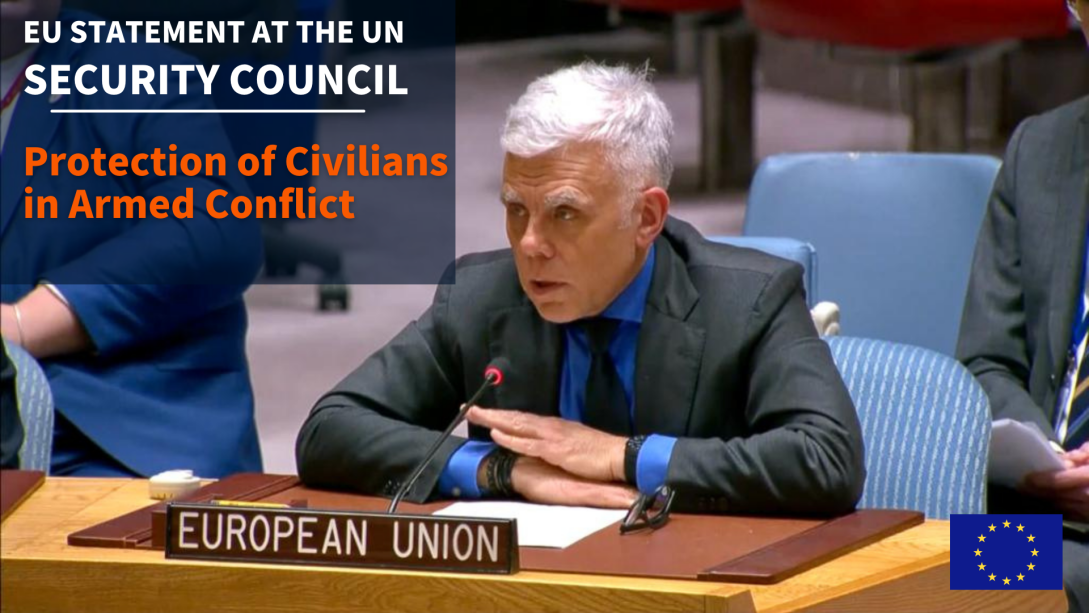
EU Statement – UN Security Council Open Debate: Protection of Civilians in Armed Conflict
Mister President,
I have the honour to speak on behalf of the European Union and its Member States.
The Candidate Countries Montenegro*, Serbia*, Albania*, Ukraine, the Republic of Moldova and Bosnia and Herzegovina*, the potential candidate country Georgia, as well as Monaco and San Marino align themselves with this statement.
Let me start by stressing our deep concern regarding both the number and the scale of armed conflicts across the globe. Among others, Russia’s war of aggression against Ukraine and the crisis in Sudan have dramatically impacted the lives of millions of civilians and resulted into continued and massive displacement.
These and other conflicts also impact food security, even in countries not directly affected by the violence. The EU and its Member States are alarmed by the unprecedented food and nutrition crisis, affecting hundreds of millions of people around the world. The European Union has been at the forefront of global efforts in supporting its partners in combatting food insecurity and malnutrition and alleviating the consequences of Russia’s war of aggression against Ukraine.
The protection of civilian infrastructure is key to ensure food security in time of conflict. When objects indispensable to the survival of civilians are attacked, damaged, or destroyed, food production and distribution, water delivery, sanitation, energy provision, and health care can all be disrupted. The EU remains deeply concerned about the humanitarian consequences resulting from armed conflicts involving the use of explosive weapons in populated areas, which destroy such objects. In this regard, the EU welcomes the adoption of the Political Declaration on strengthening the protection of civilians from the humanitarian consequences arising from the use of explosive weapons in populated areas.
The EU recalls that full compliance with IHL remains critical for the protection of civilians affected by armed conflicts, as well as for the protection of civilian infrastructure. We call on all parties to armed conflict to respect their obligations under IHL and emphasise the need for accountability for violations of IHL. The EU remains committed to keeping the promotion of, and adherence to, IHL at the heart of its external action. The EU will continue to advocate for compliance with IHL, accountability for IHL violations, and a systematic implementation of resolution 2417. To this end, the EU is funding a project to reinforce and complement the existing accountability systems which provide the information for the UN Secretary-General’s reporting obligations required by resolution 2417.In addition to protecting these important principles, the EU is committed to continue its funding in response to the global food crisis. As the needs and funding gap stretch further, we also call on increased contributions from other donors, including the private sector and international financial institutions.
We also reaffirm the need for more complementarity between humanitarian, development and peace actions to protect essential resources, address root causes, and prevent the onset of humanitarian crises.
In today’s complex operating environments for humanitarian aid delivery, we need to enhance humanitarians’ capacities to stay and deliver in a principled and efficient way. On top of this, the humanitarian space for female humanitarian workers is shrinking. Afghanistan and Yemen are the most striking examples, where female humanitarian workers have been unacceptably deprived from doing their jobs effectively, and consequently services traditionally offered by and for women and girls are limited. Supporting full humanitarian access is a key commitment for the EU, in line with our long-standing support of the UN Secretary General in coordinating the international response to emergencies and our facilitating the annual GA resolution on the safety and security of humanitarian and medical workers. We commend the work of the UN Secretariat, notably OCHA, in developing a more systematic approach to coordinate emergency relief and ensure access for the rapid provision of emergency assistance, including through negotiations with all parties concerned.
Persons in vulnerable situations require our particular attention. The EU is concerned that children remain disproportionally affected by armed conflict. We have observed an alarming increase in the number of cases of conflict-related sexual violence against children. The number of attacks against schools, school children, and teachers are also on the rise. Combined with the disastrous ramifications of the global economic crisis, it poses a serious threat to the right to education. The EU strongly supports the CAAC mandate, including the Monitoring and Reporting Mechanism, and we remain committed to the implementation of resolution 2601. The EU also welcomes the efforts of UN Member States that have endorsed the Safe Schools Declaration.
The EU remains concerned of the negative impact of crises on structural gender inequalities. Women and girls often eat least and last when food is scarce, and their voices are too often silenced. Conflicts also exacerbate gender-based violence and interrupt access to sexual and reproductive health care services.
We remain committed to providing principled humanitarian assistance to those most in need, and to ensuring the voices of all affected populations are heard. Only this way can aid be efficient and effective. The EU also remains committed to implementing resolution 2475 and making humanitarian aid inclusive and accessible to persons with disabilities.
Finally, it is critical that we address the mental health needs of conflict-affected populations and fulfil their right to mental health.
While people impacted by armed conflict continue to face grave risks and challenges every day, we remain committed to support concrete actions to protect their lives and dignity.
Thank you.
* Montenegro, Serbia, Albania and Bosnia and Herzegovina continue to be part of the Stabilisation and Association Process.