
Brussels to the Bay: Building and Governing the AI Frontier
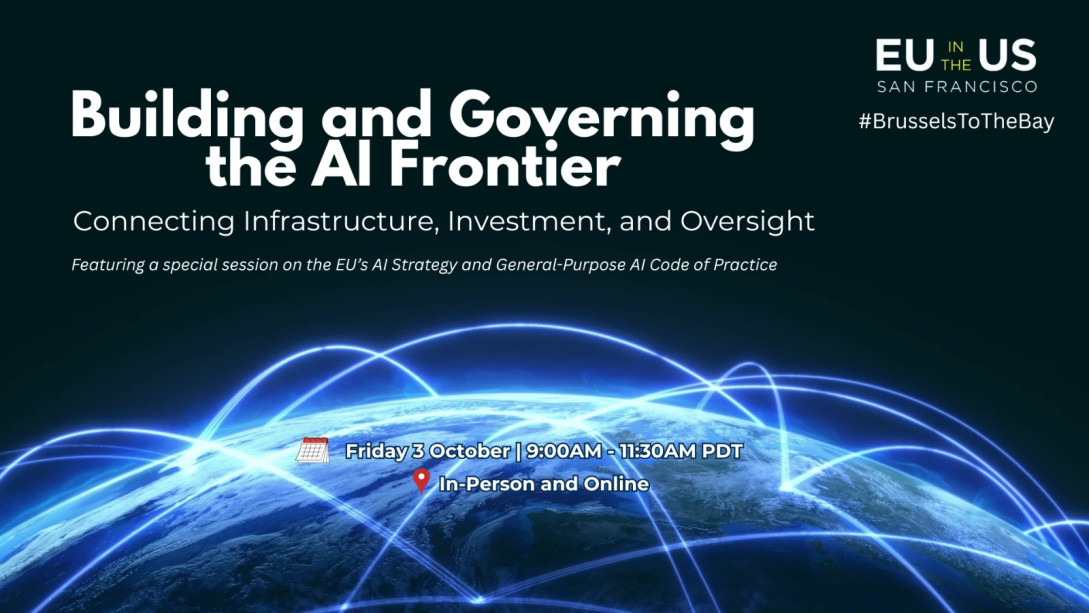
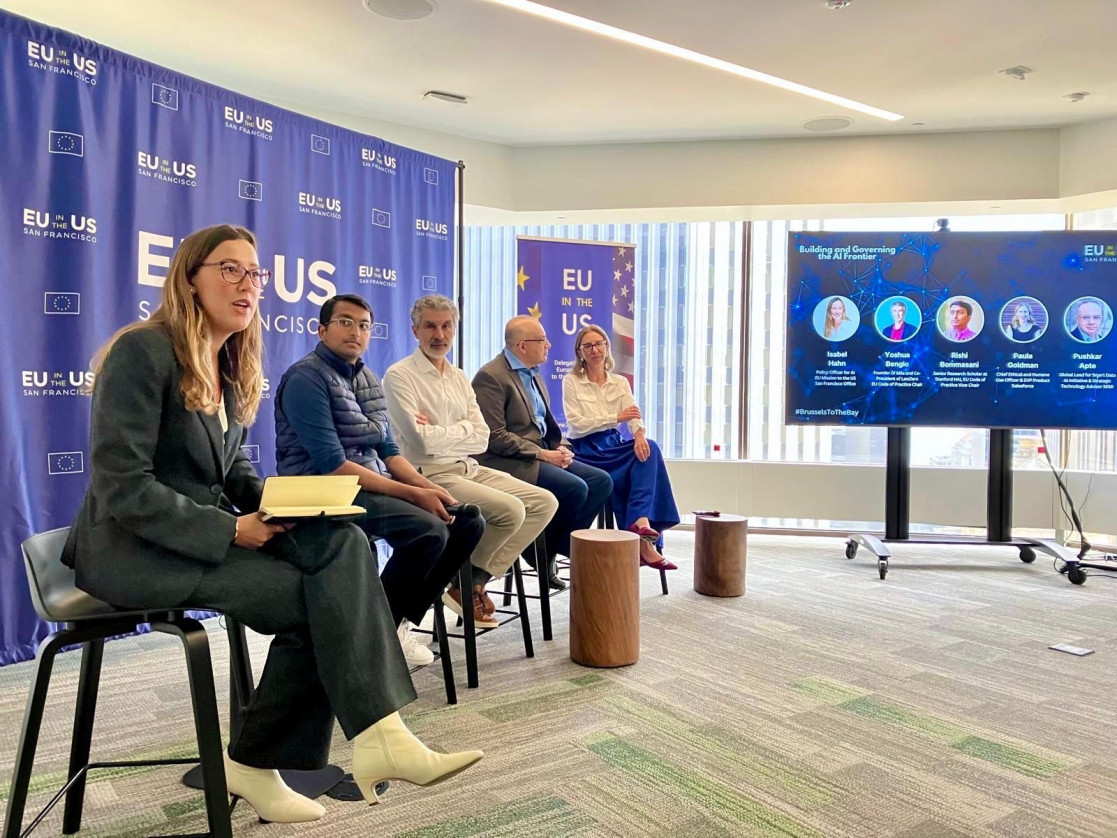
This Brussels to the Bay session organized by the EU Office in San Francisco brought together Yoshua Bengio (Mila), Rishi Bommasani (Stanford Institute for Human-Centered Artificial Intelligence), Paula Goldman (Salesforce), Pushkar Apte (SEMI), and Lauro Langosco (European Commission AI Office) to discuss how to build and govern the AI Frontier.
The livestream of this event is now available by clicking here.
As AI enters a new era of explosive growth, two major forces shape its trajectory: the massive investments in infrastructure and innovation needed to build long-term technological leadership, and the governance frameworks designed to ensure safety, trust, and accountability. Both in the European Union (EU) and the U.S., public and private entities are making enormous investments aimed at building up an AI infrastructure backbone and empowering start-ups, researchers, and applied innovation. Simultaneously, whether and how frontier AI models should be governed is at the forefront of today’s policy debates. In the EU, the AI Act’s Code of Practice offers a toolkit to clarify obligations for frontier models on the European market, while in California, legislative discussions spark broader conversations about the intersection of governance, safety, and security.
This Brussels to the Bay session “Building and Governing the AI Frontier” organized by the EU Office in San Francisco brought together perspectives from industry, policymakers, and investors to explore the opportunities and challenges of building and governing AI at scale.
EU
Among others, the panel conversation focused on these main questions:
- How do infrastructure investment strategies interact with evolving governance regimes?
- Where is there scope for transatlantic cooperation on both innovation and oversight?
- What role, if any, do governance frameworks have to play in building research and innovation capacity?
- How can alignment between investors, infrastructure providers, and regulators foster a safer, more competitive, and globally connected AI ecosystem?
As stakeholders on both sides of the Atlantic move quickly to adapt to the AI governance landscape, navigating the EU AI Act’s Code of Practice has proven crucial. The panel discussion attempted to demystify the Code of Practice and to explore its relevance by providing the audience with a practical overview and an info session to unpack its implications. The speakers further addressed the Code of Practice’s potential ripple effects beyond Europe. Speakers also touched on Governor Newson’s signature of SB 53 into law.
In addition, the panel addressed the types of investments that are most critical right now to sustain AI innovation globally, and ways for industry and policymakers to coordinate in making sure those investments also strengthen resilience and equitable access. They further discussed about AI agents as a next frontier for many companies and the impact these developments have in terms of shaping the governance conversation.
Meet our speakers:
- Yoshua Bengio, Founder of Mila - Quebec AI Institute, EU AI Act Code of Practice Chair
- Rishi Bommasani, Senior Research Scholar at the Stanford Institute for Human-Centered Artificial Intelligence, EU AI Act Code of Practice Vice-Chair
- Paula Goldman, Chief Ethical and Humane Use Officer, EVP of Product at Salesforce
- Pushkar Apte, Strategic Technology Advisor & Global Smart Data-AI Initiative Lead at SEMI
- Lauro Langosco, Technology Specialist, European Commission's AI Office [presenter]
- Isabel Hahn, Policy Officer at EU Office in SF [moderator]
If you have any questions, please email us at invitation@euinsanfrancisco.eu.