
Brussels to the Bay: Opening Digital Markets for Innovation: EU Policy Toolbox and Recent Decisions
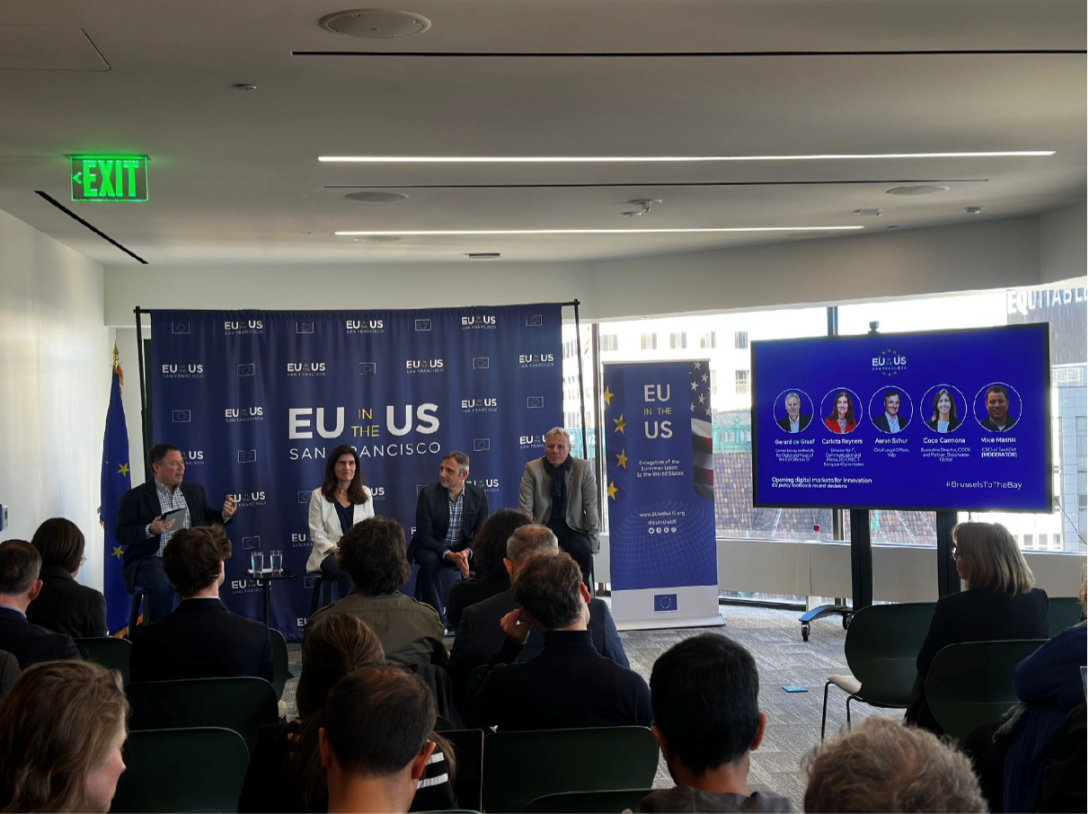
Bringing together Carlota Reyners (European Commission, DG Competition), Gerard de Graaf (EU Office in San Francisco), Aaron Schur (Yelp), and Mike Masnick (Techdirt), the discussion focused on pro-innovation effects of European digital markets policies such as Digital Markets Act (DMA) and competition law enforcement. As digital markets become increasingly concentrated, innovation depends not only on technological progress but also on fair and contestable access to key digital infrastructures - from app stores and operating systems to search, cloud, and advertising ecosystems. The panel explored how the DMA’s ex ante obligations and antitrust decisions addressing practices such as self-preferencing, ecosystem lock-in, and restrictions on steering aim to create more predictable market conditions, strengthen competition, and expand opportunities for businesses and consumers alike.
The livestream of this event is now available by clicking here.
This Brussels to the Bay session, “Opening Digital Markets for Innovation: EU Policy Toolbox and Recent Decisions,” examined how the European Union is using a combination of regulatory instruments and competition law enforcement to keep digital markets fair and contestable.
The discussion focused on the following main themes:
-
Structural bottlenecks affecting market access for startups, developers, and business users;
-
Self-preferencing, steering restrictions, and ecosystem lock-in;
-
Interoperability and data access as mechanisms to enhance contestability;
-
Ongoing enforcement actions and recent decisions under the DMA and EU competition law;
-
The transatlantic dimension of digital competition policy.
Speakers emphasized that access conditions within digital ecosystems directly shape incentives to invest, scale, and innovate. Practices such as self-preferencing in search, restrictions on steering users to alternative offers, limitations on app distribution channels, and asymmetries in access to data were discussed as factors that can reinforce market power and limit competitive opportunities for emerging players.
A central part of the conversation examined the Digital Markets Act as an ex ante framework designed to establish clear baseline obligations for designated “gatekeepers.” These obligations include requirements to refrain from self-preferencing, enable alternative app distribution, facilitate steering to external offers, ensure user control over personal data, and support interoperability. Panelists discussed how this regulatory clarity complements traditional competition law, which addresses abuses of dominant position on a case-by-case basis through ex post investigations.
Recent enforcement actions were also addressed, including decisions and preliminary findings concerning steering rules, app store practices, consent models for personal data use, and search-related self-preferencing. Ongoing scrutiny in areas such as cloud computing services was discussed as part of a broader effort to assess how evolving digital infrastructures may affect market contestability. Speakers underlined that effective enforcement requires continuous monitoring, regulatory dialogue with gatekeepers, and technical engagement to ensure that compliance measures are meaningful in practice.
Interoperability emerged as a recurring theme, including messaging interoperability and interoperability within mobile ecosystems. Participants reflected on how opening technical interfaces and reducing structural dependencies can create opportunities for alternative service providers while maintaining security and privacy safeguards. The conversation also considered how emerging technological developments (including AI-driven services) may interact with existing market structures and enforcement frameworks.
Finally, the discussion placed EU developments within a broader international context. Ongoing antitrust proceedings and digital market investigations in other jurisdictions, including the United States, illustrate the global relevance of questions related to platform power and ecosystem lock-in. Speakers highlighted the importance of dialogue and cooperation among competition authorities to promote consistency, reduce regulatory fragmentation, and provide predictable operating conditions for companies active across multiple markets.
European Union, 2026
KEY INFO
Date: Friday, January 16, 2026; Venue: EU Office in San Francisco - 1 Post Street, Suite 2300
Meet our speakers:
-
Gerard de Graaf - Head of the EU Office in San Francisco and Senior EU Envoy for Digital
-
Carlota Reyners - Director for IT, Communication and Media, Directorate-General for Competition, European Commission
-
Aaron Schur - Chief Legal Officer, Yelp
-
Moderator: Mike Masnick - CEO, Techdirt
Gerard de Graaf, Head of the EU Office in San Francisco and Senior EU Envoy for Digital
Gerard emphasized that the objective of the DMA is to create more dynamism and ensure that challengers have a fair opportunity to compete, highlighting regulatory clarity and the importance of predictable baseline obligations for gatekeepers. He underlined that the DMA is not traditional competition law, but an internal market regulation aimed at improving contestability while avoiding unnecessary fragmentation for businesses.
Carlota Reyners, Director for IT, Communication and Media, Directorate-General for Competition, European Commission
Carlota focused on enforcement practice, explaining how the DMA complements traditional antitrust investigations and why ex ante obligations were introduced in response to the structural features of digital markets. She discussed the role of specification proceedings, commitments and regulatory dialogue under DMA help addressing practices such as self-preferencing, tying, and unfair access conditions. She also underlined that consistent enforcement and cross-jurisdictional cooperation are essential to ensure legal certainty for businesses and effective outcomes for users.
Aaron Schur, Chief Legal Officer, Yelp
Aaron provided a business-user perspective, drawing on experience with search visibility and platform practices. He highlighted concerns around self-preferencing in search results and steering restrictions that can limit developers’ and businesses’ ability to reach customers directly. He stressed that enforcement must be robust and practical, ensuring that obligations do not remain formal requirements but translate into genuine market access, fair ranking conditions, and a more level playing field for independent services.
Mike Masnick, CEO, Techdirt
Mike guided the conversation across regulatory, enforcement, and innovation-related themes, raising questions about ecosystem lock-in, interoperability, and the broader implications of digital market regulation. He steered the discussion toward the interaction between the DMA and evolving competition law theories, as well as the potential impact of emerging technologies (including AI-driven services) on existing market structures and enforcement frameworks.
If you have any questions, please email us at invitation@euinsanfrancisco.eu.