

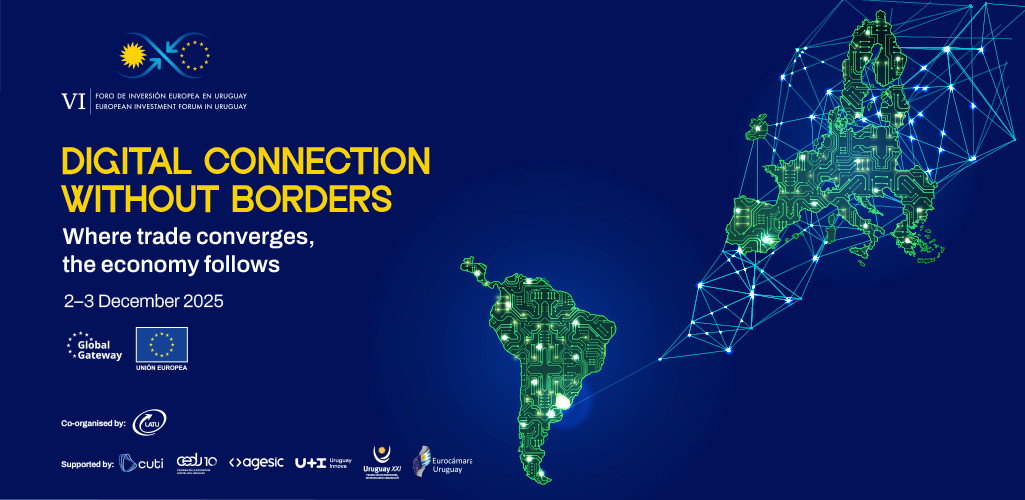
VI European Investment Forum in Uruguay: "Digital Connection without Borders"
In-person conference and streaming
- 2 December
- 08:30 to 13:30 Montevideo time
13:30 to 18:30 Brussels time - LATU Innovation Park Auditorium
Register for the conference here
(required both for those attending in person and those who will watch it by streaming)
Download:
-
Image
 Copyright
UEenUruguay
Virtual business roundtable
- 3 December
- 08:30 to 12:00 Montevideo time
13:30 to 17:00 Brussels time
Register for the virtual
business roundtable here
-
Image
 Copyright
UEenUruguay
Digital trends
The European Union and Uruguay share a common vision in the digital sphere, reflecting their close relationship in business, trade, and investment. Both in the European Union and in Uruguay, the digital economy has experienced sustained growth in recent years, and e-commerce has become a key driver of economic activity.
In Uruguay, the technological ecosystem and e-commerce are clearly expanding. Many thriving companies (such as the FinTech unicorn dLocal) have built a strong reputation and a strategic position in the digital sphere in South America. Uruguay is also recognized as an excellent destination for information technology services, including back-office operations, data centers, and call centers, making it an attractive near-shoring destination. E-commerce continues to grow, with online sales reaching USD 1.942 billion in 2024 - a 24% real increase compared to 2023. This volume represents 3.2% of private consumption and 2.4% of the country’s Gross Domestic Product (GDP). Uruguay still has room to grow, as this last percentage is higher in other countries (for example, 6% in Finland).
The EU is a global leader in innovation and technological development, setting benchmark standards in areas such as artificial intelligence, cybersecurity, and e-commerce. Thanks to the strong development of its companies, which drive technological innovation, the European Union continues to expand its presence in major international markets.
Regarding e-commerce, in 2024, 61% of internet users in the EU purchased goods or services online, compared to 54% in 2020. Internet access has also expanded significantly: while in 2014, 42% of Europe’s population was connected, by 2024, the figure reached 67%, confirming a broader process of social digitalization. At the business level, 13% of EU companies had incorporated artificial intelligence technologies by 2024, reflecting significant progress in the adoption of cutting-edge solutions. Meanwhile, SMEs with a basic level of digitalization increased from 55% in 2021 to 58% in 2023, reinforcing the digital transformation of a sector that forms the backbone of the European economy.
-
Image
 Copyright
UEenUruguay
Digitalisation waits for no-one
Digitalisation is transforming both the European Union and Uruguay. Don’t get left behind.
The European Union is a key trading partner for Uruguay and its largest foreign investor, accounting for 46% of foreign direct investment and with around 600 European companies operating in the country.
Reflecting their close business and investment ties, the EU and Uruguay share a clear vision of digital convergence – and are working to deepen it further:
-
Artificial Intelligence
In September 2025, Uruguay became the first Latin American country to join the Council of Europe’s AI Treaty. -
Cybersecurity
Since 2022, Uruguay has been part of the EU CyberNet initiative, aimed at strengthening cybersecurity capacities across the Southern Cone, aligned with Uruguay’s National Cybersecurity Strategy (2025). -
Data Governance
The EU has recognised Uruguay as an “adequate country” for personal data transfers under the General Data Protection Regulation (GDPR) since 2012, positioning Uruguay as a regional leader in data protection. -
Mutual Recognition of Digital Signatures
Uruguay and the EU are negotiating mutual recognition of digital signatures. Uruguay was the first country in the world outside the EU to request this agreement.