The RACC contributes to the final drafting of the G5 Sahel Gender Policy
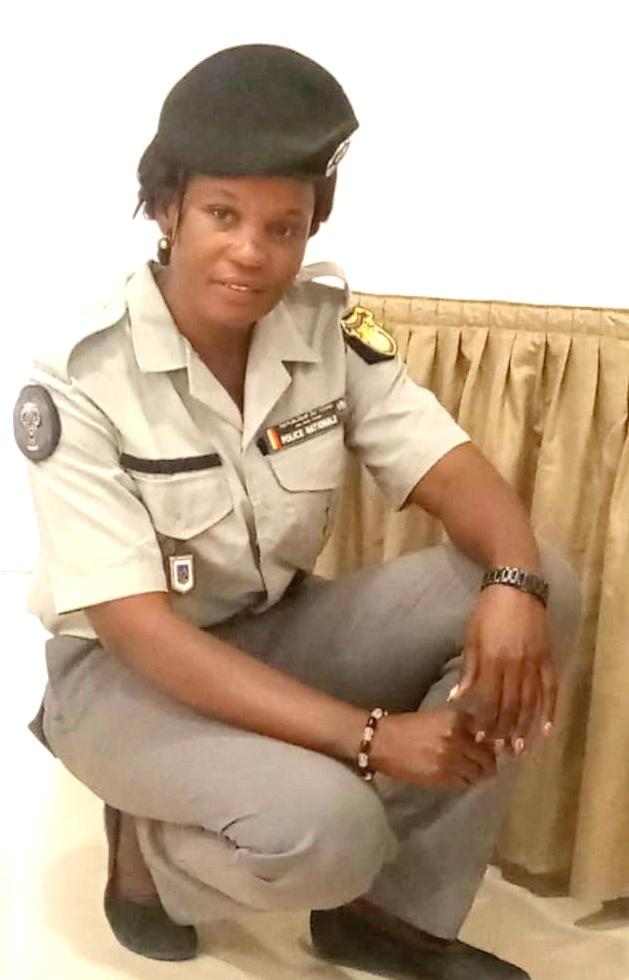
Alphonsine Allahodoum, from Chad: Deputy Head of Brigade, Central office for the fight against drugs and terrorism.
One of the objectives of the EU Regional Advisory and Coordination Cell for the Sahel – RACC, is to contribute to the integration of gender dimension into the different institutions and programs of the G5 Sahel.
The latest draft of the Gender Policy of the G5 Sahel, to which the RACC has contributed through its advisory function, was discussed in Nouakchott on 10 June 2022.
The meeting was organised by the Executive Secretariat of the G5 Sahel. Online participants included the Women Platform of the G5 Sahel, UN Women, the National Coordination Committees (NCC) of the G5S, the EU Delegation to Mauritania, and the RACC.
Discussions were very lively.
The RACC’s Human Rights and Gender Advisor, Marianne Flach explains how this milestone has been reached: “The first draft of the Gender Policy was circulated amongst a steering committee, of which the RACC was a member. Through its advisory function, the RACC ensured that the Gender Policy was well aligned with the other major strategic documents of the Executive Secretariat of G5S, notably the Security and Defense Strategy (SDS), the Integrated Framework of Priority Actions (CAPI) and the Priority Investment Programme (PIP).”
All Sahel countries have their national strategies and policies concerning gender, adds Marianne Flach, underling how the G5S Gender Policy does not impose its policies on the national strategies, rather it attempts to bring coherence in the way Defense and Security issues are part of the national strategies.
In the context of the RACC’s contribution to the definition of the main priorities of the G5 Sahel Gender policies, the Ndjamena (Chad) G5 Sahel meeting that took place last December was an important step. On the occasion, the RACC’s Interior Security Expert and the Gender Focal Point of the EU Delegation to Chad joined the discussions, contributing to the appropriate inclusion into the Gender Policy of the four strategic priorities in key G5 Sahel documents which are Security and Defense, Governance and Reconciliation, Infrastructures, and Resilience, Human Development and Humanitarian Action. These are included as sections in the Gender Policy, and for each section gender actions were defined during the Ndjamena meeting.
Some examples of these priority gender actions include the commitment to the integration of more women into the forces, as well as develop the capacities of the forces to better protect women’s rights in times of conflict, both mentioned in the section on Security and Defense. Also, in the section on Governance it is mentioned that the Executive Secretariat strives to improve women’s leadership in the fight against extremism. Finally, in the section on Resilience, the need for women’s capacity development for the fight against climate change is mentioned.
The final version of the G5 Sahel Gender Policy will be completed in July 2022 and discussed during a planned internal workshop at the SE G5S, in view of preparing action plans.
Since the adoption over twenty years ago of the UN Council Resolution 1325 on Women Peace and Security (WPS), the EU has actively implemented it, putting it at the centre of the full spectrum of the EU Common Foreign and Security Policy.
The latest example of the EU everlasting commitment to WPS is the EU Strategic Compass where Women, Peace and Security forms an integral part.
Sahelian women remain important victims of the conflict, and it is crucial that they are part of the solution.
Within the overall framework of the EU engagement in the Sahel the RACC remains fully committed to contribute to a meaningful and equitable role in decision-making for women in conflict prevention, peacebuilding and post-conflict rehabilitation.