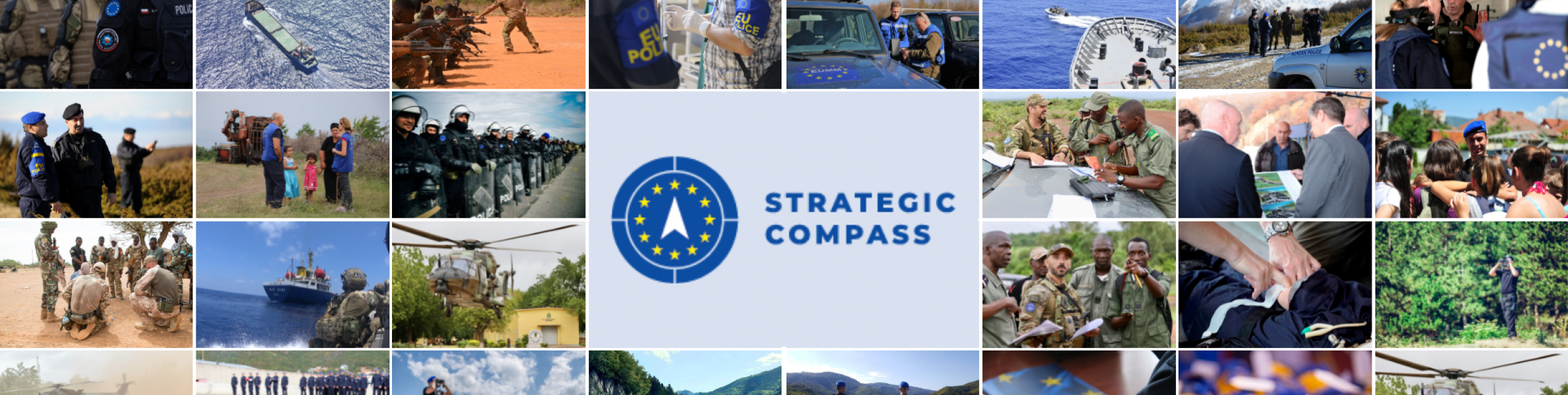
A Strategic Compass for Security and Defence
The European Union and its Member States formally approved the Strategic Compass in 2022, just a few weeks after the return of high-intensity war on our continent. Since then, the global threat landscape has become even more alarming. Four years after the adoption of the Strategic Compass, the world is no less complex, and the threats and challenges we face have only increased. Simultaneously, our understanding of security has greatly expanded.
The Strategic Compass is an ambitious plan of action for strengthening the EU's security and defence policy by 2030. It's an EU security and defence strategy to advance towards a common forward-looking strategic culture as well.
The strength of our Union lies in unity, solidarity and determination. The objective of the Strategic Compass is to make the EU a stronger and more capable security provider. The EU needs to be able to protect its citizens and to contribute to international peace and security. This is all the more important at a time when war has returned to Europe, following the unjustified and unprovoked Russian aggression against Ukraine, as well as of major geopolitical shifts. This Strategic Compass enhances the EU’s strategic autonomy and its ability to work with partners to safeguard its values and interests.
A stronger and more capable EU in security and defence will contribute positively to global and transatlantic security and is complementary to NATO, which remains the foundation of collective defence for its members.. It also supports the global rules-based order, with the United Nations at its core.The Strategic Compass provides a shared assessment of the strategic environment in which the EU is operating and of the threats and challenges the Union faces. The document makes concrete and actionable proposals, many of which are already being delivered, improving the EU's ability to act decisively in crises and to defend its security and its citizens. As of 2026, most of the Compass’s objectives have been implemented, while some work remains to achieve all of them.
The Compass covers all the aspects of the security and defence policy and is structured around four pillars: act, invest, partner and secure.
-
Image
 Copyright
European Union, 2026
2026 Progress Report on the Implementation of the Strategic Compass for Security and Defence
Under the guidance of the Compass, we continue to advance on our ability to guarantee access to strategic domains.
Since its adoption in March 2022, the EU has implemented many of the goals set in the Strategic Compass and further accelerated work to strengthen European security and defence.
Russia’s war of aggression against Ukraine has instilled further urgency into our efforts to make the EU a stronger and more credible security and defence actor.
Our response to this military aggression has been united and unprecedented from the start, rapidly putting the Compass into motion and mobilising tools foreseen across its four pillars. This included the provision of lethal and non-lethal equipment as well as the training of more than 90,000 Ukrainian military and capacity building of Ukrainian armed forces within the EU Military Assistance Mission (EUMAM).
Additionally, the EU Advisory Mission for Civilian Security Sector Reform (EUAM) in Ukraine remains an important element of overall EU support, as it provided training to nearly 7000 counterparts and broadened its activities to several key areas, such as countering hybrid threats and protecting critical infrastructure, veterans’ reintegration and psychosocial support, and strengthening resilience of the civilian security sector.
In the past year, the EU Rapid Deployment Capacity became operational in May 2025, enhancing the Union’s ability to respond swiftly to external crises, while live exercises continue to strengthen readiness and interoperability.
Additionally, the EU further reinforced its resilience against hybrid, cyber, space and maritime threats, including through the first deployment of a Hybrid Rapid Response Team to Moldova, continued action against Russia’s destabilising activities, and stronger protection of critical infrastructure such as submarine cables.
Regarding investments, Member States continued to increase defence spending, estimated at EUR 392 billion in 2025, while key instruments such as SAFE (up to EUR 150 billion) and the European Defence Industry Programme (EUR 1.5 billion) were launched to help close capability gaps, strengthen the European defence industry and support joint procurement.
Lastly, the EU expanded and deepened cooperation with like-minded countries by concluding new Security and Defence Partnerships with the United Kingdom, Canada, India, Australia, Iceland and Ghana, while further reinforcing cooperation with NATO, the UN and regional partners.
Act
To act rapidly and robustly whenever a crisis erupts, with partners if possible and alone when necessary, the EU:
- Established a strong EU Rapid Deployment Capacity of up to 5000 troops for different types of crises, which becoming operational in May 2025
- Conducts regular live exercises on land and at sea, including EU Rapid Deployment Capacity live exercises.
Enhances military mobility, including through the Military Mobility Package presented in November 2025 - Reinforces the EU's civilian and military CSDP (Common Defence and Security Policy) missions and operations by making them more adaptable, strengthening command and control structures, and improving decision-making while ensuring greater financial solidarity.
- Makes full use of the European Peace Facility to support partners.
Secure
To strengthen its ability to anticipate, deter and respond to current and fast-emerging threats and challenges, and safeguard the EU’s security interests, the EU is implementing measures to:
- Boost its intelligence analysis capacities including by strengthening the Single Intelligence Analysis Capacity and reinforcing the EU Satellite Centre.
- Use the Hybrid Toolbox and deploy Rapid Response Teams to detect and respond to a broad range of hybrid threats
- Further develop the Cyber Diplomacy Toolbox to strengthen EU cyber defence and resilience, including through the Cyber Solidarity Act and work to establish an EU Cyber Defence Coordination Centre.
- Be better prepared for and respond to cyberattacks through an EU Cyber Defence Policy
- Use our tools against Foreign Information Manipulation and Interference, including by raising situational awareness and the inclusion of CSDP missions and operations through the equipment of monitoring capabilities
- Implement the 2023 EU Space Strategy for Security and Defence, and conduct preparatory work on a European Space Shield
- Strengthen the EU’s role as a maritime security actor, including through maritime operations and exercises, as well as action to counter shadow fleet.
Invest
Member States have committed to substantially enhance their defence expenditures to match our collective ambition to reduce critical military and civilian capability gaps and strengthen our European Defence Technological and Industrial Base.
Therefore, the EU:
- provides incentives for Member States to engage in collaborative capability development and jointly invest in strategic enablers and next-generation capabilities, supported by instruments such as SAFE and the European Defence Industry Programme.
- boosts defence technological innovation to fill strategic gaps and reduce technological and industrial dependencies, including through the European Defence Fund, innovation initiatives such as BraveTech EU.
Partner
To address common threats and challenges, the EU is enhancing its partnerships by:
- Strengthening cooperation with strategic partners such as NATO, the UN and regional partners, including the OSCE, AU and ASEAN
- Developing and further deepening tailored bilateral partnerships with like-minded countries and strategic partners including through Security and Defence Partnerships, concluded with Moldova, Norway, Japan, the Republik of Korea, North Macedonia, Albania, the UK, Canada, India, Iceland, Australia and Ghana
- Developing tailored partnerships in the Western Balkans, our eastern and southern neighbourhood, Africa, Asia and Latin America, including through enhancing dialogue and cooperation, promoting participation in CSDP missions and operations and supporting capacity-building.
The way forward
While the Fourth Annual Progress Report highlights that many of the objectives from the Strategic Compass have been achieved, it also identifies remaining areas of work and gives concrete recommendations for further action.
These recommendations, combined with input from Member States, academia and think tanks, will feed into the new European Security Strategy (ESS).
The aim of the ESS is to streamline the lessons learned from the implementation in the Strategic Compass to create a broader and more comprehensive picture of our security environment and the EU’s way forward.
Main documents
- A Strategic Compass for Security and Defence - document (EN) (FR)
- 2026 Annual Progress Report on the Implementation of the Strategic Compass for Security and Defence (EN)
- 2025 Annual Progress Report on the Implementation of the Strategic Compass for Security and Defence (EN)
- 2024 Annual Progress Report on the Implementation of the Strategic Compass for Security and Defence (EN)
- Factsheets:
A Strategic Compass for the EU
EU Rapid Deployment Capacity