
The European Union and the Republic of Korea
The European Union(EU) and the Republic of Korea(RoK) are like-minded partners sharing similar values and common interests. Strategic Partners since 2010, cooperation between them brings tangible benefits to citizens in both regions and the wider international community. This interaction is facilitated through three core agreements:
• The EU-RoK Framework Agreement (2010);
• The EU-RoK Free Trade Agreement (2010);
• EU-RoK Framework Participation Agreement (2014).
Cooperation with the RoK advances the priorities under the EU's Indo-Pacific Strategy on security and defence, trade and economic security, and the green and digital transitions.
The EU and the RoK held the first Strategic Dialogue in January 2026, taking our partnership to the next level by enhancing cooperation and coordination on key foreign policy issues.
The EU's goals are to support an easing tensions on the Korean peninsula and in the region, to uphold the international non-proliferation regime and to improve the situation of human rights in the DPRK.
Peace, Security and Defence
The EU and Republic of Korea work closely in the areas such as crisis management, maritime security, addressing hybrid and cyber threats and the fight against terrorism. In November 2024, the EU and the Republic of Korea adopted a Security and Defence Partnership, opening a new era for bilateral engagement on these matters. Through annual Security and Defence dialogues, the EU and the Republic of Korea advance cooperation on a wide range of shared security priorities. The first one took place in November 2025 in Brussels and the second one in May 2026 in Seoul.
The EU and RoK are defending between rules-based international order by:
• Supporting multilateral institutions
• Upholding the international nuclear non-proliferation architecture
• Contributing to crisis management and peacekeeping
• Collaborating on space security to protect space assets and space-based services
• Supporting open sea-lanes
• Preventing and countering terrorism and violent extremism
• Addressing hybrid threats and foreign information manipulation and interference
• Exchanging on relevant defence initiatives to uphold respect for international law in Europe, the Indo-Pacific and globally.
The EU and the RoK are supporting peace and security on the Korean Peninsula by:
• Urging the Democratic People´s Republic of Korea (DPRK) to abandon its nuclear and ballistic missile programmes and return to diplomacy towards a complete, verifiable and irreversible denuclearisation of the Korean Peninsula
• Calling on the UN Security Council and UN Member States to f ully implement relevant resolutions and to respond to the DPRK's illegal actions.
• Highlight the DPRK's obligation to protect human rights
• The EU and RoK condemn Russia's deepening military cooperation and arms trade with the DPRK in flagrant violations of multiple UNSC resolutions
Support to Ukraine
• Since the start of Russia’s illegal war of aggression, the EU and the RoK have stood with the people of Ukraine, providing financial and humanitarian support and conveying a joint message of solidarity with Ukraine, as well as a determination to uphold respect for international law in Europe, the Indo-Pacific and globally
• The EU and the RoK condemn Russia’s deepening military cooperation and arms trade with the DPRK in flagrant violations of multiple UNSC resolutions
Through the Framework Participation Agreement, the RoK contributes to and participates in EU crisis management operations, such as in EU naval Operation Atalanta and a joint naval exercise in early 2026.
Human Rights
Like in the Republic of Korea, fundamental rights are guaranteed nationally by the constitutions of the Member States and at EU level by the EU Charter of Fundamental Rights.
Under the aegis of the UN bodies, the Republic of Korea and the European Union also promote human rights abroad. The European Union views all human rights as universal, indivisible and interdependent. It actively promotes and defends them both within its borders and when engaging in relations with non-EU countries.
The 2012 strategic framework on human rights and democracy is designed to make EU human rights policy more effective and consistent. Promoting human rights work can help to prevent and resolve conflicts and, ultimately, to alleviate poverty.
In 2012, the EU appointed Mr. Stavros Lambrinidis as a Special representative for human rights. The EU has also adopted a number of guidelines to promote specific human rights. EU guidelines are not legally binding, but because they have been adopted at ministerial level, they represent a strong political signal that they are priorities for the Union.
- Death penalty - 2013
- Torture and other cruel, inhuman or degrading treatment or punishment - 2012
- Promotion and protection of freedom of religion or belief - 2013
- Promote and protect the enjoyment of all Human Rights by lesbian, gay, bisexual, transgender and intersex (LGBTI) - 2013
- Human Rights dialogues with third countries
- Children and armed conflict - 2008
- Human Rights defenders - 2008
- Violence against women and girls and combating all forms of discrimination against them - 2008
- International Humanitarian Law
- EU Human Rights Guidelines on Freedom of Expression Online and Offline - 2014
In 2017, the EU revised the 2008 guidelines for the promotion and protection of the rights of the child.
The Member States of the European Union are all Parties to the UN Human Rights Convention and the European Union is a State Party to the UN Convention on the Rights of Persons with Disabilities, in its own right.
The Republic of Korea is party to most of the main International Human Rights instruments with the exception of the Optional Protocol of the Convention against torture and the Optional Protocol to the Covenant on Civil and Political Rights on the abolition of the Death Penalty. The Republic of Korea has not acceded to four of the ILO’s core conventions, Conventions 29 and 105 on forced labour and Conventions 87 and 98 on freedom of association, the protection of the right to organise and collective bargaining. The positions of the Republic of Korea and the European Union are aligned in the Human Rights Council and at the UN General Assembly - not least on the issue of Human Rights in the DPRK especially the EU-Japan led resolution.
During the latest Universal Periodic Review by the UN Human Rights Council, which took place in 2012, the Republic of Korea accepted 42 of the 70 recommendations issued. The third UPR will be taking place in 2017.
Every year, the EU and the Republic of Korea hold human rights consultations, marks international human rights day (10 December) and other international day events relating to human rights, such as International Women’s Day (8 March). The EU Annual Report on Human Rights and Democracy appraises its human rights work worldwide on a thematic basis and on a geographical basis, including in the Republic of Korea.
Disarmament and Non Proliferation of Weapons of Mass Destruction.
The EU strongly and consistently supports international diplomatic and counter-proliferation efforts and works closely with the Republic of Korea on addressing DPRK nuclear and ballistic challenges. In support of the UN Security Council resolutions, the EU has adopted a series of sanctions, including additional sanctions, lastly on 6 April 2017.
Since its establishment, the European External Action Service (EEAS), coordinates the EU positions in international non-proliferation and disarmament fora, to ensure the active and visible EU role. In 2013, Jacek Bylica was appointed as the EU Special Envoy on Non-proliferation and Disarmament in order to reinforce EU action and enhance the visibility of its relevant policies.
The Republic of Korea is also active, as one of the 65 members of the Conference on Disarmament (CD), which was established in 1979 to negotiate the Biological Weapons Convention(link is external) and the Chemical Weapons Convention. In November 2016, the 15th Republic of Korea-United Nations joint conference on disarmament and non-proliferation issues was held on Jeju Island.
The engagement of the Republic of Korea towards promoting the international non-proliferation regime, including as the chair of Nuclear Supplier's Group and the Missile Technology Control Regime has to be underlined.
In November 2016, the Republic of Korea became the 91st State Party to the Arms Trade Treaty (ATT) and the European Union looks forward to working together with the Republic of Korea on the effective implementation of the ATT.
The participation of the Republic of Korea in EU crisis management operations.
The bilateral Agreement on EU crisis management operations came into force in December 2016 and reinforces the Strategic Partnership between the two entities by establishing a framework for the participation of the RoK in EU crisis management operations of a civilian and military character.
There are currently 16 EU crisis management operations in the world, where the EU mobilises all relevant instruments (political, diplomatic, economic, financial, military, consular, judicial and development aid related) to respond to emerging or ongoing crises throughout the world.
In March 2017, only a few months after the entry into force of the bilateral Agreement, the Republic of Korea dispatched the warship Choi Young to the EU naval force’s counter-piracy operation in the Gulf of Aden off the coast of Somalia.
Trade Relations
EU-REPUBLIC OF KOREA FREE TRADE AGREEMENT
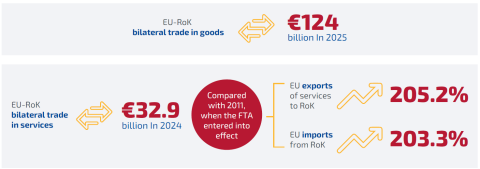
The Free Trade Agreement (FTA) between the EU and the Republic of Korea was applied in July 2011 and formally entered into force in 2015. It is the first trade deal with an Asian country and the first to include a chapter on trade and sustainable development. The EU-RoK FTA has become one of the EU’s most substantial bilateral economic relationships.
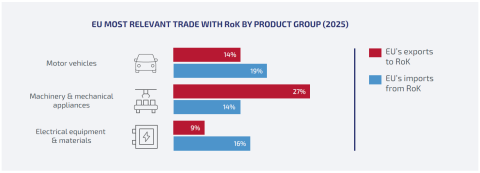
Trade in goods between the two partners rebounded in 2025 to around EUR 124 billion, with a trade deficit for the EU of around EUR 15 billion. The trade balance is nuanced. The EU imports large volumes of Korean semiconductors, vehicles, batteries and electronic components, resulting in a goods deficit. However, this is partly offset by a consistent European surplus in services, particularly in finance, professional services and intellectual property.
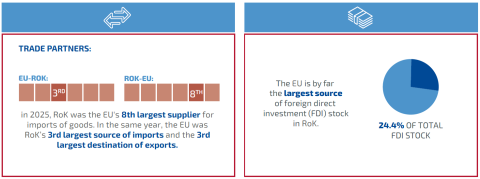
Bilateral trade in services reached around EUR 33 billion in 2024, growing modestly by 4% year-on-year. The EU has maintained a long-standing surplus in services trade with Korea, totalling EUR 8.6 billion in 2024. It also remained the largest foreign investor in Korea, with an FDI stock of EUR 53 billion (24.4% of Korea’s total), ahead of Japan (18.5%), the US (16.5%), Southeast Asia (16.2%), and China (5.8%).
European Union, 2026
European Union, 2026
Investment ties have deepened, with Korean companies expanding across Europe in batteries, electric vehicles, and semiconductor facilities. These long-term, strategic investments reflect industrial alignment rather than short-term trade flows.
European Union, 2026
The partnership increasingly focuses on shared priorities: decarbonisation, digital transformation, and supply chain resilience. Cooperation now extends beyond tariff reduction to emerging industries and regulatory standards. The EU–Korea relationship counters the narrative of fragmentation. Despite modest growth and structural challenges, both economies show that open markets, strong institutions, and technology underpin resilience.
For more information on the FTA and its implementation, see EU trade relations with the Republic of Korea. Facts, figures and latest developments and 2026 EU-ROK Trade and Investment Relation .
To complement the FTA, the EU-Korea concluded a Digital Trade Agreement in March 2025.
DIGITAL TRADE AGREEMENT
In November 2022, the EU and the Republic of Korea launched a comprehensive Digital Partnership to strengthen cooperation in crucial areas. Since the launch of the Digital Partnership, three Digital Partnership Councils have taken place in June 2023, March 2024 and in November 2025 in Seoul.
The EU and the RoK work across different fields of cooperation such as
- ICT collaborative research
- Semiconductors
- Quantum/HPC
- Cybersecurity
- Beyond 5G/6G
- Digital skills
- Online platforms
- Data
- SMEs digital transformation
The EU and RoK are both pursuing ambitious AI promotion and innovation agendas. As the first ones to pass AI legislation to ensure trust and legal certainty, the EU and RoK recognise the importance of AI safety, continued regulatory cooperation for the use of AI technologies and cooperation on global AI governance.
Cooperation between the Korean National Police Agency and Europol is developing based on the Working Arrangement that entered into force in 2021. The RoK joined the SIENA (Secure Information Exchange Network Application) community in June 2023. This platform allows for the secure and swift communication and exchange of operational and strategic crime-related information and intelligence, and the Europol Liaison Officer community in 2024.
Building on the EU-RoK Digital Trade Principles, the EU and RoK concluded a Digital Trade Agreement in March 2025 and signed it at the 11th Summit in June 2026. The agreement includes binding rules fit to face the fast-paced digital developments of today.
- Providing legal certainty for businesses and facilitate digital trade: Sets out rules on the use of electronic transactions with provisions on e-signatures, e-contracts, e-invoicing, e-payments, paperless trading, and single windows for data submission.
- Enhancing consumer and business trust: Improves trust in the digital trade environment through provisions on online consumer protection, spam, personal data protection and cybersecurity.
- Countering protectionist measures: Prohibits data localisation requirements and mandatory transfer of source code. It includes a a permanent ban on customs duties on electronic transmissions, as well as rules on open government data and internet access.
Since 2021, personal data flows freely and safely from the EU to the Republic of Korea on the basis of an adequacy decision.
Climate Change, Energy and Environment
Addressing global challenges of climate change, biodiversity loss and environmental pollution is a key priority for the European Union, and it is committed to delivering on the implementation of the Paris Agreement to keep the 1.5℃ target within a reach. (See EU Climate Action website)
The EU has adopted in 2019 a comprehensive strategic framework “The European Green Deal” aiming to make Europe climate neutral by 2050. To make this objective legally binding, the European Climate Law writes into law the goal set out in the Green Deal, also setting the intermediate target of reducing net greenhouse gas (GHG) emissions by at least 55% by 2030, and also recently in December 2025 the 90% reduction target by 2040 compared to 1990 levels.
In 2023, the EU fully adopted a package of legal proposals, known as the ‘Fit for 55’ package, which developed and revised all relevant policy instruments necessary to achieve the 2030 climate target. Through this effort, the EU’s share of global emissions is falling, now responsible for 6% of global emissions by bringing total reductions in 2023 to 37% below 1990 levels.
Climate change is a global challenge that requires a decisive and confident response from all countries. Green diplomacy is an integral part of the EU’s foreign policy agenda. Through diplomacy and cooperation initiatives, the EU aims to advance global climate action and support partner countries in their efforts to tackle the global climate and environmental challenges.
Against this backdrop, the EU is closely cooperating with the Republic of Korea and appreciates the Republic of Korea’s active and constructive contribution to multilateral dialogues such as international negotiations at various multilateral fora such as UNFCCC COPs, as well as other UN convention processes.
Bilaterally, the EU and the Republic of Korea have created a momentum in May 2023 to strengthen cooperation on climate action, clean and fair energy transition and protection of environment by establishing the EU-Korea Green Partnership. The Green Partnership focuses on several priority areas embracing climate mitigation & adaptation, biodiversity, deforestation, circular economy, environmental pollution, renewable energies and energy efficiency. The Green Partnership is supported by a dedicated EU-funded programme for its implementation, bringing together all relevant stakeholders including public sector, industry, academia and civil society to accelerate the cooperation.
Education and Culture
Education
The EU and the Republic of Korea both face similar challenges in terms of ageing populations and the need to compete in high-value sectors and nurture a skilled workforce to deal with these challenges. In that context, they also recognise the crucial contribution higher education makes to developing a globally competitive, knowledge-based economy and so boosting growth and jobs inter alia through the promotion of entrepreneurship.
The EU and the Republic of Korea both have much to gain by expanding academic links. The outstanding reputation of Korean education, and the country's leading role in research and technological development, make the Republic of Korea a highly valued partner.
The Joint Declaration signed on 11 November 2013 provides the framework for policy dialogue on issues of common interest in higher education. The first policy dialogue was held in Brussels (15/03/2016) to discuss practical ways of strengthening cooperation in higher education and to engage in an exchange of best practice, policy review and knowledge building and sharing. A second policy dialogue should be taking place in the Republic of Korea at a date to be determined.
On the practical level, over recent years, both sides have seen the practical value of cooperation and exchange, especially through Erasmus + and the co-funded Industrialised Countries Instrument – Education Cooperation Programme (ICI-ECP). These have helped develop joint degrees, partnerships and mobility programmes that have enhanced academic exchanges and prepared students for the increasingly globalised and competitive labour market.
In the Republic of Korea, there are 3 Jean Monnet Centres of Excellence, which act as focal points of competence and knowledge on European Union subjects, in the following Universities:
Other schemes include:
Erasmus Mundus Joint Master Degrees (EMJMD)
Research Fellowship Programme — Marie Skłodowska-Curie actions
Jean-Monnet Programmes for teaching and research in the field of European studies
Culture
Recognising the importance of culture in Foreign Policy, in 2016, the EU adopted a 'Strategy for international cultural relations' aiming at encouraging cultural cooperation between the EU and its partner countries and promoting a global order based on peace, the rule of law, freedom of expression, mutual understanding and respect for fundamental values.
Together with the Embassies of the Member States and their cultural institutes in the Republic of Korea, the European Union provides access to a wide range of European creativity by working closely with local partners in the field of culture.
Bilaterally, the EU and the Republic of Korea cooperate on cultural issues through a Protocol on cultural cooperation under the EU-Republic of Korea Free Trade Agreement, signed in 2010. Particular emphasis is given to the audio-visual sector, granting preferential treatment for market access for co-production and the promotion of audio-visual works of the EU and the Republic of Korea through film festivals and similar initiatives.
Science and Technology
The EU and South Korea have a long standing cooperation in the field of science and technology. The Agreement on the Scientific and Technological Cooperation between the EU and South Korea was signed in 2006 and entered into force in 2007. In addition, the Agreement for Cooperation between Euratom and South Korea in the field of fusion energy research has been in force since 2006.
The EU-Korea Joint Science & Technology Cooperation Committee (JSTCC) takes place biennially. The 8th edition (and the 1st Joint Committee meeting under Association Agreement) was held in Seoul on 7 March 2025. The two sides exchanged views on their latest science and technology policies, key thematic areas, such as health, artificial intelligence, quantum technologies, and carbon neutrality, and other Horizon Europe programmes, including the ERC, MSCA, EIC, and JRC.
Horizon Europe Association since 2025
As of 1 January 2025, the Republic of Korea joined Horizon Europe, the EU's research and innovation programme, as the first Associated Country in Asia. This association opens new opportunities for researchers and unlocks potential for collaboration. The Agreement was officially signed on July 17, 2025.
The Association agreement aims to foster joint research in fields such as health, digital transformation, and technological innovations for carbon neutrality. It is also designed to strengthen the geopolitical alliance between the EU and the Republic of Korea by fostering deeper cooperation in science, research, and innovationn. This association agreement with Korea strengthens the EU’s geopolitical alliance with like-minded countries.
The association allows Korean researchers to participate in Pillar II of Horizon Europe, which focuses on "Global Challenges and European Industrial Competitiveness." Under this pillar, Korean researchers and organisations can join and lead international research consortia on terms similar to those of EU Member States.
Background:
Horizon Europe, with a budget of €93.5 billion for 2021-27, is the EU's key funding programme for research and innovation. It tackles climate change, supports the UN's Sustainable Development Goals and boosts the EU's competitiveness and growth. Pillar II, the largest collaborative part with a budget of €52.4 billion, to which Korean researchers have access on equal terms now, focuses on shared global challenges such as climate, energy, digital economy and health.
Other pillars, including Excellent Science and Innovative Europe, along with the Marie Skłodowska-Curie Actions for doctoral education, postdoctoral training and collaborative research, remain open to Korean organisations and researchers.
As of end 2025, 22 countries are associated, either based on their membership of the European Economic Area (EEA); or as acceding countries, candidate countries and potential candidates; as European Neighbourhood Policy (ENP) countries; or as other third countries and territories that fulfil a set of criteria related to their economic, political and research and innovation systems.
Digital Partnership
Since 2022 the EU and the Republic of Korea have also entered into a Digital Partnership.
The Digital Partnership provides an overarching framework for advanced cooperation across the full spectrum of digital issues including infrastructures, skills, digital transformation of businesses, and digitalisation of public services, as well as digital economy and trade. It intends to strengthen consumer and business trust by respecting a high level of privacy and security.
Both sides have identified a set of joint actions for 11 priority areas to implement the Partnerships, including
- Collaborative Research
- Semiconductors
- High Performance Computing and Quantum Technologies
- Cybersecurity and trust
- Beyond 5G/6G
- Skille / Mobility
- Artificial Intelligence
- Platform Governance
- Data and data spaces
- Digital Identities
- Digital Trade
The third meeting of the Digital Partnership Council was held on 28 November 2025 in Seoul, both sides issuing a Joint Statement after the meeting.
At that occasion both sides took stock of the progress since the second EU-ROK Digital Partnership Council in Brussels (24 March 2024) and recognised that the Digital Partnership has brought important outcomes in various digital fields. Building on this success, both sides agreed that the Digital Partnership will be further deepened and to involve stakeholders in its implementation to foster industry cooperation.
Both reaffirmed the central role of the Digital Partnership in advancing cooperation in digital emerging technologies which will unlock mutual benefits for their economies. The Digital Partnership is crucial in boosting competitiveness, innovation and resilience in emerging technologies through advanced cooperation in research and innovation. It also enhances economic security by promoting resilience in digital critical technologies.
The EU Partnership Instrument
The EU Partnership Instrument (PI) for cooperation with countries that are not members of the EU aims to advance and promote the European Union and issues of mutual interests. It aims to support measures that respond in an effective and flexible manner to objectives arising from the Union's bilateral, regional or multilateral relationships with non-EU countries and address challenges of global concern and ensure an adequate follow-up to decisions taken at a multilateral level.
Since 2014, a number of PI projects in Korea have emerged as a direct result of the collaboration between the EU Delegation to the Republic of Korea and EU countries with Korean public authorities, civil society organisations, business promotion agencies, academia and more.
Among the key ongoing PI projects are:
- EU-RoK IP Action (https://internationalipcooperation.eu/en/rokipa ) on intellectual property
- the EU-Korea Green Partnership Programme (https://capacity4dev.europa.eu/projects/eu-korea-green-partnership-project_en )
- the EU business hub (https://korea.eubusinesshub.eu/about-programme-0 )
- EU-Republic of Korea (ROK) Aviation Partnership Project (https://www.easa.europa.eu/en/domains/international-cooperation/technical-cooperation-projects/eu-republic-korea-rok-aviation-0 )
- EU-Asia Competition Cooperation ( https://competitioncooperation.eu/about-the-project/ )