
EU-Norge symposium om sikkerhet og forsvar: Innlegg av Deputy Secretary General for Peace, Security and Defence, Charles Fries
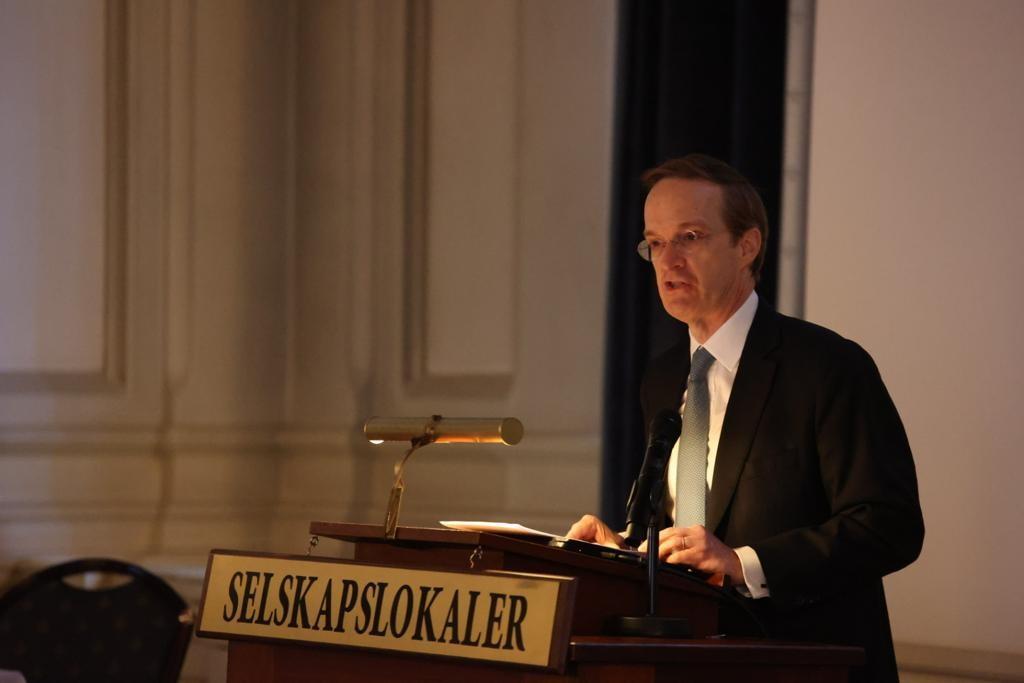
Bilde: NUPI
Thank you for hosting me in Oslo today.
Thank you to the Norwegian Ministry of Foreign Affairs and the Ministry of Defence as well as to Norwegian Institute of Foreign Affairs and the EU Institute for Security Studies for organising this event on EU-Norway security and defence cooperation.
Last week, High Representative Borrell hosted in Brussels the Schuman security and defence partnerships forum – with more than 50 partners participating, many at ministerial level. The objective was to listen to each other and to discuss how to further strengthen our cooperation.
It is no surprise that the Minister of Defence of Norway Bjørn Arild Gram played a prominent role at the Forum: we share the same interests and values as well as the same threat assessment. Norway is EU’s ‘most closely associated partner’. This is how Norway is qualified in the EU Strategic Compass on security and defence that European leaders adopted last year, a few weeks after Russia’s invasion of Ukraine.
This document will guide European efforts in the area of security and defence until 2030. EU Foreign and Defence Ministers met last week to take stock of its implementation, and all reiterated full support to this roadmap.
One of its objectives is to ‘deepen our constructive relations’ with Norway.
So, to set the scene for our conversation today, I would like to elaborate on three main questions:
- How did EU and Norway jointly respond to Russia’s invasion of Ukraine and what does it mean for our cooperation more generally?
- What can we do to further improve our common security?
- And lastly: how does the EU-Norway partnership fit in the broader context of transatlantic security and EU-NATO cooperation?
1. First, how did EU and Norway jointly respond to Russia’s invasion of Ukraine?
The EU’s response to the war in Ukraine has changed the way the EU Security and Defence agenda is regarded – both within and outside of the EU. Our resolve and our actions over this past year have surprised many, not least Russia.
From the start, Norway has been the first partner to engage with EU initiatives in support of Ukraine.
Let me give you three concrete operational examples where our partnership makes a real difference:
- Massive EU military support for Ukraine: to date, 5.6 Bn EUR (3.6 + 2Bn EUR politically agreed last week for the provision of ammunition and missiles) have been committed for Ukraine under the European Peace Facility. The delivery of lethal equipment was a taboo in the EU. Since the start of the invasion, the vast majority of our support for Ukraine via the European Peace Facility goes precisely into that. Norway has consistently regarded the EPF as a good vehicle to channel its support for the Ukrainian Armed Forces. So far, Norway has pledged almost 400 million Norwegian Krones (approx. € 35.6 million). This is much appreciated!
- Second example: the EU launched last year the most ambitious military training mission ever, in record time – and for the first time, on EU soil. The EU Military Assistance Mission for Ukraine is now well on track, with close to 11 000 Ukrainian soldiers already trained by now. The goal is to train a total of 30 000 Ukrainian soldiers by the end of the year. Here again, Norway chose to provide support and sent instructors to EUMAM training camps in Germany and Poland.
- Third example: EU Leaders agreed last week to speed up the delivery and joint procurement of one million rounds of artillery ammunition for Ukraine within the next twelve months. A 2 Bn EUR envelope was made available for that purpose under the EPF. We will deliver ammunition – and, if requested, missiles – from existing stocks or pending orders, but we will also jointly procure 155 mm ammunition from the European defence industry and Norway. We will do this through an existing project led by the European Defence Agency or through complementary joint acquisition projects led by a Member State. We welcome Norway’s decision to join this EDA project. As a member of the European Economic Area, Norway belongs to the internal market. Norway’s defence industry is part of the European defence industry. So, it is possible to involve relevant economic operators established in Norway in those joint procurement initiatives.
The threat posed by Russia, and the response to the invasion of Ukraine was a test for our political commitment and our partnership. The concrete examples I just mentioned show that our cooperation in the field of security and defence is not a political statement or a “paper-partnership”. It is real, and we can do even more together. This brings me to my second point.
2. What can we do to further improve our common security?
The new threats to Europe’s security highlight the urgency of stepping up our efforts in the area of security and defence.
EU leaders have already taken important decisions to develop a stronger and more capable European Union.
Several of these EU initiatives are relevant for Norway. And Norway’s participation in many of these EU intiatives brings a concrete added value for the EU.
Let me point to four examples – I am sure that some others will be mentioned in the course of our debate later:
Capability development is a key priority. Russia’s war in Ukraine confirmed the relevance of initiatives launched few years ago, such as PESCO and the European Defence Fund. Today, 35 Norwegian companies are benefitting from the European Defence Fund. This puts Norway among the 10 countries (EU member states included) with the highest number of entities benefitting from the EDF. I believe this is a positive development and one that shows clearly that EU efforts to support the European Defence Industry can also benefit our closest partners.
As the Commission is now taking additional steps in order to ensure a rapid ramp-up of production capacities, secure supply chains, facilitate efficient procurement procedures, and promote investments, it will be important to ensure that Norway is kept involved.
Second example: Military Mobility. This is another area where we need to advance our cooperation and switch from peace to war mode. The EU has put forward a new Action Plan on Military Mobility in November 2022. It builds on progress made since 2018, but it includes additional areas linked to the civilian and logistical sector, from cyber resilience to transport infrastructure. This new Action Plan also calls for a closer coordination with the Military Mobility PESCO project, of which Norway is a member since May 2021. The participation of NATO Allies such as Norway, Canada and the United States – and soon the United Kingdom - is key to the overall success of this project aimed at enabling the swift movement of military personnel and assets throughout the EU, whether by rail, road, air or sea.
So, we want to coordinate even more closely with Norway, as we will implement our new Action Plan on Military Mobility.
Third example: Resilience. As a result of the war in Ukraine, Norway has become the main provider of gas to Europe. But the Northstream pipelines explosion has raised the level of hybrid threat against the EU to a new level. Norway’s proximity to Russia’s major military bases requires continuous surveillance of the entire energy infrastructure in the North Sea. Coordinated efforts by Norway, Allies and EU member states are key to ensure the surveillance of critical infrastructure, both on shore, and at sea.
In the context of the EU-NATO partnership, we want to address specifically the resilience of critical infrastructures and we think that oil and gas infrastructure in the North Sea is a case in point. The recent visit of the President of the European Commission and the NATO Secretary General together with the Norwegian Prime Minister to a natural gas platform off the west coast of Norway is clear signal of joint commitment.
On a related issue, we also stand ready to cooperate closely on maritime security to secure the sea lines of communication that benefits the whole of the European continent. As Minister Gram stated in his remarks at the Schuman Forum: “protection of our seas is of vital importance for our prosperity and our security”. We would welcome closer engagement with Norway be it through Operation Atalanta or through the EU Coordinated Maritime Presences active in the Gulf of Guinea and North-Western Indian Ocean.
Another strategic domain: Space is an area extremely relevant for our cooperation, given Norway’s geographical position, its ground infrastructures in the Arctic, and its research station in Antarctica – all of them are crucial for satellite control and downloading of data and the EU space activities heavily rely on them. On its side, Norway participates in many EU space programmes such as Galileo or Copernicus. The EU has recently adopted its first Space Strategy for Security and Defence.
On both maritime security and space security and defence, the EU just adopted two important strategies, which we can use together to foster even further our cooperation. We will discuss this further in the framework of our dialogue.
3. Looking at the wider picture: how does the EU-Norway partnership fit in the broader context of transatlantic security and EU-NATO cooperation?
My main argument is that a stronger and more capable EU in the field of security and defence will contribute positively to global and transatlantic security and is complementary to NATO, which remains the foundation of collective defence for its members.
In other words: the more effective and stronger European defence will get, the more reliable the EU will become as a security and defence provider, and a good and efficient partner.
Our response to the Russian aggression has demonstrated the value and relevance of EU-NATO cooperation. While NATO has strengthened its deterrence and collective defence, the EU has used its unique toolbox to isolate Russia internationally, constrain it financially and economically, provide economic and humanitarian support to Ukraine, as well as military support to its armed forces. This is the best example of synergy and mutual complementarity.
Moving forward, we want to see a strengthened, expanded and even more concrete EU-NATO cooperation across the board, including in new areas – such as cyber, information manipulation and disinformation, critical infrastructure
Norway as a NATO Ally and closest EU partner with its unique geostrategic position has a key role to play in that regard. With Finland now entering NATO and Sweden on its way, Denmark returning to the EU’s Common Security and Defence Policy, Nordic security cooperation could serve as a vehicle for building a stronger EU-NATO partnership. We count on Norway to help us achieve that.
To conclude, the new geopolitical context imposed on us by Russia’s invasion of Ukraine leaves no room for hesitation or procrastination.
The EU-Norway cooperation has demonstrated its added value for both sides. It can be a vehicle for further EU-NATO rapprochement. I am looking forward to discussing how we can further strengthen our cooperation across all domains – operations, capabilities, resilience.
Thank you.