
GJU Launches Higher Diploma in Integrated Education (STEAM)

Amman – September 8, 2026 – The German Jordanian University (GJU), in partnership with the Queen Rania Teacher Academy (QRTA) and with the support of the European Union-funded EDU-SYRIA Programme, has launched the Higher Diploma in Integrated Education (STEAM), to enhance teachers' professional development, enabling them to keep pace with the rapid transformations in education and technology, and equipping students with the skills they need to thrive in the future.
The Higher Diploma in Integrated Education (STEAM) consists of 25 credit hours distributed over three academic semesters. It aims to prepare teachers to design and implement integrated educational units and experiences that connect different disciplines, utilize knowledge and technology in real-world contexts, and incorporate design thinking, project-based learning, and inquiry into educational practices.
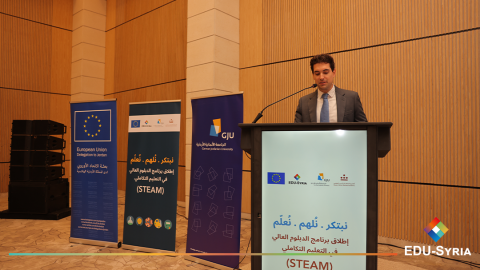
The diploma was launched during a conference held under the theme "We Innovate. We Inspire. We Educate," that brought together officials, experts, academics, and educators to discuss the future of education and skills, in the presence of H.E. Eng. Mothanna Gharaibeh, Former Minister of Investment, Digital Economy and Entrepreneurship.
The diploma offers an integrated educational model that brings together science, technology, engineering, arts, and mathematics. It empowers teachers to design learning experiences that transcend the boundaries of individual subjects and connect knowledge with practical applications and real-world challenges, with a focus on inquiry-and project-based learning, critical thinking, problem-solving, creativity, and innovation.
During his keynote address on the future of STEAM education and teachers' professional development, H.E. Eng. Mothanna Gharaibeh emphasized the importance of building students' future skills from the early years and shifting the focus from knowledge acquisition toward enabling students to apply knowledge in real-world situations, while developing their abilities in critical thinking, creativity, problem-solving, communication, and collaboration.
Gharaibeh highlighted the pivotal role of teachers in developing these skills and the importance of ensuring that education keeps pace with rapid developments in technology, artificial intelligence, and the labor market, while simultaneously strengthening human skills that will become increasingly important in the future. He stressed that preparing students for the future is a shared responsibility that requires integrated efforts among schools, universities, the private sector, and policymakers.
President of GJU, Prof. Ala'aldeen Al-Halhouli, said that launching the Higher Diploma in Integrated Education (STEAM) reflects the University's belief in the importance of investing in teachers and equipping them with the knowledge, skills, and tools needed to develop educational practices and create a tangible impact in learning environments.
He added that the program comes at a time when the world is witnessing rapid transformations in technology and artificial intelligence, making the development of education and the empowerment of teachers essential to preparing generations capable of learning, innovating, and competing. He emphasized that empowering teachers is an investment in people and in the future of the nation and its economy.
For his part, Chief Executive Officer of the Queen Rania Teacher Academy, Abdul Majeed Shamlawi, said that launching the diploma represents a model of partnership that connects academic knowledge, professional expertise, and the needs of the education field. He noted that advancing STEAM education and achieving sustainable impact require joint efforts among universities, teacher preparation institutions, the Ministry of Education, human resource development institutions, the public and private sectors, and international partners.
Shamlawi added that the Higher Diploma provides an academic and professional framework that enables teachers to translate integrated education concepts into practical practices within learning environments and design experiences that are more closely connected to students' lives and realities, thereby strengthening the teacher's role as a learning designer and a leader of innovation within the school.
European Union, 2026
In his remarks, Adrian Fernandez Dickmanns, Attaché for Migration and Mobility at the European Union Delegation to Jordan reaffirmed the European Union's support for the Higher Diploma in Integrated Education (STEAM) through the EDU-SYRIA Programme. He highlighted the programme's role in equipping teachers—particularly those serving marginalised schools and underserved communities—with future-oriented skills, while promoting quality education, sustainability, and scalability across Jordan.
The program also focuses on enabling teachers to utilize educational and emerging technologies, including artificial intelligence, virtual reality, and augmented reality, while enhancing experiential learning. It also aims to develop assessment methods that measure students' learning and their ability to apply knowledge, demonstrate creativity, and solve problems. The first cohort of the diploma is scheduled to begin in October 2026.
The launch of the diploma comes within the framework of cooperation supported by the EU-funded EDU-SYRIA Programme, contributing to expanding access to high-quality professional development programs, strengthening teachers' capacities, and supporting efforts to improve the quality of education in Jordan.
Interested teachers can apply for the Higher Diploma in Integrated Education (STEAM) through the MyGJU Guests portal at https://guests.gju.edu.jo. Applications are open from August 23 to September 20, 2026.

European Union, 2026