Improving Connectivity for Critical Raw Materials in Central Asia: Insights from Industry

On 5 November 2026, the European Union, in cooperation with the Organisation for Economic Co-operation and Development (OECD) and the Government of Uzbekistan, supported a workshop in Tashkent to present the preliminary findings of the EU-funded project Improving Connectivity for Critical Raw Materials in Central Asia: Insights from Industry. The event brought together representatives of the public and private sectors to discuss transport, trade and investment conditions shaping critical raw material value chains in Uzbekistan and across Central Asia, and to explore opportunities for strengthening regional connectivity and facilitating sustainable investment in the sector.
Discussions pointed to three closely connected challenges: improving the reliability and competitiveness of transport routes to international markets; facilitating trade and transit across borders; and creating the conditions for commercially viable investment in domestic mineral processing to move up value chains.
Opening remarks
Mr Christos Marazopoulos, Head of Co-operation at the Delegation of the European Union in Uzbekistan, reaffirmed the EU’s support for Uzbekistan’s development priorities. He emphasised the value of public-private dialogue in identifying the infrastructure, regulatory and policy constraints affecting mineral exports from Central Asia, and in exploring opportunities to facilitate and strengthen critical raw material trade between Uzbekistan and EU markets.

EU in Uzbekistan
Mr Rustam Yusupov, Deputy Minister of Mining and Industry and Geology of Uzbekistan, thanked the OECD and the EU for organising the workshop and underscored the importance of mineral trade and the development of the mining industry for Uzbekistan’s economy. He encouraged participants to identify practical ways to strengthen Uzbekistan’s connections with international markets, including the EU and OECD member countries.
Part I: Transport and logistics
Ms Céleste Laporte Talamon, Deputy Head of the Central Asia Unit in the OECD Eurasia Division, presented preliminary OECD findings on transport and logistics along the Trans-Caspian Transport Corridor (TCTC). While use of the TCTC has increased among surveyed companies in Uzbekistan, most respondents reported that they continued to rely on the Northern Corridor for mineral exports to the EU. Respondents identified higher costs, longer transit times and limited predictability of the TCTC as important constraints on its use.
The findings also suggest that addressing bottlenecks requires action beyond individual countries. While Uzbekistan is investing in its domestic transport and logistics infrastructure, the competitiveness of the TCTC also depends on capacity and co-ordination across the wider corridor, including freight capacity across the Caspian Sea.
Ms Dildora Ibragimova, Head of Department of Complex Development of Transport Systems at the Centre for the Study of Transport and Logistics Development Issues under the Ministry of Transport of Uzbekistan, highlighted capacity constraints affecting the TCTC, including challenges related to Caspian Sea levels and high transport costs. She outlined Uzbekistan’s efforts to expand warehousing and multimodal transport capacity and raised the potential for stronger connections between the China-Kyrgyzstan-Uzbekistan railway, currently under construction, and TCTC routes through Uzbekistan. She also stressed the importance of stronger regional and EU-Uzbekistan co-operation to improve the co-ordination of transport operations.
Part II: Trade facilitation, export restrictions and transit policies
Mr Egor Polishchuk, Policy Analyst in the OECD Eurasia Division, presented preliminary OECD findings on trade and transit policies affecting critical raw materials in Central Asia. He highlighted the progress made by Uzbekistan in reforming its trade framework and reviewed mineral export restrictions across the region. Survey results nevertheless suggest that Uzbek exporters continue to face constraints arising from transit policies in neighbouring countries, including Russia, China and Kazakhstan.
Mr Abror Kushmatov, Deputy Head of the Department for Improving the Business Environment and Ratings at the Ministry of Investment, Industry and Trade of Uzbekistan, reiterated Uzbekistan’s objective of finalising its WTO accession by the end of 2026 and outlined the country’s framework governing mineral export restrictions. He also presented ongoing efforts to accelerate transit through digitalisation and the exchange of transit documentation with neighbouring countries.
Mr Yerzhan Shakargaliyev, Director of the Tariff and Non-Tariff Measures Department at QazTrade, presented Kazakhstan’s experience in facilitating mineral transit towards European markets. Measures include electronic licensing for mineral exports, digitalised customs procedures through the Keden platform, electronic transit declarations for rail freight and electronic queuing systems at road border crossings.
Private-sector participants illustrated how these conditions affect commercial decisions. Mr Dima Orazimbetov, Nonferrous Metals Trader at Trafigura, noted that transport times and costs had risen as some mineral exports to European markets shifted from the Northern Corridor to the TCTC. In this context, he observed that exporting copper to China could increasingly offer a more competitive commercial alternative to Western markets.
Mr Sergei Redkin, Expeditor at Cargo Star, highlighted the challenges that international sanctions can create for Uzbek mineral transporters, particularly for transit through Kazakhstan and Russia. He also stressed the commercial implications of high transport costs and long delivery times along the TCTC.
Part III: Domestic processing capabilities and investment opportunities
The final session examined the conditions needed to support greater domestic processing of critical raw materials and attract investment into mineral value chains.
Mr Egor Polishchuk presented recommendations from OECD work on attracting sustainable investment into the mining sector, alongside preliminary findings from the industry survey. Respondents expressed interest in expanding mineral-processing activities but also raised questions about the commercial viability and profitability of potential projects and the availability of international financing.
Mr Almaz Ashirov, OECD Local Consultant, presented a case study on Kazakhstan’s tungsten industry. Against the backdrop of higher tungsten prices and changing international trade conditions, he discussed opportunities for stronger Kazakhstan-Uzbekistan co-operation, including on the security of mineral supply, assessment of extraction technologies, exchange of technical expertise and potential investment in concentrate production.
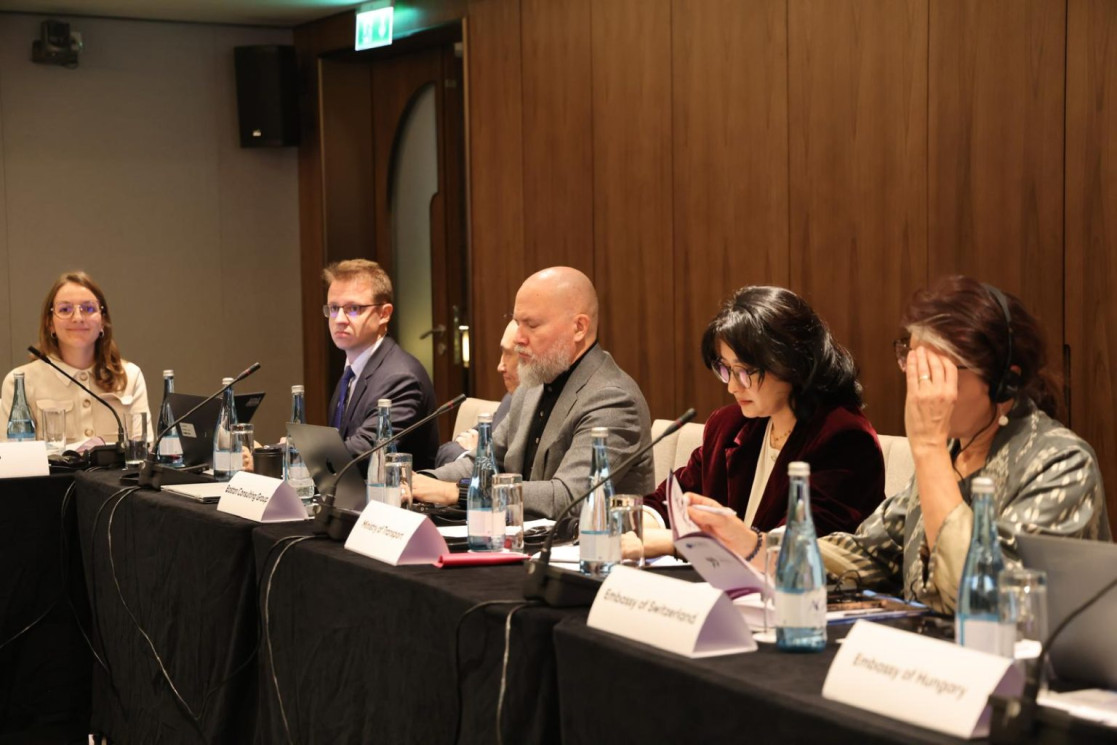
Mr Akbarkhan Bobokhanov, Deputy Head of Department for Investments at the Almalyk Mining and Metallurgical Combine, outlined the company’s ongoing processing-capacity expansion and its interest in attracting investment from a range of international partners. He noted, however, that accessing some sources of international finance can require additional technical and feasibility studies, reflecting differences between national requirements and the standards applied by international financial institutions.
EU in Uzbekistan
Mr Timur Khikmatullayev, Special Envoy to the Chairman of the Board and Director of the Diplomatic Cooperation Department at UzTMK, presented the company’s plans to expand metallurgical production, building on its existing tungsten and molybdenum processing activities. He emphasised that further expansion would depend on several enabling conditions, including secure feedstock, predictable water and energy costs, access to lower-carbon power, workforce development, and more efficient and interoperable customs and transit systems.
Mr Andrei Lukyanov, Partner at Boston Consulting Group (BCG), similarly stressed that expanding domestic processing requires more than new production capacity. He highlighted the importance of securing predictable feedstock, developing a pipeline of commercially viable projects, strengthening workforce skills, increasing access to renewable energy and establishing reliable offtake arrangements for new processing capacity.
Taken together, the discussions highlighted that stronger critical raw material value chains in Central Asia depend on progress across several interconnected areas. More competitive transport routes, predictable transit arrangements and effective trade facilitation can improve access to international markets, while investment in processing will also depend on commercially viable projects, reliable infrastructure and inputs, appropriate skills and financing, and predictable demand.