
The European Union and the United Nations
The EU is a staunch supporter of the UN. Cooperation between the EU and the UN system, including the UN Secretariat and the various UN Agencies, Funds and Programmes, spans all policy areas.
The European Union at the United Nations
EU-UN cooperation includes multiple areas and a broad range of issues, including human rights, sustainable development, climate change and environmental protection, digital issues, peacebuilding, disarmament and non-proliferation, humanitarian assistance, fighting corruption and crime, advancing global health security, managing migratory flows, labour issues, and UN reform.
UN GENERAL ASSEMBLY

UN Photo/Manual Elias 2018
The General Assembly is the UN’s main deliberative, policymaking and representative organ.
Since 2011, the EU is an observer member with enhanced status at the UN General Assembly. This allows the EU to present common positions, make interventions, present proposals and participate in the general debate each September.
The added value of the EU is to coordinate among its 27 Member States to present a unified position. The EU coordinates its voting within the UN General Assembly’s six main committees, as well as other bodies and agencies such as the Economic and Social Council.
UN SECURITY COUNCIL

UN Photo/Rick Bajornas 2017
Article 34 of the Lisbon Treaty stipulates that EU members at the UN Security Council must act in concert and foster the interests of the EU. The strong presence of EU Member States at the UN Security Council and an effective coordination among them as well as with other partners contributes to the promotion of EU interests in a cooperative way.
Currently, there are four EU Member States on the Security Council. France as a permanent member, and Denmark and Greece (2025-2026), and Latvia (2026-2027), as non-permanent members. From January 2027, Austria and Portugal will join the Security Council as non-permanent members for the 2027-2028 term.
Supporting the UN
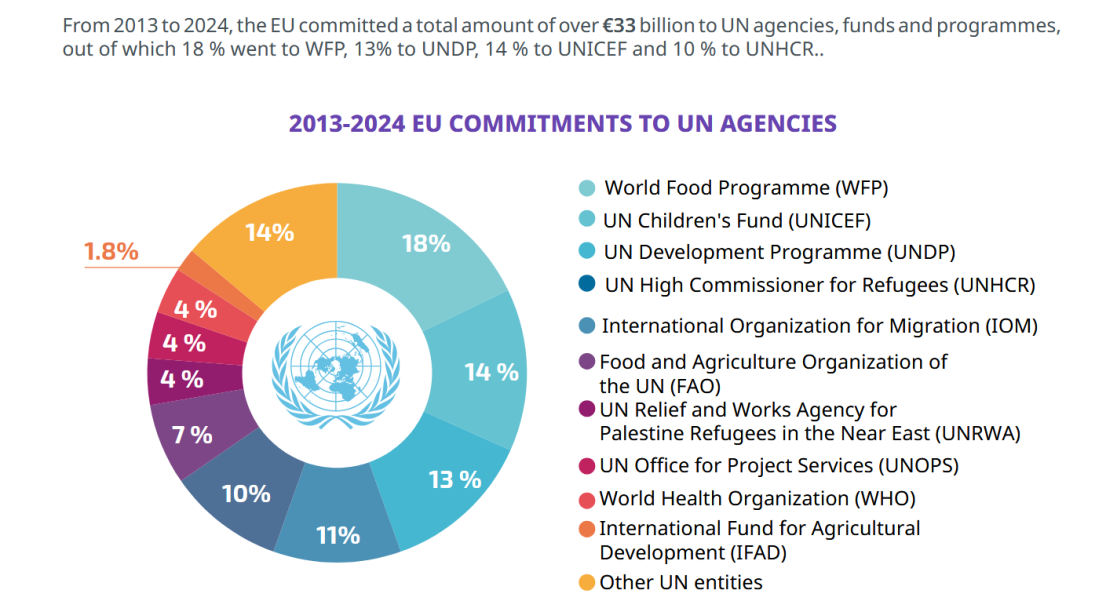
The EU and its Member States are collectively the single largest financial contributor to the UN system. Together, EU and its Member States provide almost one-third of voluntary contributions to the UN’s agencies, funds and programmes, whilst EU Member States also provide over one-fifth of the UN’s regular budget (22.3%) and UN Peacekeeping budget (21%).
In 2024, the UN system received voluntary contributions of approximately:
- $3.6 billion from the EU;
- $9 billion from EU member states.
Source: UN System Chief Executives Board for Coordination
Aligned with the UN’s 2030 Agenda and its Sustainable Development Goals, the EU and its Member States are the leading development donors in the world, providing over €96 billion in development assistance in 2023. Much of this funding is channeled through UN agencies.
The EU and EU Member States are among the top financial donors to many key UN bodies, including the UN’s Children Fund (UNICEF), the World Health Organisation (WHO) and the UN Development Programme (UNDP).
They are also the largest donors to the United Nations Relief and Works Agency for Palestine Refugees in the Near East (UNRWA), together providing between 40-50% of its funding over time.
Together, the EU and the UN also work to eradicate hunger around the world.
European Union 2025
-
Image
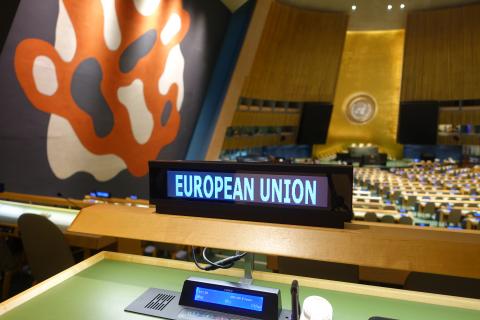
View from the European Union seat in the United Nations General Assembly Hall
Copyright: European Union/Photo by Shila Patel
EU Priorities at the UN General Assembly
The Council adopted the EU priorities for the 81st session of the UNGA (September 2026 – September 2027) in July 2026.
The EU firmly believes that it is in the collective and individual interest of all to ensure respect for international law and the sovereign equality and territorial integrity of all States, to commit to the peaceful settlement of disputes and to invest in international cooperation. At a time of growing fragmentation, contestation and serious violations of international law, the EU and its Member States remain steadfast in their commitment to an effective multilateral system, based on international law and the purposes and principles of the UN Charter.
The EU will remain a predictable and credible partner, working with partners and across regions to defend and uphold international law and to find global solutions to common challenges, including through the implementation of the Pact for the Future.
In a changing world, the multilateral system must continue to evolve. The EU also stands ready to engage with partners in advancing the UN80 reform initiative towards a more effective, cost-efficient and responsive United Nations that is fit to address today's and tomorrow's challenges.
Four priorities will guide EU action at the UN this year:
I. Defend and develop an efficient, effective and inclusive multilateral system firmly rooted in the UN Charter and international law, including international humanitarian law and international human rights law
II. Advance reforms towards an effective, cost-efficient and responsive UN in all three pillars through partnerships and coalitions
III. Strengthen the UN peace and security architecture based on prevention and sustaining peace
IV. Advance prosperity and sustainable development towards 2030 and beyond