
UN Women and the European Union drive action for gender equality and inclusive workplaces in China (15 July 2026 - World Youth Skills Day)
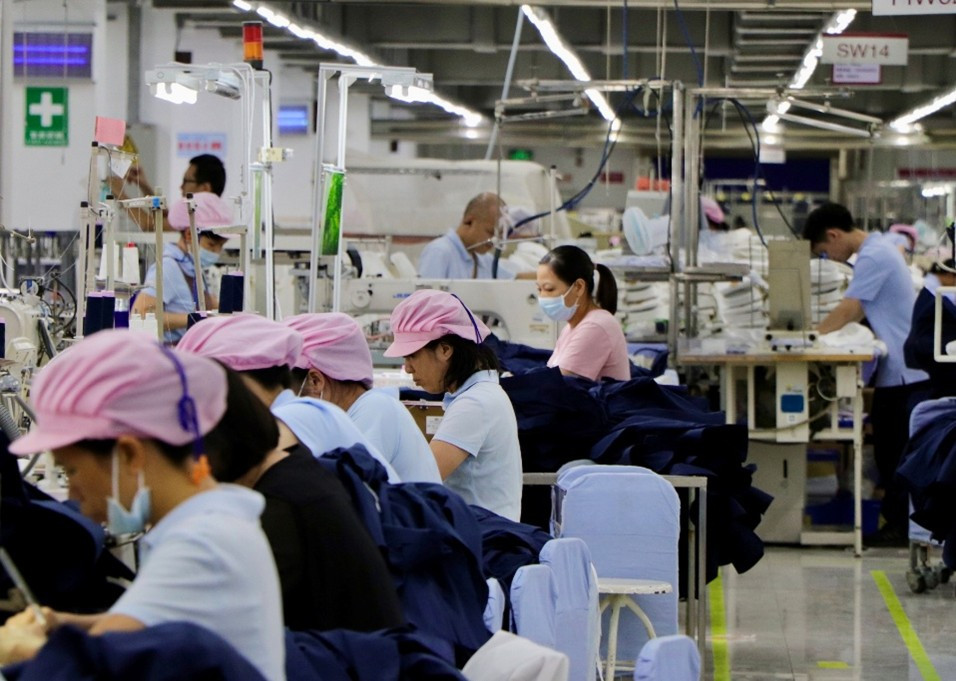
(Women workers are working at a textile factory in Foshan, Guangdong Province. © Photo: UN Women/Wenting Zhao)
UN Women and the European Union jointly launched “Women in Motion 2.0”, a four-year programme to advance women’s economic empowerment, and promote gender-responsive and inclusive workplaces in China.
Funded by the European Union, the programme will expand women’s access to skills development, lifelong learning and labour rights awareness, with a focus on young women and women with disabilities. It will also support employers in adopting gender-responsive policies and practices, and in creating safe and family-friendly workplaces. In addition, the programme will engage different stakeholders to promote more equitable gender norms and attitudes to end discrimination against women and girls.
Grounded in international conventions and commitments that China has signed onto, the project will contribute to the United Nations Sustainable Development Cooperation Framework for the People’s Republic of China 2026-2030, which aligns with national priorities such as the employment-first strategy and high-quality development under the 15th Five-Year Plan and the implementation of China’s Law on the Protection of Women’s Rights and Interests.
Across China, women now account for over 43 per cent of the labour force and play a central role in driving economic growth. Yet many women — particularly young women and women with disabilities — continue to face barriers to decent work and career advancement, including harmful stereotypes, discriminatory hiring practices and limited workplace support.
Baseline findings from the programme (covering over 60 enterprises primarily in Shaanxi and Jiangsu provinces) point to encouraging progress on gender-responsive workplaces. For instance, over two-thirds of enterprises offer women with access to industry exchanges and training opportunities, and basic family-leave provisions are widely in place. Yet, progress remains uneven: the majority of enterprises still have unfinished work to prohibit gender discrimination in promotion decisions, existing parental and family care leave is often underused, and anti-sexual harassment mechanisms remain largely reactive rather than preventive.
A complementary survey of more than 3,000 employees found that key support needed identified by employees include fair and transparent promotion and pay, flexible working arrangements to support work–life balance, and stronger career development support including AI-relevant skills.
Addressing these gaps requires coordinated action across government, industry associations, the private sector and civil society to expand access to employment and skills development, promote gender-responsive workplace practices and foster inclusive environments.
At the programme launch, Chu Q. Wang, Head of Office (ad interim) of UN Women China Office, said: “As AI and digital transformation reshape China's workplaces, we must ensure these shifts open doors for women, particularly women with disabilities, rather than create new barriers. Only through multi-stakeholder partnerships can we drive sustainable and systemic change for women in the world of work.”
H.E. Mr. Jorge Toledo, Ambassador of the European Union to China, highlighted: “The first phase of this initiative has been very successful, bringing tangible improvements to the lives of countless women workers, and fostering changes in enterprises to create an environment where female workers are empowered, skilled, and increasingly successful in their career journeys. This next chapter will expand our reach to vulnerable groups of women, addressing new challenges in new regions and industries, with renewed energy and vision.”
UN Women will implement the Women in Motion 2.0 in partnership with the China Enterprise Confederation, the China Disabled Persons’ Federation, International Labour Organization and the Inno Community Development Organisation, with Caixin Video serving as a strategic media partner. Additional collaboration with sector associations, women’s organisations, organisations of persons with disabilities, and academia are expected to help amplify the impact and outreach.
The programme builds on the achievements of the first phase of EU-funded Women in Motion (2023–2025), which supported 63 enterprises across the textile, ICT and automobile sectors establish gender-responsive workplace mechanisms, reaching approximated 200,000 employees, and directly benefited 11,886 women workers through skills development.
For more information, please contact:
Zhao Wenting
Head of Communications
UN Women China
Email: wenting.zhao@unwomen.org
Press & Information Section
Delegation of the European Union to China
Email: delegation-china-press@eeas.europa.eu