
EU Delegation co-hosted panel discussion on “The Gendered Impact of Disinformation”
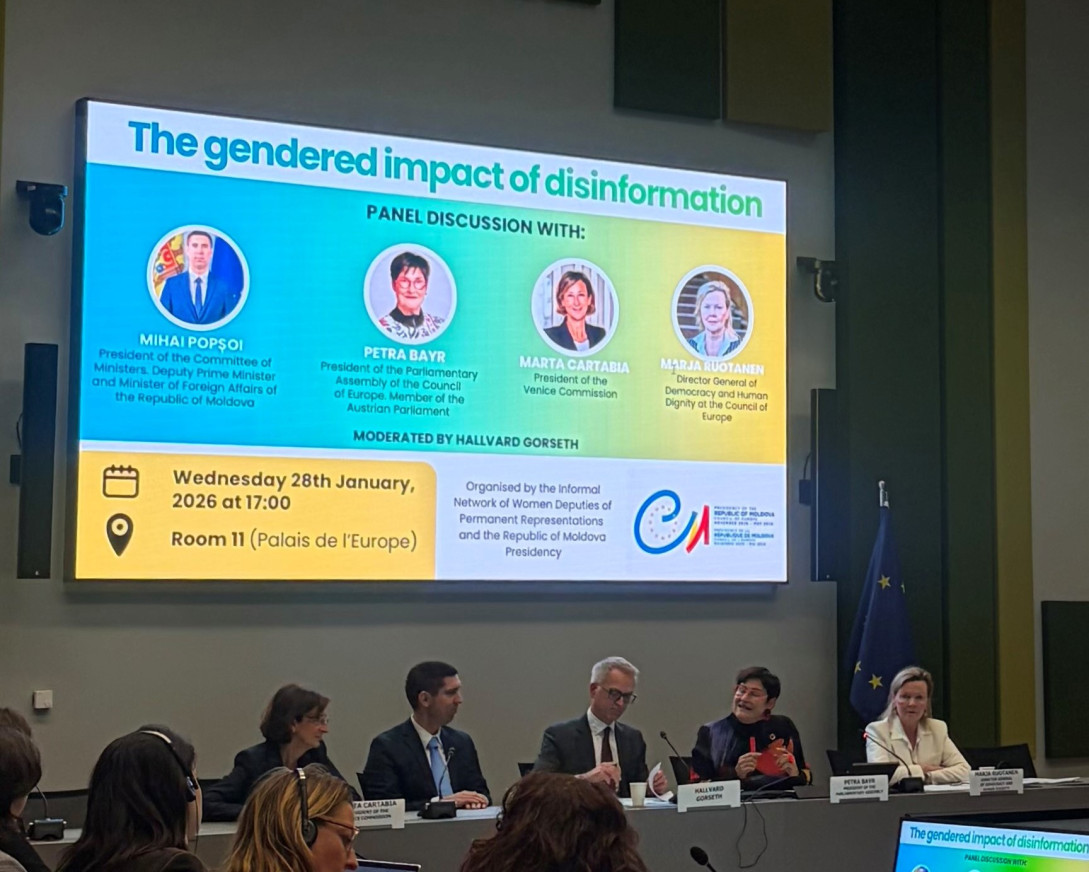
On 28 January, the EU Delegation co-hosted a high-level panel discussion on “The Gendered Impact of Disinformation,” in partnership with the Informal Network of Women Deputies of Permanent Representations and the Moldovan Presidency of the Council of Europe Committee of Ministers. The event brought together political and legal leaders to explore the threat disinformation poses to democracy and women’s participation in public life. The panel featured Mihai Popșoi, President of the Committee of Ministers of the Council of Europe (CoE) and Deputy Prime Minister and Minister of Foreign Affairs of the Republic of Moldova; Petra Bayr, President of the Parliamentary Assembly of the CoE; Marta Cartabia, President of the Venice Commission; and Marja Ruotanen, Director General of Democracy and Human Dignity at the Council of Europe.
The discussion highlighted the growing evidence that disinformation disproportionately targets women, discouraging their engagement in politics and public institutions. Mihai Popșoi spoke about Moldova’s gender equality policies and emphasised the progress made in advancing women’s political participation. He cited the example of President Maia Sandu, who faced significant criticism as an unmarried woman without children in leadership, yet her election inspired a new generation of women to challenge traditional stigmas. Despite advances such as the criminalisation of femicide in Moldova, Popșoi noted that progress is not irreversible and continuous effort is required.
Petra Bayr highlighted the chilling effect of gendered disinformation on women’s mental health and political participation. Marta Cartabia emphasised the vulnerability of courts and democratic institutions to disinformation campaigns, noting that attacks on the judiciary undermine democracy itself by eroding checks on power. She stressed the need for new standards and instruments to protect democratic processes, particularly in the electoral context.
Marja Ruotanen outlined the Council of Europe’s dual approach of protection and prevention, emphasising treaty implementation, civil society engagement, and private sector partnerships. Key instruments include the European Convention on Human Rights, the Istanbul Convention, and recommendations on hate speech and sexism, with ongoing work on technology-related violence against women. Both Cartabia and Ruotanen stressed the importance of dialogue, education, and awareness-raising, highlighting that influence and shared values can be more powerful than coercion alone.
Moderator summaries underlined that addressing gendered disinformation cannot be gender-neutral. Combating these threats requires integrating a gender equality perspective, coordinating across multiple stakeholders, and embedding these principles into initiatives like the proposed New Democratic Pact for Europe. Panelists agreed that gendered disinformation is not a marginal issue – it is a direct threat to democracy that must be prioritised.