Reshaping Democracy and Public Space in Europe: What Place for Young Journalists and the New Media?
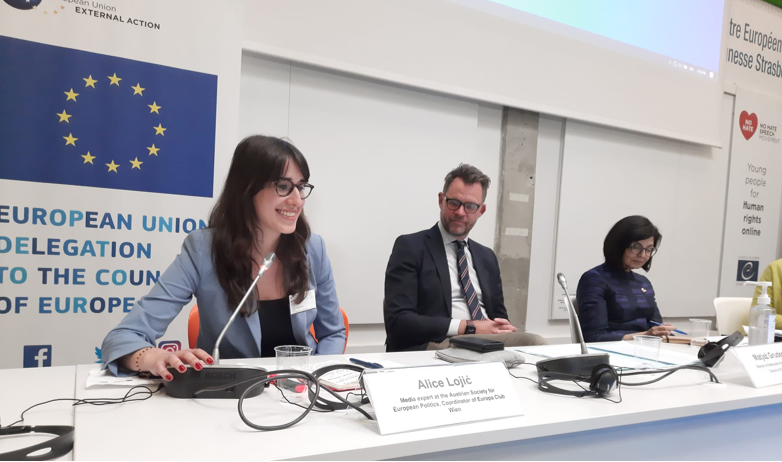
Copyright: EU Delegation to the Council of Europe. In the picture (from left to right): Ms Alice Lojić, Mr Matjaž Gruden, Ambassador Meglena Kuneva
The conference aimed to raise awareness of the common priority of the EU and the Council of Europe to promote and protect press freedom, free access to information and the key role of the media in shoring up democracy. It also gave the opportunity to young journalists to express their views on how to further enhance youth presence and participation in democratic processes and public debate.
The event kick-started with the screening of a short animated video explainer we produced, focusing on EU-Council of Europe youth cooperation and the European Year of Youth, introduced by Ambassador Meglena Kuneva, Head of the EU Delegation to the Council of Europe.
The first panel showcased the perspectives of young journalists on the role they should play in defending and reinforcing democratic societies in Europe. It also looked into how existing European standards can be best applied to empower young journalists in their work. Mr Matjaž Gruden, Director of Democratic Participation at the Council of Europe, emphasised the need for young persons to be better represented and quality journalism to continue to be supported as a key lever for the functioning of democracy.
Ms Alice Lojić, Media expert at the Austrian Society for European Politics and Coordinator of Europa Club Wien, stressed that problems such as the precariousness and uncertainty of jobs in the media domain and underrepresentation of journalists with a migrant background should be effectively addressed. Less hierarchy and more democratisation within the field are also needed. Moreover, she highlighted the importance of fact-checking, and mentioned as an example the terrorist attacks in Vienna in 2020 and the need for reliable information when reporting.
Ms Maria Bajorek, a young journalist from Poland, who is running her own project on tackling disinformation, pointed to systemic problems in her country regarding respect for freedom of the media and the dialogue between public and private journalism. She further stressed that young people need to be actively engaged in the process, as older people often lack the necessary knowledge on the extensive use of the media and communication technologies.
The second panel focused on the growing power of the new media in shaping public debate and action. Mr Jan Kleijssen, Director of Information Society and Action against Crime at the Council of Europe, pointed out that wide access to new media does not equate exposure to a diversity of views as most often people are presented with information confirming their own bias. In the current context of the war in Ukraine, disinformation is also especially concerning. Artificial Intelligence only strengthens this tendency. Unregulated AI can lead to excessive profiling, for example delivering political messages to Internet users when they are most likely to respond positively to it. The absence of human supervision can lead to serious consequences, as in the childcare benefits case in the Netherlands, which was the object of a Venice Commission report last year. Mr. Kleijssen recalled the pioneering role of the Council of Europe in addressing such challenges, notably by having already come up with the first binding legal instrument on cybercrime, the Budapest Convention, and the current work on standards for AI regulation.
From a more global perspective, Ms Louise Haxthausen, Director of the UNESCO Liaison Office in Brussels and UNESCO Representative to the EU, stressed the existing digital divide as most of the world’s population has no access to the Internet. She also highlighted an increasing number of threats for journalists, not only online but also physical, and current declining standards of press freedom around the world. On the other hand, she stressed a recent important UNESCO achievement in the field, the Recommendation on the Ethics of Artificial Intelligence, the first global normative framework on AI, focusing on human rights, non-discrimination and linguistic diversity with concrete policy proposals.
Mr. Léonardo Kahn, young journalist and Paris Correspondent for Luxembourg public service radio station “radio 100, 7”, raised the issue of underfunding for public broadcasting services in Europe. Independent journalism is crucial, but requires both financial and legal security. More education and better implementation of legal standards and rules are also needed to get young people more interested in the implications of AI.
In his concluding remarks, Ambassador Roeland Böcker, Permanent Representative of the Netherlands to the Council of Europe, emphasised the courage needed to be a young journalist today, in a context of increasing contestation of democracy – including among certain young publics.
Ms Sabine Verheyen, Chair of the Committee on Culture and Education in the European Parliament, reiterated the need to preserve mainstream media while addressing properly the impact of digitalisation in the media and information landscape. In this regard, Ms Verheyen called on EU Member States to implement the existing EU Audiovisual Media Services Directive which ensures coherent national audiovisual standards in the Union, as well as the recently agreed Digital Services Act and Digital Markets Act, which aim to increase accountability of online platforms, curb illegal content, and ensure fair competition among platforms and better access for users.