
Two Institutions, One Generation: bringing young people to the centre of Europe Month in Strasbourg

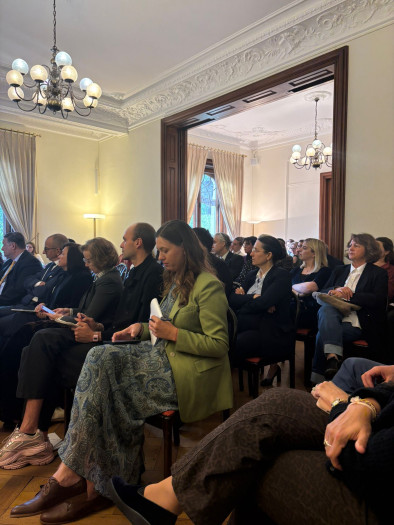
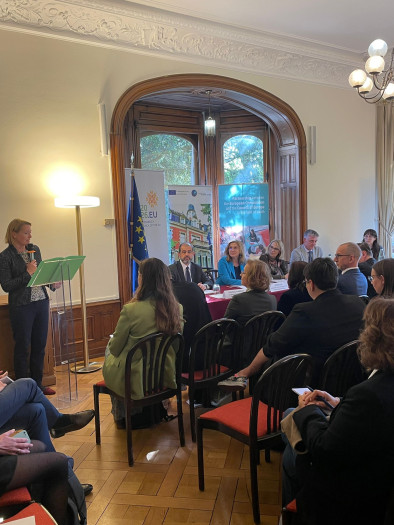
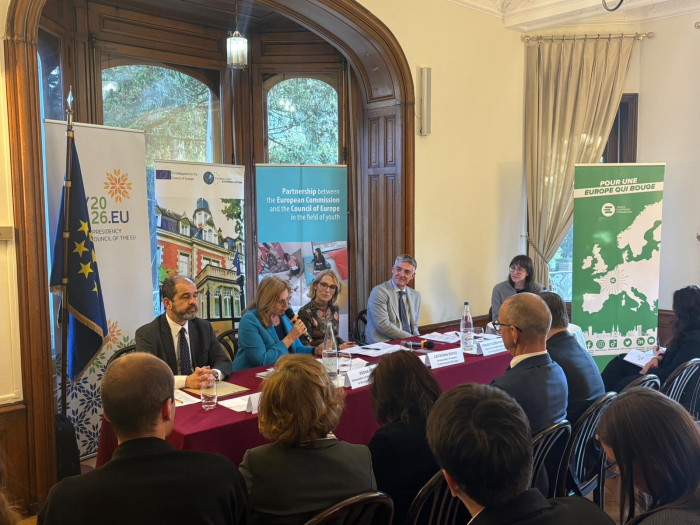
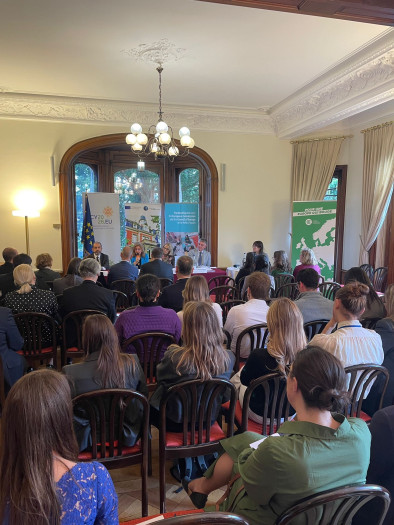
On 12 May, the EU Delegation co-organised the roundtable “Two Institutions, One Generation: EU–Council of Europe Cooperation for Young Europeans” with the Permanent Representations of Cyprus (current EU Council Presidency) and Ireland (incoming EU Council Presidency) to the Council of Europe. The event was moderated by Juliette Lacourt, a representative of the Young Europeans of Strasbourg.
Main speakers that included George Yiangou, Ambassador of Cyprus to the Council of Europe, Vesna Kos, EU Ambassador to the Council of Europe, Tobias Flessenkemper, Head of the Council of Europe’s Youth Department and Caitriona Doyle, Ambassador of Ireland to the Council of Europe had an opportunity to engage in an open dialogue with youth on the EU-Council of Europe cooperation, formalised through successive joint programmes and political agreements. The roundtable brought together EU Ambassadors to the Council of Europe, Council of Europe officials, as well as young people that discussed the value and future of EU–CoE cooperation.
Empowering young Europeans: a key priority of the Cyprus Presidency
Ambassador George Yiangou, as representative of the current EU Council Presidency, expressed the conviction that Europe must remain strong and confident, open to dialogue, to diversity, and above all to its young people and citizens. Empowering young Europeans is a key priority of the Cyprus Presidency, he stressed, not merely as beneficiaries of policy but as active shapers of Europe’s political future. He drew attention to challenges disproportionately affecting young people including climate change, mental health and artificial intelligence, and acknowledged that these have not yet been addressed with sufficient ambition at EU level.
Three policy priorities: fighting against racism and discrimination, gender equality and EU enlargement
Ambassador Vesna Kos offered a substantive overview of the EU–Council of Europe partnership, framing youth not as a standalone sector but as a cross-cutting thread running through all major cooperation areas. She noted that the event was itself a concrete expression of that partnership, a deliberate choice to celebrate Europe Day differently, by placing inclusion and the voices of young people at its centre.
Ambassador Kos in her speech, addressed three substantive policy domains: fighting against racism and discrimination, gender equality and EU enlargement. On the first domain, she highlighted the role of the European Commission against Racism and Intolerance (ECRI) as a key reference for EU action across all 27 Member States. Regarding gender equality, she pointed to the EU’s accession to the Istanbul Convention (2023) as the most tangible symbol of convergence between the two institutions on gender equality. At the same time, she presented the newly adopted EU Gender Equality Strategy 2026–2030 (March 2026), which addresses emerging threats including cyberviolence, anti-gender narratives and AI-related risks. On the third domain, Ambassador Kos framed enlargement as a generational project, with young people in candidate countries as its primary audience. She underlined the role of EU–Council of Europe Joint Programmes in supporting democratic reforms against the benchmarks of democracy, rule of law and human rights, and credited the Council of Europe’s independent monitoring bodies with providing the credibility that underpins the process.
Ambassador Kos closed by presenting the Kokopello comic booklet, our recent publication designed to introduce both institutions in an accessible, pedagogical format, available in French and English, as a concrete symbol of the institutions’ shared commitment to reaching younger audiences.
A “one European family” approach for youth
Tobias Flessenkemper reflected on the two decades of the EU–Council of Europe Youth Partnership, emphasising that working with young people always brings something new. He described the Council of Europe as a unique space in which difficult questions about history, identity and shared values, can be explored through direct participation and genuine dialogue. He stressed the importance of enabling young people to participate directly in programmes such as Erasmus+, and of using civic space, in partnership with the EU, to produce rational, evidence-based recommendations. Tobias Flessenkemper called for a genuine “one European family” approach, drawing on all available instruments of both institutions and their member states, and acknowledged the role of the Council of Europe’s European Youth Foundation in supporting this work.
Preserving hope as a political and a personal resource for young people
Ambassador Caitriona Doyle, speaking as representative of the incoming Irish EU Council Presidency, offered a forward-looking perspective on the EU–CoE cooperation agenda. She acknowledged the difficulty of defining ‘young people’ by age alone, and noted that the central issues on the table such as artificial intelligence, the environment, mental health and the future of work, are inherently inter-generational and will remain priorities across successive presidencies. She emphasised the importance of resisting catastrophic thinking about the future, and of preserving hope as a political as well as a personal resource for young people.
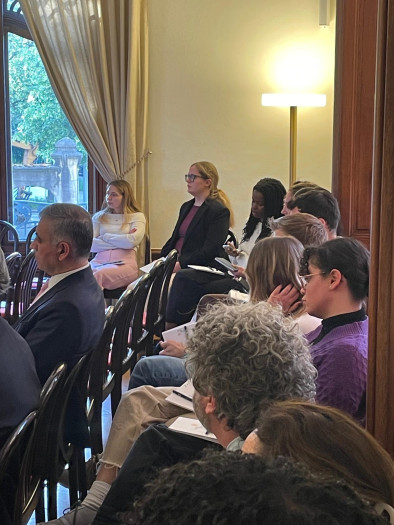
The Q&A that followed provided the young participants the opportunity to engage directly with all four speakers in a lively and personal exchange that moved between institutional substance and individual experience. The discussion broadened into a conversation about what it means to be European today: the importance of mobility, cross-border encounters and school exchanges; the need for young people to hold not just a seat at the table but genuine agency over decisions that affect their lives; and the challenge of making European institutions more accessible by communicating in clearer, simpler terms.
This roundtable reaffirmed the shared commitment of the European Union and the Council of Europe to empowering young Europeans through democracy, human rights and active participation. Bringing together institutional representatives and youth voices, the discussion highlighted the importance of continued EU–Council of Europe cooperation in addressing the aspirations and challenges of younger generations. Overall, the event served as a reminder that investing in youth engagement is essential for building a more inclusive, democratic and resilient Europe.
Media gallery
-
Image
EUDEL
-
Image
EUDEL
-
Image
EUDEL
-
Image
EUDEL
-
Image
EUDEL
-
Image

EUDEL