
European Union builds up Kosovo Institute for Forensic Medicine to strengthen the rule of law and help identify missing persons

The EU, including through EULEX, started investing in the development of forensic medicine capacities in Kosovo back in 2008 in an effort to strengthen the rule of law and help identify missing persons.
“Forensic medicine services are fundamental for the functioning judiciary and a strong rule of law system as they help establish facts and obtain crucial evidence in criminal and other investigations and court proceedings,” said the EU Ambassador in Kosovo, Tomas Szunyog.
“It is therefore imperative that these highly specialised services are carried out in a scientific manner by qualified, well-trained, and properly equipped professionals, and that is what the EU is helping achieve in Kosovo,” added Szunyog noting that the rule of law is a prerequisite for European integration.
“One of the main strategic goals of the Ministry of Justice is the rule of law and the protection and respect of human rights and freedoms. Having an independent, efficient and effective Institute of Forensic Medicine providing its professional services to law enforcement agencies and judiciary significantly contributes to achieving that goal,” said Kosovo Mister of Justice, Albulena Haxhiu and highlighted the importance of the EU’s support for the development of forensic medicine and rule of law in Kosovo.

Head of EULEX Mission in Kosovo, Lars-Gunnar Wigemark, noted that determining the fate of missing persons is EULEX’s daily commitment.
“From the beginning of our mandate until today, EULEX has conducted 700 field operations and has identified 332 missing persons. Our experts will continue to work together with our local counterparts at the Institute of Forensic Medicine to identify potential clandestine graves and identify victims related to the Kosovo war and its aftermath. We will also continue to support the Institute within the framework of the upcoming protocol for the treatment of victims of sexual violence cases, as well as in raising awareness of this issue,” said Wigemark.
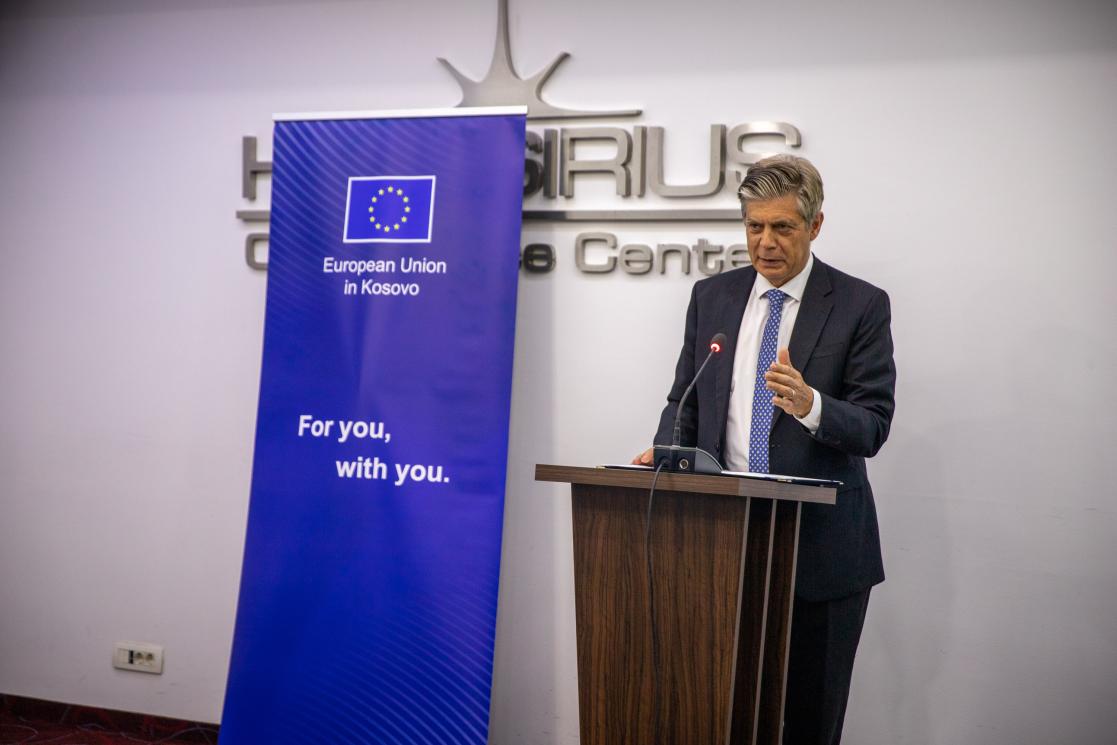
The IFM that operates under the auspices of the Ministry of Justice has recently adopted its Development Strategy, a key document that lays the foundations for its long-term development vision.
The General Director of the IFM, Flutra Goga Bajrami, noted that “the strategy and the will not only increase the quality of our services but also contribute towards enhancing public trust and confidence in the justice institutions and the rule of law.”
The overarching objective of the European Union is to support the Institute for Forensic Medicine to strengthen and modernize its forensic services, technical and administrative capacity, and improve inter-institutional cooperation. From 2014 to date, the EU has invested close to EUR 3 million in building up the Institute and professional capacities of its staff.
For more information, please contact Elsa Bala at elsa@ipa2-ifm.net.