
Ambassador Sattler Visits Pljevlja Thermal Power Plant
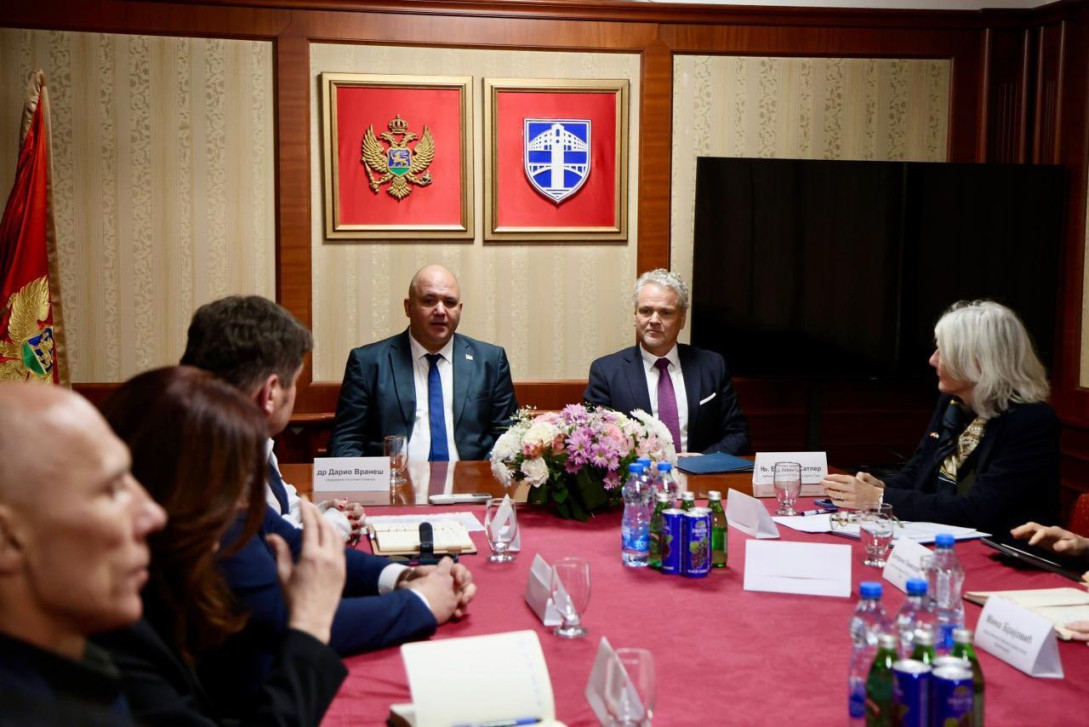
The Ambassador of the European Union to Montenegro, Johann Sattler, together with the United Nations Resident Coordinator in Montenegro, Carolin Tissot, and representatives of the EU Delegation, visited the Pljevlja Thermal Power Plant, where they were briefed on the progress and results achieved so far in the environmental reconstruction of this energy facility. This is one of the most significant investment projects in Montenegro’s energy sector, aimed at meeting European environmental standards and preserving the stability of the country’s electricity system.
As part of the trial operation of the thermal power facility, following the installation of new equipment and the completion of hot tests, the flue gas denitrification plant (DeNOx) was commissioned at the Pljevlja Thermal Power Plant. Initial results indicate a significant reduction in nitrogen oxide (NOx) emissions, from the previous level of 480 mg/Nm³ to values below 130 mg/Nm³. In comparison in certain operating intervals emissions of 108 mg/Nm³ were recorded, which is well below the designed limit value of 150 mg/Nm³.
During a meeting with the Chief Executive Officer of the Electric Power Company of Montenegro (EPCG), Zdravko Dragaš, Executive Director of FC Production, Miro Vračar, Executive Director of the Directorate for Development and Investments, Ivan Mrvaljević, and Head of the Pljevlja Thermal Power Plant, Žarko Ćaćić—also attended by a delegation from the Ministry of Energy and Mining led by Minister Admir Šahmanović—Ambassador Sattler underlined the European Union’s commitment to the economic strengthening of all parts of Montenegro, stressing that no municipality should be left behind on Montenegro’s path towards EU membership.
“The EU is ready to support this transition, drawing on the experience of its Member States and guided by the principles of a just transition. Here, we see strong potential and recognise that both local and international investors are interested in renewable energy and innovative technologies. At the same time, Pljevlja faces serious health and environmental challenges, with current air pollution levels reaching unacceptable levels. The accession process places strong emphasis on people’s wellbeing and public health, highlighting the need for coordinated and comprehensive efforts involving local authorities, the Government of Montenegro and UN agencies,” said Sattler.
The CEO of EPCG, Zdravko Dragaš, stated that the project is being implemented in line with the planned timetable and that the highest technical and environmental standards are being applied.
“This project confirms that it is possible to modernise production capacities while at the same time significantly reducing negative environmental impacts, in accordance with the requirements of European energy and environmental policy,” Dragaš noted.
Minister of Energy and Mining, Admir Šahmanović, assessed that the joint visit by the Head of the EU Delegation to Montenegro, representatives of the United Nations in Montenegro and the European Investment Bank confirms the strong support of international partners for the just transition process in Montenegro.
“Pljevlja has been a pillar of Montenegro’s energy system for decades, and it is our responsibility to implement the just transition here in a responsible and well-planned manner. Through concrete and effective co-operation between all ministries, institutions, partners and the local community, we can carry out this process while creating new perspectives for Pljevlja and for the people who live there and plan their future there,” Šahmanović emphasised.
The United Nations Resident Coordinator in Montenegro, Caroline Tissot, stated:
“The joint visit by the EU and the UN confirms our commitment to supporting Pljevlja in a just transition process that places people at its centre. By aligning environmental responsibility with economic resilience, Montenegro is moving closer to membership of the European Union and the achievement of the Sustainable Development Goals.”
This visit is of particular significance given that the Pljevlja Thermal Power Plant was toured by an exceptionally large and high-level international delegation, sending a strong signal of support from European and international partners for the process of environmental reconstruction and a just energy transition in Montenegro. The visit was also attended by the UN Development Programme Resident Representative in Montenegro, Ekaterina Paniklova; Mina Brajović, Head of the World Health Organisation Office in Montenegro; representatives of the EU Delegation to Montenegro, Bernard Brunet and Ana Stanišić; and Davor Kunc, representative of the European Investment Bank (EIB).


