Strong Local Governments as a Key to Successful European Integration
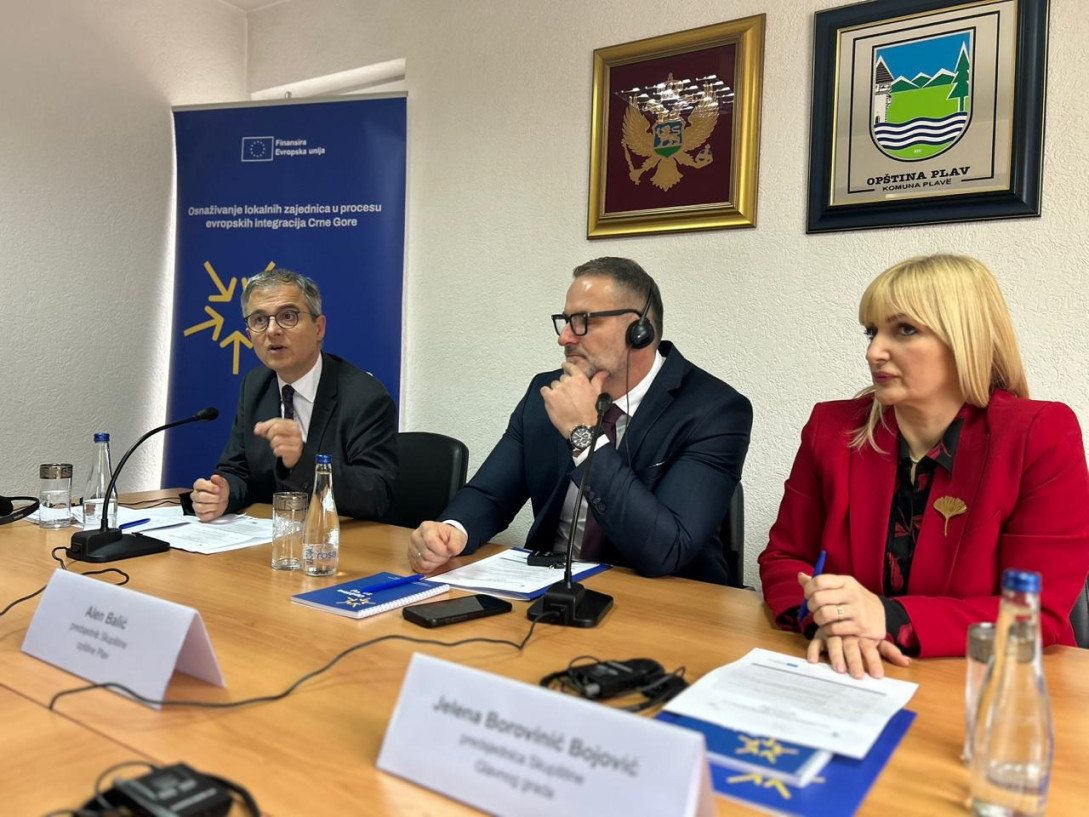
European integration does not take place only in Brussels or Podgorica — it happens in every local self-government unit. That is why strengthening administrative capacities capable of adequately responding to the requirements arising from the implementation of EU laws and reforms is essential, it was concluded at the First Meeting of Presidents of Municipal Assemblies of Montenegro, held in Plav.
At the event, organised by the Municipalities for the EU project and funded by the EU, participants emphasised that empowering local decision-makers and civil servants is a key precondition for successful integration, as well as for Montenegro’s future EU membership, which the country aims to achieve by 2028.
“This gathering is an opportunity to show that municipalities in Montenegro are not merely an administrative tier of government, but active drivers of reforms. Local assemblies are the institutions closest to citizens, and therefore bear a special responsibility. For European values to truly take root in Montenegro, they must be visible in every segment of our work — through transparency, citizen participation, efficiency and accountability,” said Alen Balić, President of the Municipal Assembly of Plav.
Plav, Balić added, is today not only the host, but also a municipality committed to setting an example of applying these principles.
The importance of local parliaments was also highlighted by the President of the Capital City Assembly, Dr Jelena Borovinić Bojović, who initiated the creation of the Network of Presidents of Municipal Assemblies of Montenegro in June this year.
“Local parliaments are key in the European integration process because over 70% of EU legislation is implemented at the local level, and because public trust in state institutions is built through communication with local authorities,” said Dr Borovinić Bojović.
She emphasised that EU integration will not be completed with the signing of documents in Brussels; rather, it will be completed in schools, kindergartens, health centres, local administrations, municipal budgets, and in the daily relationship between institutions and citizens.
Dr Borovinić Bojović also reflected on Plav as the host of the meeting: “Plav today symbolises balanced regional development, recognition of the north as an equally important part of European Montenegro, and a message that no municipality is ‘small’ if given an opportunity.”
Head of Cooperation at the EU Delegation to Montenegro, Bernard Brunet, stated that Montenegro’s accession process is accelerating, with important negotiation steps ahead — including the expected closing of five negotiating chapters by the end of this month, and the prospect of closing all chapters next year.
“The success of the reform agenda depends on the local level. As much as 40% of the negotiation benchmarks relate to administrative capacities. This means that local governments have a crucial role in making European policies a tangible reality in the lives of citizens,” Brunet said.
He further noted that the upcoming EU financial period will bring a “fundamental change” in the way cohesion funds are planned and implemented, which will require stronger involvement of municipalities in strategic planning and investment management, as well as close coordination with central authorities.
Representatives of the Municipalities for the EU project — Team Leader Branka Mračević and expert Dr Nenad Koprivica — presented the project’s results, the types of support available to municipalities, and the overall role of local governments in the European integration process.
The meeting adopted a Decision on establishing the Network of Presidents and Secretaries of Municipal Assemblies of Montenegro. Members of the Network’s Presidency will be Dr Jelena Borovinić Bojović, Alen Balić, and President of the Municipal Assembly of Tivat, Miljan Marković. Tivat will host the next meeting of the Network.
Today’s gathering — attended by 11 assembly presidents, 4 secretaries and 2 advisers — represents a continuation of the initiative launched in June with the adoption of the Declaration on Connecting Local Parliaments of Montenegro in the Spirit of European Values, which has now evolved into its practical, operational phase.