
The EU stands with its partners against threats to global food security
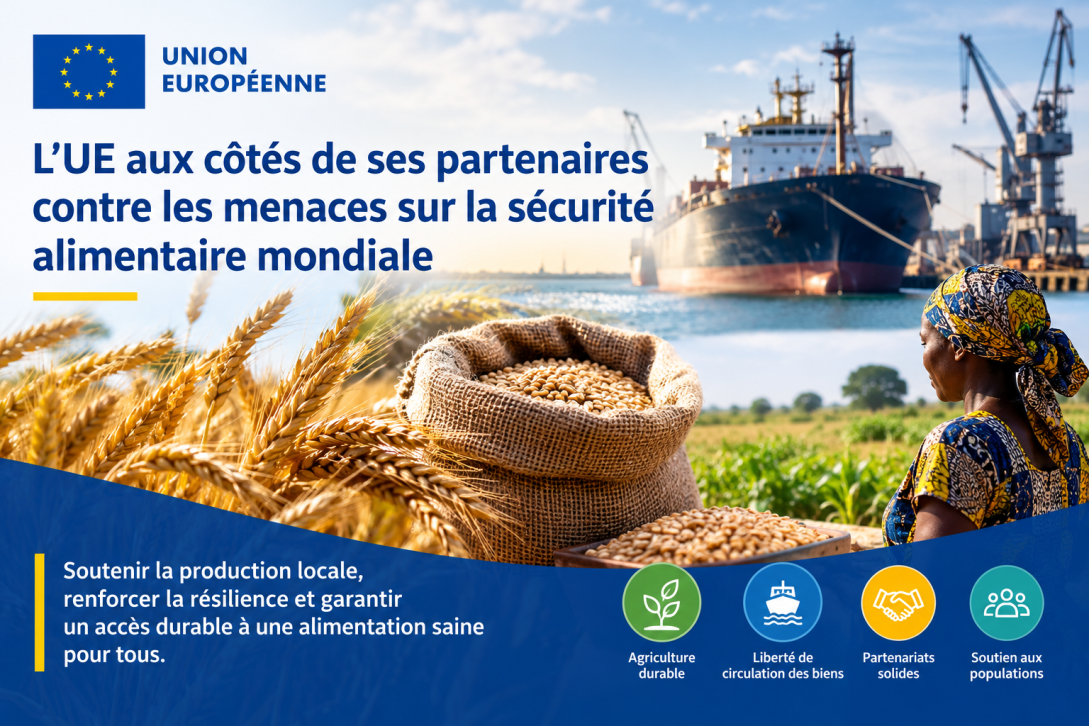
War Drives Up Global Prices
In Dakar, the price of a baguette might seem far removed from the tensions in the Strait of Hormuz, the Red Sea, or the Black Sea. Yet, when major maritime routes are threatened, the costs of grain, energy, fertilizers, and their transport rise globally. This has a direct impact on bakers, households, and—more broadly—food security in regions that rely on imports to meet domestic demand.
This reality is particularly significant for Senegal, where wheat imports amounted to approximately 175 billion CFA francs in 2025. Any substantial reduction in the global wheat supply leads to an increase in the import bill. The recent debate over the price of bread provides a concrete illustration of this: bakers point to rising costs for flour, transport, diesel, yeast, salt, and electricity. It serves as a reminder of how essential the free movement of goods remains for maintaining purchasing power.
The war of aggression waged by Russia against Ukraine is a major factor behind these rising costs. Before Russia’s full-scale invasion of Ukraine in February 2022, Ukraine accounted for roughly 10% of global wheat exports, 15–20% of barley exports, and nearly half of the world’s sunflower oil exports. Since then, Russia has intensified its attacks on port and logistics infrastructure in the Black Sea and along the Danube—a route used for approximately 90% of Ukraine’s agricultural exports. By early August, the volume of grain exports had fallen by about 47% compared to the same period the previous year. Storage capacities are also being targeted, which increases the risk of shortages and long-term price volatility.
Escalating military tensions in the Middle East are also severely disrupting maritime traffic and oil production, with dramatic consequences for global prices and supply chains.
The El Niño phenomenon constrains domestic agricultural production.
Compounding the impact of war are the negative effects of the El Niño phenomenon. The World Meteorological Organization has warned of its return, bringing an increased risk of floods, droughts, and extreme heat across Africa. Forecasts suggest the phenomenon could persist until February 2027, potentially ranking among the most intense episodes since 1950. Previous occurrences in 2015–2016 and 2023–2024, combined with the effects of climate change, have already led to poor harvests, livestock losses, rising household debt, and population displacement. For Senegal, this could hinder the efforts toward food sovereignty that have been underway for several years.
The European Union stands with its African partners.
In West Africa, the UN estimates that nearly 55 million people are at risk of falling into acute food insecurity due to the combined impact of these crises. The European Union is working alongside its African partners to address these challenges.
In response to Russia’s actions targeting food corridors, the European Union has established "solidarity lanes," which provide alternative routes for exporting Ukrainian grain via road, rail, and inland waterways. More than 2 billion euros have been mobilized for this purpose. The European Union also reiterates that its sanctions against Russia do not target the trade of agricultural products, food, grain, or fertilizers with third countries. Safeguards and exemptions are specifically in place to preserve global food security. The European Union also acts through diplomatic channels, in coordination with its international partners, to defend the free movement of vessels wherever it is threatened.
The European Union also supports the expansion of grain storage capacity, as well as emergency responses and long-term resilience initiatives. In 2025, it mobilized 2.1 billion euros to strengthen food security in several regions of the world.
To develop local production in Senegal and reduce dependence on imports, the European Union promotes local agricultural value chains for crops such as maize, rice, bananas, peanuts, millet, onions, and cashews. In 2025, this support contributed to a record banana harvest—allowing Senegal to suspend imports for three months—as well as an increase in the production of maize and rice. Furthermore, more than 4,000 producers, the majority of whom are women, have been assisted in adopting agroecological practices.
For decades, the European Union has been actively committed to food security in Africa, and it will continue to support its partners in the face of the challenges that threaten them. Working alongside Senegal, the EU contributes both to climate resilience efforts and to initiatives aimed at preserving peace and the stability of food supplies.
Ambassadors of the European Union and its 17 Member States represented in Senegal.