European Union Delegation in Uzbekistan held the online master class for Media of Uzbekistan on environmental protection

Ecology has become the main trend of 2020: more than 4 million people went on strike at FridaysforFuture and about 4.5 million photos with the hashtag #zerowaste appeared on Instagram; forests burned in Siberia, the Amazon and Australia, and The Guardian dropped the term "climate change" in favor of "climate crisis."
Mr. Jussi Narvi, Charge d'Affaires of the European Union in the Republic of Uzbekistan, addressed the participants of the master class with welcoming speech.
“The cooperation of the European Union with Central Asia and Uzbekistan is based on the new geopolitical priorities of the EU, consisting of five pillars: green deal, digitalization, sustainable growth and job creation, migration partnership and governance, peace and security,” said Jussi Narvi. - The COVID-19 pandemic has shown very well that we must change our attitude towards nature and join our efforts to start creating a healthier and more sustainable future for our planet now. We need to rethink our economic policies to ensure the early and more effective transition to the green economy model.”
The speakers of the online master class were the Programme Manager at the European Commission on climate and ecology Nicola di Pietrantonio, the representative of the State Committee for Ecology and Environmental Protection Sevara Davlatova, specialist of the Center for Hydrometeorological “Uzhydromet” Sayora Abdullaeva and media trainers Saida Sulaimanova and Daria Osmanova.
Nicola di Pietrantonio stressed that climate change affects not only the environment, but also the economic and social spheres. The expert mentioned that if no action is taken now, the number of people who lack drinking water by 2050 will increase from the current 3.6 billion to more than 5 billion, and agricultural productivity will decrease by 30%. The EU Green Initiative is about transforming the economy and includes the supply of clean, affordable and safe energy, the pursuit of zero pollution, and the conservation and restoration of biodiversity.
Sevara Davlatova, the representative of the State Committee on Ecology and Environmental Protection, spoke about the steps taken by the committee in solving environmental problems and close cooperation with international organizations to implement ongoing projects to protect the environment.
Sayyora Abdullayeva, a specialist at the Center for Hydrometeorological Service, highlighted the activities of Uzbekistan on the implementation of the UN Framework Convention on Climate Change and the Paris Agreement. Thus, state policy is aimed at reducing greenhouse gas emissions in key sectors of the economy and Uzbekistan's transition to a "green economy".
In the practical part of the master class the participants got acquainted with a variety of multimedia tools for interesting coverage of environmental topics. Media trainers Saida Sulaimanova and Daria Osmanova introduced with such formats of environmental journalism as multimedia storytelling, eco-lifehacks, podcasts, cards, lists, environmental fact-check, and journalistic investigation. Journalists received powerful data visualization tools that are relevant to both online media and print media.
The master class was attended by journalists from Uzbekistan National broadcasting company, as well as online and print media journalists from 9 territories of the country: Namangan, Andijan, Samarkand, Termez, Bukhara, Navoi, Nukus, Tashkent and Tashkent region.
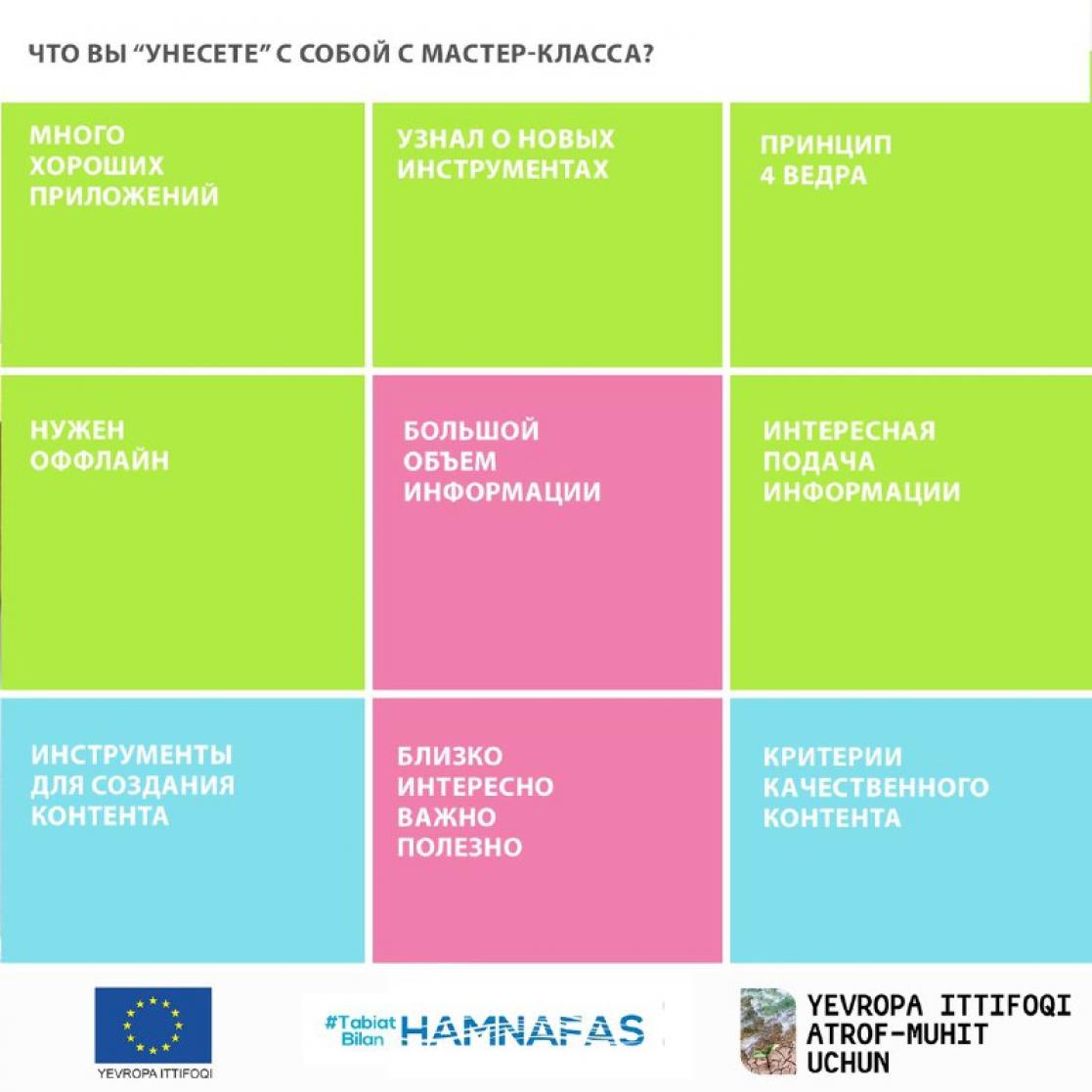
“It's always difficult to create quality content on environmental issues. This is associated not so much with the processing of a voluminous array of information, as with the presentation of the material that is as accessible as possible for the reader. Therefore, master classes introducing journalists to new multimedia tools and trends in the information space will always be in demand. The online training, which was dynamically and constructively conducted by S. Sulaimanova and D. Osmanova, gave us this opportunity. Despite the format of the master class and the limited time, its participants were able to get an idea of current trends in environmental journalism and even outline topics for future articles ”, - noted Anastasia Pavlenko, editor-in-chief of the newspaper “Samarkandskiy vestnik”.
The master class of the European Union evoked the greatest response from journalists from Karakalpakstan, where the issue of ecology is of especially acute.
“I was born and raised in Nukus, in the Republic of Karakalpakstan. And until now the problem of the Aral Sea for me was like "to be born blind and not know what vision is." The whole world is alarming about the crisis of the Aral Sea, but I’ve been paying much attention to this, since I did not feel the whole tragedy of the situation. After participating in the training on the study of effective methods of environmental coverage, organized by the EU Delegation in Uzbekistan, the editors of the Makan.uz website added another important direction to their editorial plan: promoting the formation of a cultural attitude of people towards the environment. The goal is to bring environmental problems and their direct impact on people's livelihoods to the attention of the population as actively and often as possible with the help of our website. Many thanks for organizing the training for us", - Lolagul Kalykhanova, editor of the website Makan.uz, shared her impressions.