
EUNAVFORMED OPERATION IRINI – An exemplary EU Maritime Security Provider in the Southern Central Mediterranean
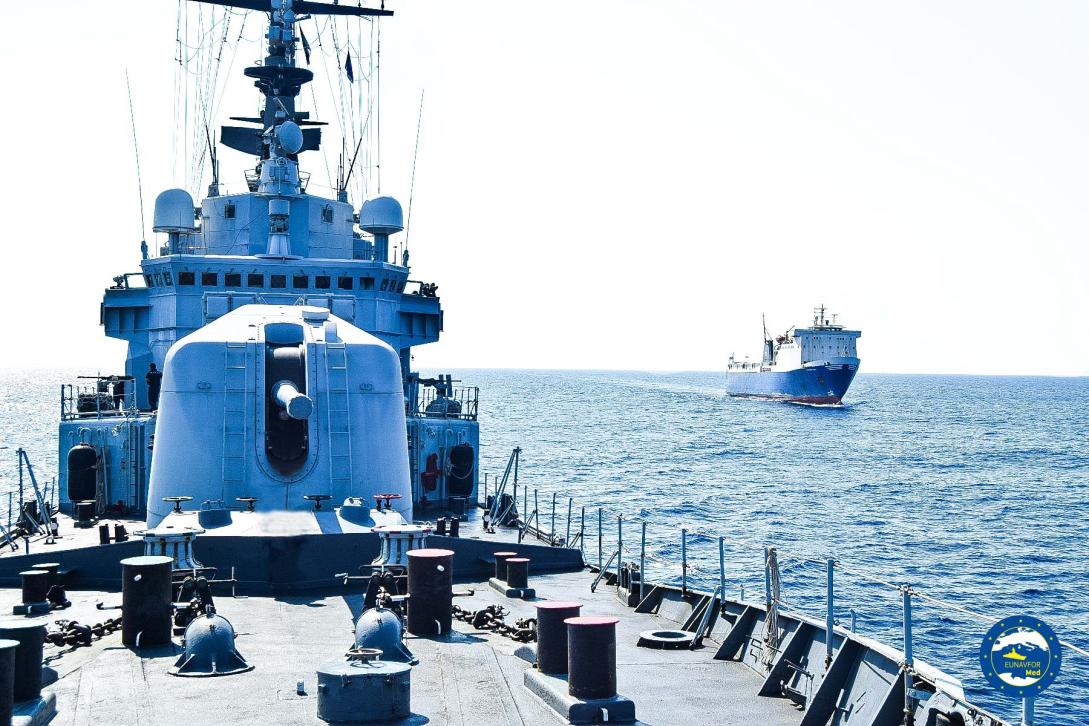
EUNAVFORMED Opearation IRINI-Providing Maritime Security in the Mediterranean
“Only political solutions and the full respect of the UN arms embargo will bring a solution to the Libyan crisis. But diplomacy cannot succeed unless it is backed by action. This operation will be essential and a clear contribution to promoting peace in our immediate neighbourhood through a permanent ceasefire”. (Mr Josep Borrell, High Representative of the Union for Foreign Affairs and Security Policy and Vice President of the Commission)
Introduction
Echoing the recently adopted Strategic Compass, the Mediterranean is a maritime area of crucial strategic interest for the European Union, and to the same extent, Operation IRINI represents a paramount instrument in the area. Being the only actor supporting as a core task of the implementation of the United Nations (UN) arms embargo on Libya and acting in full compliance with International Law, the operation continues to represent a tool to understand, deter, disrupt and monitor a maritime area of strategic importance for EU security and stability where illicit trafficking needs to be fought.
Mandate
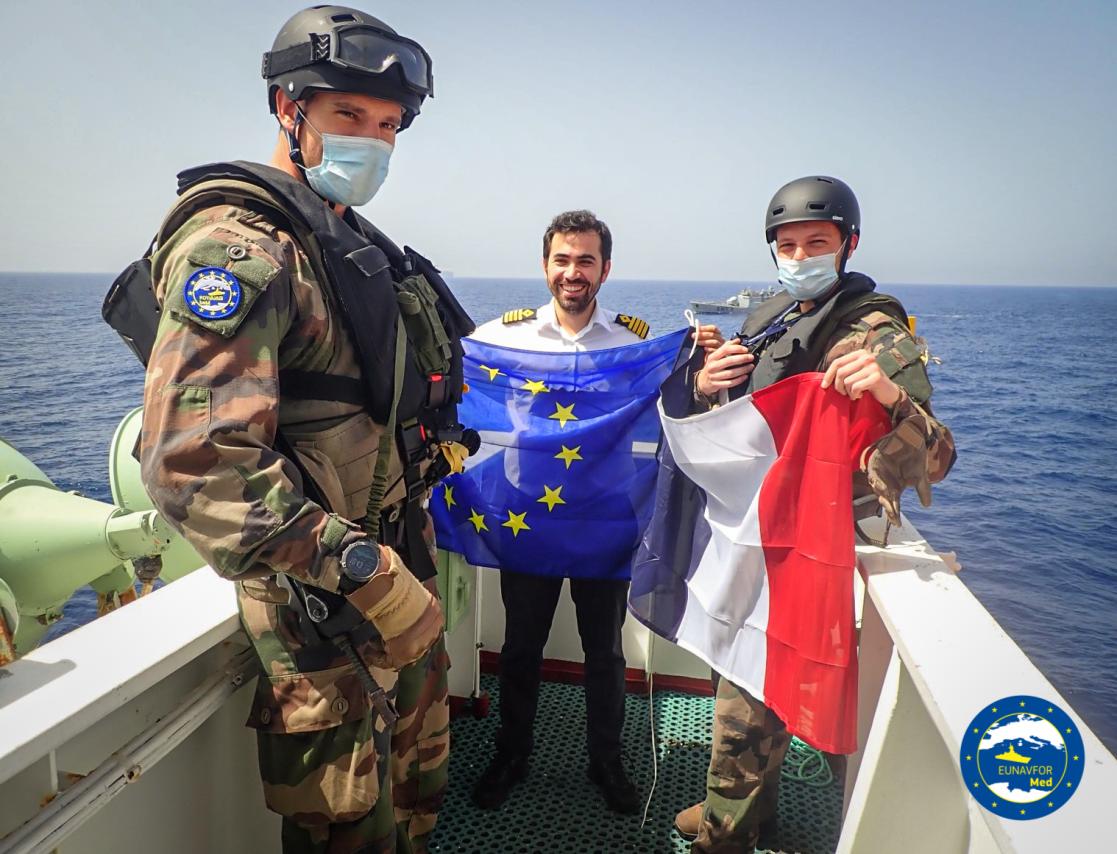
Operation IRINI is an EU military CSDP crisis management executive operation deployed in the Southern Central Mediterranean Sea, which contributes to the:
- Implementation of the UN arms embargo on Libya with aerial, satellite and maritime assets, which is authorised in accordance with the UN Security Council Resolution (UNSCR) 1970 (2011) and subsequent resolutions.
- Implementation of UN measures to prevent the illicit export of petroleum from Libya, by monitoring and surveillance activities and gathering information, in accordance with UNSCR 2146 (2014) and subsequent resolutions.
- Disruption of the business model of human smuggling and trafficking networks, through information gathering and patrolling carried out by aerial assets above the high seas, in accordance with UNSCR 2240 (2015) and subsequent resolutions
- Development of the capacities and the training of the Libyan Coast Guard and Navy (LCG&N) in law enforcement tasks at sea. These activities do not require any international legal basis beyond a mutual agreement.
State of Play - Achievements
The Operational Commander is Rear Admiral Stefano TURCHETTO, Italy (IT), while the Operational Headquarters (OHQ) is located in Rome (IT). Totally, twenty-three (23) Member States (MS) contribute with personnel, assets or training funds. The operational activity is currently conducted by naval, air and satellite assets in direct and associated support, along with intelligence from the EU Satellite Centre (SATCEN), the EU Intelligence Centre (EU INTCEN) and the MS. In line with the EU Integrated Approach, it continues to maintain regular coordination and cooperation with multiple entities within the EU and the UN.
IRINI assets have performed twenty-five (25) unopposed boardings, the most robust and visible activities, from which three (3) violations were detected and led to vessel diversion and cargo seizure. They have also performed more than 7600 hailings, more than 400 friendly approaches and seventy-two (72) recommendations for inspection to States. Furthermore, forty (40) reports have been submitted to the UN Panel of Experts (UNPoE,) in an impartial manner, concerning both sides of the conflict in Libya. Moreover, IRINI has tracked more than sixteen (16) ports and oil facilities, twenty-five (25) airports and landing strips and more than 860 flights suspected of carrying military cargos to and from Libya.
Challenges – Way ahead
The Operation has achieved considerable results, in spite of certain shortfalls in personnel and assets. Actionable and timely intelligence, particularly that given by MS remains a paramount for the success of the operation. In this context, the operation also works towards the enhancement of its cooperation with NATO Maritime Command (MARCOM) in the domain of Maritime Security Awareness (MSA) information sharing. Capacity Building, Training & Monitoring (CBTM) of the Libyan Coast Guard & Navy (LCG&N) remains suspended, due to the political deadlock and volatile situation in Libya. However, ENFM Operation IRINI OHQ staff developed a Capacity Concept and Plan, which is going to be finalized in collaboration with the appropriate EU authorities and the MS when the situation in allows. CBTM of the LCG&N, though being a secondary task, it is consider significantly linked to the core task of the operation, allowing the law enforcement maritime authorities of Libya in the future to effectively contributing to the mitigation of arms smuggling and human trafficking trends.
Regarding the assessment and the way ahead of IRINI, the operation’s Strategic Review 2022 process has already been initiated, to be concluded by the end of January 2023. Soon after, the OHQ will draft a revised Operational Plan (OPLAN), estimated to be formalized by March 2023, prior to the promulgation of the next Council’s Decision for the operation’s new mandate.
Conclusions
ENFM Operation IRINI was born to provide an emergency structured and effective response to the Libyan crisis, contributing to the stabilisation of Libya as a key component of the EU Integrated Approach. IRINI is a key tool for EU as a Maritime Security Provider in the Central Mediterranean, to counter illicit activities in the high seas and support the LCG&N through training and capacity building. It demonstrates a model of synergy between internal and external security domains of EU, required to effectively fight organized crime. The current security situation in Libya requires a continued maritime presence to guarantee the overall security and stability in the Central Mediterranean. Consequently, IRINI is the appropriate respective EU response at present.